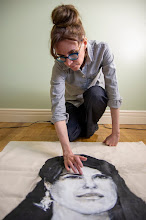
“…this panel of three female authors at the Art Gallery of Ontario…considered what it’s like to write about sex.”
As an analogue TV owner without cable, I’m behind on contemporary programming. Because I have seen exactly one episode of 30 Rock while visiting relatives, I missed the reference in the title of last night’s panel discussion organized by Toronto artist, Margaux Williamson; I mistook ‘I’m a Very Sexy Baby’ for a discussion about the sexualization of baby girls in Western culture (a classic case of projection since that’s the focus of my own art). As it turned out, this panel of three female authors at the Art Gallery of Ontario moderated by Darren O’Donnell considered what it’s like to write about sex. That’s also a topic close to my heart: I’m very aware of what boundaries I don’t want to transgress in writing a blog containing words like ‘masturbation’, ‘labioplasty,’ and ‘sexting.’ To clarify, these entries in Artist in Transit are always written in the name of art, librarianship, or feminism. Still, it makes me nervous that a colleague at the academic institution where I started the blog described it to his class as an ‘erotica blog,’ though that may say more about the lens through which he views the world than it does about my writing. It’s a concern that is paramount for me today, writing this post and knowing that tomorrow I assume another academic position. I feel like a hybrid of the 30 Rock characters, Abby Flynn and Liz Lemon, shown in a clip at the AGO event. As Abby says, why is it any worse for Abby to use her sexuality than it is for Liz to wear glasses to look smart?
The passages read by the authors proved invariably that language and sex are intertwined. Tamara Faith Berger read a passage in which a female character defends her sexual choices to a friend while smoking a joint; Chris Kraus read a sex scene from the female point of view in which “words come out as they do,” but she is tongue-tied post-coitus; and Sheila Heti read about a woman distracted from playwriting because of a task assigned by her lover, to write a report on an elderly man’s voyeurism.
If this seems like an unlikely event for the AGO, allow me to share some details about the writers: Sheila Heti collaborates with Williamson, and she had artist Shary Boyle read a draft of her first erotic novel before it contained x-rated passages. Chris Kraus started reviewing art in the process of writing her cult classic, I Love Dick, because the object of her desire was an art critic (1). Berger, meanwhile, went to art school, and was always interested in sex as a subject but couldn’t find a way to address it visually. “Going to art school helped…with writing porn,” she said, eliciting laughter from the audience.
O’Donnell asked what was at stake for the authors in writing about sex. Although their initial responses indicated it was relatively risk-free, the comments they made later suggest otherwise. Kraus, who called the art world puritanical, felt that I Love Dick was written off as “exhibitionism and narcissism,” and that she was only respected as a writer when she took sex out of her books. Heti removed her email address from her website when her writing took an erotic turn because she was worried about receiving perverted comments, and Berger had someone walk out of her recent reading at a public library. Liz Lemon was right on the money when she said, “Society puts a lot of pressure on us [women].” The Madonna/whore complex is alive and well in writing, and kudos to these women for staring it down.
The prickly topic of feminism came up on multiple occasions. Williamson noted that she has watched a lot of television while doing her residency at the AGO, and she was intrigued that 30 Rock addressed “such insane feminist politics” (re. Liz trying to correct the behaviour of the threesome-loving, pigtail-wearing Abby, all the while indulging in reading a website “where women talk about how far we've come and which celebrities have the worst beach bodies” [2]) without fixing problems. The three authors are similarly unapologetic about the explicit passages in their published works. Even when the sex scenes are degrading in some way or are the outcome of obsession, as Berger says, “You can’t devalue the bond” or dismiss its role in paving the way for self-awareness. In the authors’ books, a single male character unlocks female desire, so even if that desire is not female-generated, as far as feminism is concerned, at least it’s not at the mercy of the entire male sex. “That’s what’s hot about it,” Heti says. An audible gasp went around the room when audience member Misha Glouberman raised the notion of male-generated desire. It was a reductive moment that reminded me of something I heard Moe Tkacik, co-founder of Jezebel (see Liz Lemon quotation above), say two years ago at the Elizabeth A. Sackler Centre for Feminist Art, which has been burned in my brain ever since: “Men. F*#! ‘em. They’re the problem.” As a feminist, I feel that attacking men for being thoughtful about female sexuality is counterproductive, and as a librarian, I have to say that making observations about fictional characters does not constitute agreement with their philosophies. There must be a better use of our collective energy.
Sources:
(1) Guthrie, Kayla. Performing is Storytelling: Q+A with Chris Kraus. Performing is Storytelling: Q+A with Chris Kraus.
(2) TGS Hates Women, season 5, episode 16, aired February 24, 2011
Tuesday, March 27, 2012

Monday, March 19, 2012
Babe Walker takes on art school
“The ironic conclusion to the socialite’s brief stint in the art world is that she finds it ‘silly and fake’, so she has her nanny perform a voodoo exorcism.”
If you’ve seen the 2011 remake of Arthur starring Russell Brand, you are familiar with Narcissistic Personality Disorder. Arthur careens through life without regard for anyone else, utterly dependent on his nanny (Helen Mirren) and spending money as recklessly as he drinks alcohol. If you replace Arthur with a young woman; his rich mother with an equally rich father; Helen Mirren with a Jamaican nanny; and Arthur’s collection of automobiles from famous movies with a designer wardrobe, you’ve got Babe Walker’s facetious new memoir. White Girl Problems (Hyperion, 2012) is the 140-characters-plus version of the Twitter account crafted by the Cohen brothers and Lara Schoenhals, which was voted one of TIME Magazine’s 140 best Twitter feeds.
Generally, I’m not one to read a book endorsed by Tori Spelling on the cover, but I had heard that the main character ends up in art school, and I was curious to see how this most improbable of choices transpired.
Babe doesn’t apply to college because she assumes she will become a famous actress without even trying and fall into the arms of Leonardo di Caprio. Her hard-working entertainment lawyer father convinces her to buckle down, and gets her into the University of Southern California for performing arts. Before long, she is suspended for parking wherever she wants. Next up is her flirtation with visual art at the Rhode Island School of Design, a school whose chicness she prefers to Brown, “some stupid school I’d never even heard of,” where she was registered but refused to live in a dorm with a roommate.
Until this point, her only awareness of art was noticing that a waiter at her Studio 54-themed Sweet 16 party was dressed like Andy Warhol and telling her father that her pre-labiaplasty genitals looked like Basquiat so she needed the surgery as a high school graduation gift.
At RISD, she majors in glass blowing. She never attends class but she attends seminars occasionally because of the hot teacher. In her world, it’s the whole experience that matters and not just what her transcript reflects. And she does make some work outside of class with an androgynous printmaking major she befriends because she calls her skinny. One night, high on mushrooms, they break the heels off of all of Babe’s shoes and toss her designer clothes out the window for a bonfire that gets her arrested. She passes out during the mug shot but ultimately makes it into Art Forum. (Editorial note: I know—it’s Artforum, not Art Forum. Disregarding details is key to Babe Walker’s identity. Case in point: when her father agreed that she could come work for him, she mistook an entry-level office assistant job for a junior partner position). Her “artist moment” comes to an end when her horse, who is named Mischa Barton, flips out during a photo shoot with her friends and she breaks her back. The ironic conclusion to the socialite’s brief stint in the art world is that she finds it “silly and fake” so she has her nanny perform a voodoo exorcism. From there, she writes poems, such as “A Babe Haiku” about couture, and eventually studies fashion, where she should have put her focus from the get-go.
This book will make you laugh, because it’s hard not to laugh at something like Jamie Oliver being double booked because of a birthday party for Jennifer Aniston’s cat’s cat. It will also make you glad you are the kind of person who doesn’t send 93 texts to an ex in one night or drop $246,893.50 at Barney’s in an afternoon...which I'm assuming you aren't if you are a repeat reader of my blog. The Barney’s incident is what finally landed Babe in rehab and gave her the time and space to craft her memoir, which she considered calling Babe Walker: The Babe Walker Story but whose title, White Girl Problems, came instead from the jabs of her rehab peers.
At the end of the book, there’s a hint that Babe Walker has some substance after all. She meets her biological mother, Donna, who is a former runway model and coincidentally the lesbian partner of her rehab roommate. Just when this emotional turn threatens to counteract the horrendous superficiality of the rest of the book, a therapy session with Donna ends with Babe elated at receiving the oddest of heirlooms: a Chanel bikini with emblazoned crotch from spring 1994.
For more on the infamous Babe Walker, check out @whitegrlproblem on Twitter and www.babewalker.com.
If you’ve seen the 2011 remake of Arthur starring Russell Brand, you are familiar with Narcissistic Personality Disorder. Arthur careens through life without regard for anyone else, utterly dependent on his nanny (Helen Mirren) and spending money as recklessly as he drinks alcohol. If you replace Arthur with a young woman; his rich mother with an equally rich father; Helen Mirren with a Jamaican nanny; and Arthur’s collection of automobiles from famous movies with a designer wardrobe, you’ve got Babe Walker’s facetious new memoir. White Girl Problems (Hyperion, 2012) is the 140-characters-plus version of the Twitter account crafted by the Cohen brothers and Lara Schoenhals, which was voted one of TIME Magazine’s 140 best Twitter feeds.
Generally, I’m not one to read a book endorsed by Tori Spelling on the cover, but I had heard that the main character ends up in art school, and I was curious to see how this most improbable of choices transpired.
Babe doesn’t apply to college because she assumes she will become a famous actress without even trying and fall into the arms of Leonardo di Caprio. Her hard-working entertainment lawyer father convinces her to buckle down, and gets her into the University of Southern California for performing arts. Before long, she is suspended for parking wherever she wants. Next up is her flirtation with visual art at the Rhode Island School of Design, a school whose chicness she prefers to Brown, “some stupid school I’d never even heard of,” where she was registered but refused to live in a dorm with a roommate.
Until this point, her only awareness of art was noticing that a waiter at her Studio 54-themed Sweet 16 party was dressed like Andy Warhol and telling her father that her pre-labiaplasty genitals looked like Basquiat so she needed the surgery as a high school graduation gift.
At RISD, she majors in glass blowing. She never attends class but she attends seminars occasionally because of the hot teacher. In her world, it’s the whole experience that matters and not just what her transcript reflects. And she does make some work outside of class with an androgynous printmaking major she befriends because she calls her skinny. One night, high on mushrooms, they break the heels off of all of Babe’s shoes and toss her designer clothes out the window for a bonfire that gets her arrested. She passes out during the mug shot but ultimately makes it into Art Forum. (Editorial note: I know—it’s Artforum, not Art Forum. Disregarding details is key to Babe Walker’s identity. Case in point: when her father agreed that she could come work for him, she mistook an entry-level office assistant job for a junior partner position). Her “artist moment” comes to an end when her horse, who is named Mischa Barton, flips out during a photo shoot with her friends and she breaks her back. The ironic conclusion to the socialite’s brief stint in the art world is that she finds it “silly and fake” so she has her nanny perform a voodoo exorcism. From there, she writes poems, such as “A Babe Haiku” about couture, and eventually studies fashion, where she should have put her focus from the get-go.
This book will make you laugh, because it’s hard not to laugh at something like Jamie Oliver being double booked because of a birthday party for Jennifer Aniston’s cat’s cat. It will also make you glad you are the kind of person who doesn’t send 93 texts to an ex in one night or drop $246,893.50 at Barney’s in an afternoon...which I'm assuming you aren't if you are a repeat reader of my blog. The Barney’s incident is what finally landed Babe in rehab and gave her the time and space to craft her memoir, which she considered calling Babe Walker: The Babe Walker Story but whose title, White Girl Problems, came instead from the jabs of her rehab peers.
At the end of the book, there’s a hint that Babe Walker has some substance after all. She meets her biological mother, Donna, who is a former runway model and coincidentally the lesbian partner of her rehab roommate. Just when this emotional turn threatens to counteract the horrendous superficiality of the rest of the book, a therapy session with Donna ends with Babe elated at receiving the oddest of heirlooms: a Chanel bikini with emblazoned crotch from spring 1994.
For more on the infamous Babe Walker, check out @whitegrlproblem on Twitter and www.babewalker.com.
Saturday, February 25, 2012
Keeing it reel [sic]
“Let’s hope that artists who are featured in documentaries don’t feel like hostages.”
Yesterday’s panel discussion at the TIFF Bell Lightbox in Toronto posed the question, should—or how should—documentarians incorporate an artist’s life into a film without detracting from his or her art? In films like The Art Star and the Sudanese Twins: Vanessa Beecroft's Controversial Art, the interplay between personal and artistic life can be overwhelming. In this case, her marriage becomes jeopardized by her ongoing attempt to adopt twins from Darfur whom she met while doing research for an art installation at the 2004 Venice Biennale. The panel discussion was about similarly gripping characters—some equally outlandish and others more reserved. Panel moderator and film critic Marc Glassman commented, “The biographical question intrigues me…you have to somehow create a balance” between who an artist is and their practice.
The panel was co-hosted by Point of View magazine and Reel Artists, the Canadian Art Foundation Film Festival (and the only one of its kind in North America). It featured filmmakers Larry Weinstein, Matthew Akers, and Roz Owen. Weinstein, whose films portray music composers, feels that some biographical details are more pertinent than others. For instance, he believes that it is useful to know about Toulouse-Lautrec’s dwarfism to appreciate the low angles of his paintings, but that it is less critical to know that an elderly Renoir attached brushes to his wrists because of a debilitating illness. He’s qualified to make this judgment, having depicted an incredible end-of-life story already. In the film Ravel’s Brain, the composer struggles to write music after he develops aphasia, agrees to undergo risky brain surgery, and dies.
Perhaps relevance hinges on the extent to which the boundaries between art and life are blurred. Of artist Marina Abramović, Akers says, “Her art in a way is her.” As Abramović told Leah Sandals in a recent interview, in long-term performances, “You're doing life.” (1) This is an artist who has invited viewers into her personal space so much that she has been referenced on Sex in the City as the woman who is fasting at 3 am in a gallery loft for all to see. The performance on which that fictionalized account is based pales in comparison to her longest performance to date in terms of blending art and life. In The Artist is Present (which is also the name of Akers’ film), she is shown seated on a wooden chair across from interchangeable viewers, one at a time, six days a week during the MoMA’s hours of operation. I saw this piece performed three times during its three-month run, but I didn’t appreciate its duration until I saw a film clip showing her tallying yet another week on the wall only half way through its run. Witness the skill of filmmakers to help us see what we do not.
On the other end of the spectrum of spectacle is the artist-activist couple, Carole Condé and Karl Beveridge. Roz Owen’s film, Portrait of Resistance, revisits, among other projects, their 1976 exhibition at the Art Gallery of Ontario, which revealed the realities of artist life while insisting on artists’ political responsibility. Even though they have exposed this element, they remain private. Condé, for example, did not want personal details about her in the film. Owen noted that this worked out because she is such a present person that it came through in the film. Beveridge was more open to including details. The fact that his parents were communists certainly sheds light on their community-based social justice work. Ultimately, though, they wanted the film to be about the many people they have worked with and resisted the idea of it being about them lest it glorify them. That contrasts Abramović, for whom Akers says there is a lot of reverence. Her willingness to allow 700 hours of footage to be shot for the documentary doesn't exactly fight against this reverence.
Just as the boundaries between life and art entered the discussion, so did the boundaries between filmmaker and subject. Weinstein tends to represent dead composers in his films, but when they are alive he pretends otherwise to gain focus. He keeps his own voice out of the film whereas Owen, a friend of Condé and Beveridge, asks questions of her subjects openly because it feels honest and natural. Akers did not include his voice and he maintained a distance during Abramović’s performance. He feels that because the public completes the piece, he too represented the public, but he admits that there is no such thing as being the fly on the wall. The term ‘Stockholm syndrome’ was tossed around between the panel and the audience but more than mimicking hostages who empathize with their kidnappers, this filmic phenomenon seems closer related to the Hawthorne effect (in which the very act of being studied affects the behaviour of a subject). Let’s hope that artists who are featured in documentaries don’t feel like hostages. Akers said that the trick is to tell as a story as you see it, not as the subject wants it to be told. In speaking about artists he's worked with like John Cage, who are masters of constructing their identity, Weinstein says that the more you look at their art, the more you see its worth. Akers went to great lengths for answers. For instance, he flew to Naples to interview a gallerist to determine if photographs from Abramović’s Rhythm 0, in which she provided the audience with objects that caused pleasure or pain, were staged or real (as the legend goes, one audience member held a loaded gun to her head.) His question, “Where does the truth lie?” functions as a double entendre in this situation.
Akers states, “Every artist has a myth they create or that has been created for them.” The challenge, aside from paying tribute to an artist’s work and making an entertaining film, is to cut through that myth and portray them honestly. By including footage that makes Abramović seem superficial or, as Weinstein says, banal, he makes her seem normal and thus relatable. Such is the case with a scene in which Condé and Beveridge restage a photograph taken 34 years prior. He makes a joke about the couch they’re sitting on holding up better than themselves, and his wife retorts with an expletive.
Sources:
Sandals, Leah. Marina Abramović: The Gifts of the Present. February 23, 2012, ¶14.
Yesterday’s panel discussion at the TIFF Bell Lightbox in Toronto posed the question, should—or how should—documentarians incorporate an artist’s life into a film without detracting from his or her art? In films like The Art Star and the Sudanese Twins: Vanessa Beecroft's Controversial Art, the interplay between personal and artistic life can be overwhelming. In this case, her marriage becomes jeopardized by her ongoing attempt to adopt twins from Darfur whom she met while doing research for an art installation at the 2004 Venice Biennale. The panel discussion was about similarly gripping characters—some equally outlandish and others more reserved. Panel moderator and film critic Marc Glassman commented, “The biographical question intrigues me…you have to somehow create a balance” between who an artist is and their practice.
The panel was co-hosted by Point of View magazine and Reel Artists, the Canadian Art Foundation Film Festival (and the only one of its kind in North America). It featured filmmakers Larry Weinstein, Matthew Akers, and Roz Owen. Weinstein, whose films portray music composers, feels that some biographical details are more pertinent than others. For instance, he believes that it is useful to know about Toulouse-Lautrec’s dwarfism to appreciate the low angles of his paintings, but that it is less critical to know that an elderly Renoir attached brushes to his wrists because of a debilitating illness. He’s qualified to make this judgment, having depicted an incredible end-of-life story already. In the film Ravel’s Brain, the composer struggles to write music after he develops aphasia, agrees to undergo risky brain surgery, and dies.
Perhaps relevance hinges on the extent to which the boundaries between art and life are blurred. Of artist Marina Abramović, Akers says, “Her art in a way is her.” As Abramović told Leah Sandals in a recent interview, in long-term performances, “You're doing life.” (1) This is an artist who has invited viewers into her personal space so much that she has been referenced on Sex in the City as the woman who is fasting at 3 am in a gallery loft for all to see. The performance on which that fictionalized account is based pales in comparison to her longest performance to date in terms of blending art and life. In The Artist is Present (which is also the name of Akers’ film), she is shown seated on a wooden chair across from interchangeable viewers, one at a time, six days a week during the MoMA’s hours of operation. I saw this piece performed three times during its three-month run, but I didn’t appreciate its duration until I saw a film clip showing her tallying yet another week on the wall only half way through its run. Witness the skill of filmmakers to help us see what we do not.
On the other end of the spectrum of spectacle is the artist-activist couple, Carole Condé and Karl Beveridge. Roz Owen’s film, Portrait of Resistance, revisits, among other projects, their 1976 exhibition at the Art Gallery of Ontario, which revealed the realities of artist life while insisting on artists’ political responsibility. Even though they have exposed this element, they remain private. Condé, for example, did not want personal details about her in the film. Owen noted that this worked out because she is such a present person that it came through in the film. Beveridge was more open to including details. The fact that his parents were communists certainly sheds light on their community-based social justice work. Ultimately, though, they wanted the film to be about the many people they have worked with and resisted the idea of it being about them lest it glorify them. That contrasts Abramović, for whom Akers says there is a lot of reverence. Her willingness to allow 700 hours of footage to be shot for the documentary doesn't exactly fight against this reverence.
Just as the boundaries between life and art entered the discussion, so did the boundaries between filmmaker and subject. Weinstein tends to represent dead composers in his films, but when they are alive he pretends otherwise to gain focus. He keeps his own voice out of the film whereas Owen, a friend of Condé and Beveridge, asks questions of her subjects openly because it feels honest and natural. Akers did not include his voice and he maintained a distance during Abramović’s performance. He feels that because the public completes the piece, he too represented the public, but he admits that there is no such thing as being the fly on the wall. The term ‘Stockholm syndrome’ was tossed around between the panel and the audience but more than mimicking hostages who empathize with their kidnappers, this filmic phenomenon seems closer related to the Hawthorne effect (in which the very act of being studied affects the behaviour of a subject). Let’s hope that artists who are featured in documentaries don’t feel like hostages. Akers said that the trick is to tell as a story as you see it, not as the subject wants it to be told. In speaking about artists he's worked with like John Cage, who are masters of constructing their identity, Weinstein says that the more you look at their art, the more you see its worth. Akers went to great lengths for answers. For instance, he flew to Naples to interview a gallerist to determine if photographs from Abramović’s Rhythm 0, in which she provided the audience with objects that caused pleasure or pain, were staged or real (as the legend goes, one audience member held a loaded gun to her head.) His question, “Where does the truth lie?” functions as a double entendre in this situation.
Akers states, “Every artist has a myth they create or that has been created for them.” The challenge, aside from paying tribute to an artist’s work and making an entertaining film, is to cut through that myth and portray them honestly. By including footage that makes Abramović seem superficial or, as Weinstein says, banal, he makes her seem normal and thus relatable. Such is the case with a scene in which Condé and Beveridge restage a photograph taken 34 years prior. He makes a joke about the couch they’re sitting on holding up better than themselves, and his wife retorts with an expletive.
Sources:
Sandals, Leah. Marina Abramović: The Gifts of the Present. February 23, 2012, ¶14.
Thursday, January 5, 2012
Starting the Year with an Oedipal Tragedy
"Which is harder to stomach about the unfortunate pairing of Guterson’s characters?"
A week into December, around the time New Year’s resolutions start taking shape, I visited the University of Toronto for the Book and Periodical Council Idea Exchange about public school libraries. When panelist Annie Kidder referenced a study about the positive neurological effects of reading fiction, I slunk down in my chair in the sea of librarians. It hit me that 2011 was about to pass without me having read a single fiction book, as I’d been completely absorbed by non-fiction. As luck would have it, that very day, the winner of the bad sex in fiction award was announced, making for an easily attainable resolution: the first book I would read in 2012, once my inter-library loan came in, was David Guterson’s Ed King (2011, Alfred A. Knopf). [Spoiler alert: skip the following paragraph if you want to avoid the details of the plot].
A modern day Sophoclean tragedy about patricide and incest, the novel begins with the events leading up to the conception of an Internet visionary. Walter Cousins, a father of two, has an affair with his au pair, Diane Burroughs, while his wife is hospitalized for mental illness. She becomes pregnant and demands child support even though she secretly leaves the baby on a Seattle doorstep. The baby is raised as Edward Aaron King by a local couple but is never told he is adopted. This choice may or may not have affected his emotional development, contributing to his predilection for older women and to the adolescent rage that causes him to drive a stranger, who happens to be Walter Cousins, off the road to his death. The book ends with his suicide at age 54, as he flies a plane above the allowable altitude while processing the sickening news that it was his biological father he killed and that his wife of almost twenty-five years was his biological mother.
Reading the book, I found myself reflecting on the caption within a General Idea photo screen-print called Oedipal Triangle that I’d just seen at the Art Gallery of Ontario: “This three-way relationship is easy to set your sights on.” In contrast to that sentiment, when Ed King finally discovers his father’s identity via DNA analysis and phone calls, his reaction, just before asking the question, “Who was my mother?” was “He wasn’t sure he wanted to look.”
Guterson acknowledges the complicated position of the reader. When Ed and Diane begin their romance, he interrupts by saying, “Now we approach the part of the story a reader can’t be blamed for having skipped forward to…most people, on hearing about the Oedipal complex, feel both resistant and drawn.”
It would be difficult to interpret Diane and Ed’s encounter as anything but ‘bad sex,’ and not just because of its phrasing, which is rife with euphemisms. Which is harder to stomach about the unfortunate pairing of Guterson’s characters? The fact that Diane’s mind flits back to Walter Cousins while in the act, or the thought of adult Ed smelling “breast-fed”? Shudder. In spite of his “general body worship” of Diane, it is a match made in hell. Even so, their physical chemistry is described as exhilarating years into their relationship. If Ed and Diane were not tied by blood, it would still be distasteful to read about Ed calculating the number of times they’d had sex in the same way that Rachel called Ross a loser on Friends when he boasted the number 298 in response to a furniture salesman who didn’t believe they’d once dated.
It’s only marginally easier, to use General Idea’s wording, to read a description of statutory rape (Walter and Diane) and the next closest thing, Ed having sex with his adult math coach when he is in the eleventh grade. Even the healthiest relationship supports the bad sex in fiction award, given the account of Ed’s adoptive mother—then pregnant with Ed’s younger brother—copulating with her husband with flabby legs likened to cottage cheese and milk laden breasts compared to squirt guns.
Further to the announcement of the award at London’s In & Out Club, Guterson commented, “Oedipus practically invented bad sex, so I’m not in the least bit surprised.”
Thursday, December 29, 2011
Gail Levin on Lee Krasner
“Krasner was rightfully frustrated with her unshakable identity as Mrs. Jackson Pollock, but she perpetuated it…”
After seeing how much I enjoyed reading a biography of Christo and Jeanne-Claude, my husband surprised me with a biography of Lee Krasner (HarperCollins, 2011) under the Christmas tree.
Art historian Gail Levin traces Krasner’s life from her Orthodox Jewish roots in turn-of-the-century Brooklyn to her death at age 75 (just before witnessing her dream of a retrospective at the Museum of Modern Art).
For a painter that lived in the shadow of her husband—the infamous Jackson Pollock, who set an auction record for painting five years ago—it’s interesting to note that only one-third of the book is devoted to Krasner’s life with Pollock. This ratio contrasts the movie Pollock (2000), which doesn’t even show Krasner as a widow. It also contrasts the self-indulgent memoir of Ruth Kligman, Pollock’s mistress who survived the car crash that killed him (note that if you have the impulse to read Love Affair: A Memoir of Jackson Pollock, it is as tiresome as a tabloid). Whereas the movie left me bewildered as to why Krasner would stay with an unfaithful, verbally abusive alcoholic, Levin’s biography reduces the size of that question mark. A close-up photo of the couple smiling at each other outside their Springs home on Long Island says it all, capturing their love and implicit artistic support. There’s also the telling revelation that Krasner moved between five post-secondary art schools for her studies, determined not to suffer through a bad fit. Change was not something she feared.
It could be said that Levin’s thesis is an excerpt from Pollock’s obituary: “Lee Krasner, [was] an established painter in her own right” (1). As Krasner herself noted, “I painted before Pollock, during Pollock, after Pollock” (2). During Krasner’s lifetime, Levin curated a show in which she emphasized Krasner’s use of abstraction before she met Pollock. This strategy was necessary because individuals like Ellen Landau (then affiliated with the NCFA, which is now the Smithsonian) wrote about Krasner’s pre-Pollock work in relation to her eventual husband. Jed Perl notes in his New York Times book review that Levin doesn’t personally make a case for Krasner’s artistic importance in the biography, instead relying on interview excerpts, but it seems only fair to consider her entire professional contribution since she knew Krasner personally.
One thing everyone can surely agree on is that Krasner’s association with Pollock’s ‘male genius’ was a blessing and a curse. It caused Krasner to minimize the significance of a long-term, loving relationship with the artist Igor Pantuhoff that preceded Pollock, presumably to prevent her from looking like an artist groupie in the same camp as Kligman (who went on to have an affair with Pollock’s rival, Willem de Kooning). The constant comparison of her style to Pollock’s also made her defensive. For example, she differentiated the small-scale controlled dripping she used in her Little Images from Pollock’s action painting technique of moving with his whole body above a painting while drizzling and splashing paint. The book recounts a story of her sitting at the table, cataloguing the features that Pollock picked up from her. The suggestion that her work was derivative of any of the male abstract expressionists must have stung for someone who didn’t let a broken arm stop her from painting, for someone who described painting as an extension of life. Krasner was rightfully frustrated with her unshakable identity as Mrs. Jackson Pollock, but she perpetuated it by doing things like angling for a solo show as part of a package deal with a posthumous show for Pollock. The biography is a good read, in large part because—by virtue of her humanity—Krasner is a flawed character.
As is the case with artists like Artemisia Gentileschi and Frida Kahlo, Levin notes that there is a tendency to view Krasner’s life through a feminist lens even when it’s inappropriate. Krasner may have been suspended for sneaking into a space reserved for male students in a segregated art school, broken tradition by refusing to marry her newly widowed brother-in-law, and gotten angry with an acquaintance for giving up her maiden name in marriage, but a self-described feminist she was not. She eschewed all-women art shows, but at the same time, she expressed gratitude at the surge of interest in her work that accompanied the second wave of feminism. She considered feminism to be the one true revolution of her time, but she felt separate from it. Levin’s clearest example of mislabeled feminism is the attention paid to Krasner’s name changes: from her birth name of Lena to Lenore, and finally to the noticeably gender-neutral Lee. Levin points out that she was first called Lee when she was in an all-girls’ school, which weakens the argument that it was to mask her gender. Incidentally, she assumed the pseudonym Mary Cassatt (the Impressionist painter) when she and other artists were arrested for protesting lay-offs by the Works Progress Administration, for whom she collaborated on public art projects. She quipped, “I didn’t have a big selection you know, it was either Rosa Bonheur or Mary Cassatt” (3).
The dearth of prominent females in modern art made Krasner a natural role model, not just for her aptitude in the studio but also for her ability to work the commercial side of the art world. Her significance to the next generation is captured by an anecdote of Krasner being approached by artist Deborah Kass at Krasner’s exhibition, being called her hero, and continuing the conversation outside the gallery. The local colour of New York—the image of Kass initially seeing Krasner in a fur coat carrying Bergdorf Goodman bags in both hands along West Fifty-seventh Street—peppers Krasner’s life story, spinning a rags to riches tale that can’t help but romanticize the stereotype of the impoverished artist. However, what she wanted to be paid in was respect, not money. The importance of this monograph, the first of its scope about Krasner, is underscored by her lamenting, “…there’s never any mention of me in those history books, like I was never there” (4).
Sources:
(1) p. 312
(2) p. 410
(3) p. 118
(4) p. 3
Sunday, December 11, 2011
Big Thumbs Up for Little Free Library
“I ended up going home with a hardcover biography of Christo and Jeanne-Claude by Burt Chernow…”
I learned about Bill Wrigley’s Little Free Library from the Toronto Star, which I still read in spite of Mayor Rob Ford’s vocal boycott (1). The library is the first of its kind in Toronto, and was even rumoured to be the first in Canada. On December 3rd, it opened to the public on Lee Avenue in The Beach with a ribbon cutting ceremony. When I visited seven days later, my husband and I were the only ones there. Even so, I could picture it becoming the neighbourhood equivalent of a workplace water cooler for generating conversations in warmer weather. The idea is simple: take a book, leave a book.
 Wrigley’s library sits at the edge of his front yard, within reach of the sidewalk. A quick scan reveals a large birdhouse on the side of his house, making the new addition complementary. These structures, which have been popping up across North America since 2009 in association with the US-based Little Free Library, are modeled on birdhouses. Comparable in size to a medicine cabinet, the Little Free Library in the Beach has a glass door to reveal the contents while protecting the collection from the elements. It sits on a post, meaning little kids would need to be hoisted up, which is probably for the best. You wouldn’t want someone in primary school to grab the copy of The Girl with the Dragon Tattoo that was in the upper of two shelves when I was there. I decided to donate a paperback that would appeal to most ages, Wicked: The Life and Times of the Wicked Witch of the West.
There are a number of things I like about the Little Free Library concept. As security in libraries becomes more sophisticated with RFID technology, starting a Little Free Library is a gracious gesture that assumes the honour system will work. It also makes us rethink the definition of a library, bringing to mind initiatives like the living library, which allows users to ‘check out’ a person and spend time with them. The Little Free Library is similar to the living library in appealing to the emotional side of sharing and community building. Or maybe I was just charmed by its darned cuteness. After all, with its architectural setting, it feels more celebratory than your run-of-the-mill laundromat pile of books that operates on the same principle.
I opened the gold closure gingerly, made my selection, and rearranged the books to prevent pressure on their spines. (Old habits die hard.) Since I like to put a feminist spin on my blog posts, I had hoped to read the chapter on girls in The Dangerous Book for Boys, which was mentioned in the Star article. Alas, it was gone, demonstrating the circulation potential of libraries with 24/7 access. (To give an indication of how much use a Little Free Library might get, one outside a shop in Madison had over 1,000 transactions in ten months).
I ended up going home with a hardcover biography of Christo and Jeanne-Claude by Burt Chernow (St. Martin’s Press, 2000). Christo and Jeanne-Claude (d. 2009) were an artist couple who, like Wrigley, made delightful public interventions, although theirs were anything but little. The introductory chapter was a fitting tie-in to the Little Free Library concept, underscoring the power of books with tales of Christo’s Bulgarian family burning volumes of Russian literature illustrated by avant-garde artists to avoid the wrath of the Nazis, followed by his discovery of modern art through unauthorized books shared discreetly at the Sofia Academy of Fine Arts. As the story of his political asylum unfolded in tandem with Jeanne-Claude’s glamorous upbringing in Casablanca and Paris, leading up to his commissioned portraits of her family, a brief dalliance with her half-sister, and finally, a first kiss between Christo and a then-engaged Jeanne-Claude so powerful it broke a tooth, I was totally engrossed. Great week-end reading…all thanks to the Little Free Library!
(1) For background on this ongoing controversy, see http://www.thestar.com/news/article/1095141--rob-ford-boycotts-the-star-but-we-ll-fight
Sources:
http://www.thestar.com/news/article/1096071
Scrivener, L. Book lovers alert! This teeny library will be open 24/7. Dec. 2, 2011.
http://www.thestar.com/news/article/1055331
Scrivener, L. The Little Library That Could. Sept. 17, 2011.
I learned about Bill Wrigley’s Little Free Library from the Toronto Star, which I still read in spite of Mayor Rob Ford’s vocal boycott (1). The library is the first of its kind in Toronto, and was even rumoured to be the first in Canada. On December 3rd, it opened to the public on Lee Avenue in The Beach with a ribbon cutting ceremony. When I visited seven days later, my husband and I were the only ones there. Even so, I could picture it becoming the neighbourhood equivalent of a workplace water cooler for generating conversations in warmer weather. The idea is simple: take a book, leave a book.
 Wrigley’s library sits at the edge of his front yard, within reach of the sidewalk. A quick scan reveals a large birdhouse on the side of his house, making the new addition complementary. These structures, which have been popping up across North America since 2009 in association with the US-based Little Free Library, are modeled on birdhouses. Comparable in size to a medicine cabinet, the Little Free Library in the Beach has a glass door to reveal the contents while protecting the collection from the elements. It sits on a post, meaning little kids would need to be hoisted up, which is probably for the best. You wouldn’t want someone in primary school to grab the copy of The Girl with the Dragon Tattoo that was in the upper of two shelves when I was there. I decided to donate a paperback that would appeal to most ages, Wicked: The Life and Times of the Wicked Witch of the West.
There are a number of things I like about the Little Free Library concept. As security in libraries becomes more sophisticated with RFID technology, starting a Little Free Library is a gracious gesture that assumes the honour system will work. It also makes us rethink the definition of a library, bringing to mind initiatives like the living library, which allows users to ‘check out’ a person and spend time with them. The Little Free Library is similar to the living library in appealing to the emotional side of sharing and community building. Or maybe I was just charmed by its darned cuteness. After all, with its architectural setting, it feels more celebratory than your run-of-the-mill laundromat pile of books that operates on the same principle.
I opened the gold closure gingerly, made my selection, and rearranged the books to prevent pressure on their spines. (Old habits die hard.) Since I like to put a feminist spin on my blog posts, I had hoped to read the chapter on girls in The Dangerous Book for Boys, which was mentioned in the Star article. Alas, it was gone, demonstrating the circulation potential of libraries with 24/7 access. (To give an indication of how much use a Little Free Library might get, one outside a shop in Madison had over 1,000 transactions in ten months).
I ended up going home with a hardcover biography of Christo and Jeanne-Claude by Burt Chernow (St. Martin’s Press, 2000). Christo and Jeanne-Claude (d. 2009) were an artist couple who, like Wrigley, made delightful public interventions, although theirs were anything but little. The introductory chapter was a fitting tie-in to the Little Free Library concept, underscoring the power of books with tales of Christo’s Bulgarian family burning volumes of Russian literature illustrated by avant-garde artists to avoid the wrath of the Nazis, followed by his discovery of modern art through unauthorized books shared discreetly at the Sofia Academy of Fine Arts. As the story of his political asylum unfolded in tandem with Jeanne-Claude’s glamorous upbringing in Casablanca and Paris, leading up to his commissioned portraits of her family, a brief dalliance with her half-sister, and finally, a first kiss between Christo and a then-engaged Jeanne-Claude so powerful it broke a tooth, I was totally engrossed. Great week-end reading…all thanks to the Little Free Library!
(1) For background on this ongoing controversy, see http://www.thestar.com/news/article/1095141--rob-ford-boycotts-the-star-but-we-ll-fight
Sources:
http://www.thestar.com/news/article/1096071
Scrivener, L. Book lovers alert! This teeny library will be open 24/7. Dec. 2, 2011.
http://www.thestar.com/news/article/1055331
Scrivener, L. The Little Library That Could. Sept. 17, 2011.
Sunday, November 27, 2011
Portrait of the Artist as a Mother
“While Long has portrayed women who really desired pregnancy, Page set out to make art about ‘everyone supposedly wanting a baby’.”
In 2005, Toronto artist Jennifer Linton made the trek to the blustery city of North Bay for a solo show I coordinated at White Water Gallery. On top of exhibiting, she gave an artist talk where her newborn baby was indisputably the youngest audience member, demonstrating that the roles of artist and mother are hardly mutually exclusive…though as artist Lindsay Page notes, they do tend to be “in direct competition.”
Fast forward six and a half years to Women’s College Hospital, where I caught up on Linton’s work the other night, while also taking in artist talks by Page and Jennifer Long. Their panel, Portrait of the Artist as a Mother: Visualizing the Unspoken, was part of the monthly Mother Outlaws’ Speakers Series organized by the Motherhood Initiative for Research and Community Involvement.
The merging of art and motherhood has arguably never been more pronounced than last month when Marni Kotak gave birth in Brooklyn’s Microscope Gallery, surrounded by a midwife, a doula, and a handful of gallery visitors. Bringing the focus back to the northern side of the border, what does it mean to be an artist-mother hybrid and what forms might it take beyond having one’s water break on a gallery floor?
The works discussed by the three artists cover the timeline of pregnancy, the postpartum state, and well into motherhood. Panel moderator Judith Mintz noted that they “challenge the myth of motherhood as celebration.” After finding that their peers mostly dismissed their concerns about mothering, they turned to art as a “safe place to have those conversations” (Linton). In stripping away the veneer, they are, in fact, outlaws of a sort.
Long’s MFA thesis revived the precursor to photographic portraits: black silhouettes in oval frames. In Swallowing Ice, she explored personal anxieties about being “on the…fence” about becoming pregnant. For example, a woman pulls a strand of hair insecurely beside repetitive text like, “What if I’m a disappointment?’”that spills out of its oval frame. She also photographed forlorn-looking friends with fertility aids such as saliva tests. As an artist focused on the pink-blue divide, I appreciated her disdain for the gendered “colour coding” of prenatal vitamins and ovulation sticks that appear in her work. She even found a pink paint chip called ‘doll’s dress.’
While Long has portrayed women who really desired pregnancy, Page set out to make art about “everyone supposedly wanting a baby.” Werewolf (see image 1 under 'Spawn' in the photography section) shows the artist standing naked in a forest with a swollen belly, with an unnerving background of scraggly branches. With this piece, she wanted to convey the severing of body and mind where bodily control is lost. Linton similarly portrayed the unnatural, with multiple self-portraits in a single ominous image. She represents herself pregnant with an animal and pregnant with inanimate objects, inspired by common dreams of expectant women.
Each of the artists have addressed the bodily realities of postpartum life. Linton made a largescale drawing, Breastfeeding Ridley, with “heroic proportions” to convey the exhaustion of the process and the transition to “flabby stretchy leakiness.” Page portrayed herself hunched over and naked, with her daughter strapped to her back (see image 9 under 'Spawn' in the photography section), bringing to mind a snapshot of Linton at her drafting table with her son slung to her front. Page describes her self-portraits as a defense against the erasure she felt in becoming a mother, as her daughter’s quickly developing physicality seemed to eclipse her own presence. Seeing Linton and Page present first on the panel made one of Long’s opening comments instantly clear: “As you step into motherhood, there’s a mourning that occurs.”
Long’s newer photos, the Fold series, don’t necessarily read as mournful, although there is a sense of loneliness because the human interaction I associate with her earlier work is gone. For example, we see a woman’s arm with milk dribbling down it, without a supportive partner or baby present to make it all worthwhile. There’s a bittersweetness to these images. A photo of half-eaten grapes bathed in sunlight reads not so much as domestic chaos as serenity. (While editing this post, I realized that the grapes may actually be halved to prevent choking. Long notes that it’s difficult for people to interpret these works as anything but images from a mother’s life, and the kind of childless naivety I just revealed undoubtedly factors into that complication). She explains that like author Alice Munro, she draws attention to the overlooked but precious in-between-moments. Her own in-between-moments are shrinking, she finds. By the time she would set up her beloved 4 x 5 camera, naptime would be over, causing her to turn to digital photography, which also eliminated the need to leave the house to buy and drop off film.
Linton also adjusted her process after becoming a mother. For example, she chose drawing over printmaking for an alphabet book because of concerns about toxicity, and also because a single hour became “weighted with meaning” and drawing required less set-up. It’s no ordinary alphabet book. To cite a few examples, C is for consumerism, Q is for queer, and T is for tattoo.
Page changed how she worked too. Her daughter became a ready “prop” but she also became engaged in the process. Page asked her to recreate a pose in which she was hidden under a chenille blanket and upended couch cushions, with one leg dangling from the couch. A second photo taken by Page shows the scene rearranged by her daughter, with her standing in front of the couch and holding a camera herself, with a man’s legs poking out from the blanket. So, in answer to the question ‘What does it mean to be an artist-mother?,’ maybe, in part, it means raising children who find self-expression and creativity to be second nature.
In 2005, Toronto artist Jennifer Linton made the trek to the blustery city of North Bay for a solo show I coordinated at White Water Gallery. On top of exhibiting, she gave an artist talk where her newborn baby was indisputably the youngest audience member, demonstrating that the roles of artist and mother are hardly mutually exclusive…though as artist Lindsay Page notes, they do tend to be “in direct competition.”
Fast forward six and a half years to Women’s College Hospital, where I caught up on Linton’s work the other night, while also taking in artist talks by Page and Jennifer Long. Their panel, Portrait of the Artist as a Mother: Visualizing the Unspoken, was part of the monthly Mother Outlaws’ Speakers Series organized by the Motherhood Initiative for Research and Community Involvement.
The merging of art and motherhood has arguably never been more pronounced than last month when Marni Kotak gave birth in Brooklyn’s Microscope Gallery, surrounded by a midwife, a doula, and a handful of gallery visitors. Bringing the focus back to the northern side of the border, what does it mean to be an artist-mother hybrid and what forms might it take beyond having one’s water break on a gallery floor?
The works discussed by the three artists cover the timeline of pregnancy, the postpartum state, and well into motherhood. Panel moderator Judith Mintz noted that they “challenge the myth of motherhood as celebration.” After finding that their peers mostly dismissed their concerns about mothering, they turned to art as a “safe place to have those conversations” (Linton). In stripping away the veneer, they are, in fact, outlaws of a sort.
Long’s MFA thesis revived the precursor to photographic portraits: black silhouettes in oval frames. In Swallowing Ice, she explored personal anxieties about being “on the…fence” about becoming pregnant. For example, a woman pulls a strand of hair insecurely beside repetitive text like, “What if I’m a disappointment?’”that spills out of its oval frame. She also photographed forlorn-looking friends with fertility aids such as saliva tests. As an artist focused on the pink-blue divide, I appreciated her disdain for the gendered “colour coding” of prenatal vitamins and ovulation sticks that appear in her work. She even found a pink paint chip called ‘doll’s dress.’
While Long has portrayed women who really desired pregnancy, Page set out to make art about “everyone supposedly wanting a baby.” Werewolf (see image 1 under 'Spawn' in the photography section) shows the artist standing naked in a forest with a swollen belly, with an unnerving background of scraggly branches. With this piece, she wanted to convey the severing of body and mind where bodily control is lost. Linton similarly portrayed the unnatural, with multiple self-portraits in a single ominous image. She represents herself pregnant with an animal and pregnant with inanimate objects, inspired by common dreams of expectant women.
Each of the artists have addressed the bodily realities of postpartum life. Linton made a largescale drawing, Breastfeeding Ridley, with “heroic proportions” to convey the exhaustion of the process and the transition to “flabby stretchy leakiness.” Page portrayed herself hunched over and naked, with her daughter strapped to her back (see image 9 under 'Spawn' in the photography section), bringing to mind a snapshot of Linton at her drafting table with her son slung to her front. Page describes her self-portraits as a defense against the erasure she felt in becoming a mother, as her daughter’s quickly developing physicality seemed to eclipse her own presence. Seeing Linton and Page present first on the panel made one of Long’s opening comments instantly clear: “As you step into motherhood, there’s a mourning that occurs.”
Long’s newer photos, the Fold series, don’t necessarily read as mournful, although there is a sense of loneliness because the human interaction I associate with her earlier work is gone. For example, we see a woman’s arm with milk dribbling down it, without a supportive partner or baby present to make it all worthwhile. There’s a bittersweetness to these images. A photo of half-eaten grapes bathed in sunlight reads not so much as domestic chaos as serenity. (While editing this post, I realized that the grapes may actually be halved to prevent choking. Long notes that it’s difficult for people to interpret these works as anything but images from a mother’s life, and the kind of childless naivety I just revealed undoubtedly factors into that complication). She explains that like author Alice Munro, she draws attention to the overlooked but precious in-between-moments. Her own in-between-moments are shrinking, she finds. By the time she would set up her beloved 4 x 5 camera, naptime would be over, causing her to turn to digital photography, which also eliminated the need to leave the house to buy and drop off film.
Linton also adjusted her process after becoming a mother. For example, she chose drawing over printmaking for an alphabet book because of concerns about toxicity, and also because a single hour became “weighted with meaning” and drawing required less set-up. It’s no ordinary alphabet book. To cite a few examples, C is for consumerism, Q is for queer, and T is for tattoo.
Page changed how she worked too. Her daughter became a ready “prop” but she also became engaged in the process. Page asked her to recreate a pose in which she was hidden under a chenille blanket and upended couch cushions, with one leg dangling from the couch. A second photo taken by Page shows the scene rearranged by her daughter, with her standing in front of the couch and holding a camera herself, with a man’s legs poking out from the blanket. So, in answer to the question ‘What does it mean to be an artist-mother?,’ maybe, in part, it means raising children who find self-expression and creativity to be second nature.
Subscribe to:
Posts (Atom)