Tuesday, May 22, 2012

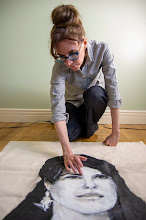
Nude PM portrait brings national media attention to library


“Here, the power dynamic is turned on its head.”

A week ago, it was only the locals who were talking about Margaret Sutherland’s nude portrait of Prime Minister Stephen Harper in the Kingston Frontenac Public Library, which is how I heard about it. By the week-end, Googling ‘Harper painting Kingston library’ produced ten-plus pages where every single result was about the controversy. On my lunch break today, I headed over to 130 Johnson Street to see the arguably iconic portrait in person.

The children’s librarian pointed me to the doorway where two viewers lingered hesitantly before heading in to see Stephen Harper reclining on a chaise lounge, without a stitch of clothing. I overheard one visitor say, “You know what’s great about showing controversial work? It gets people in to see the show.” A quick head count of fifteen people on a sunny Tuesday at lunchtime suggests that this is indeed true.

In the same way that Charles Pachter’s paintings of the Queen on a moose elicited hostile reactions 40 years ago, Sutherland’s portrait has provoked extreme feedback, ranging from hilarity to disgust. My husband and I debated when the last time was that a painting caused as much commotion in the Canadian media as Sutherland’s Emperor Haute Couture (2011). His suggestion was the National Gallery of Canada’s 1989 acquisition of Voice of Fire (1967) by American artist, Barnett Newman. In contrast to that scandal, it’s exciting that the present discussion has stemmed from a female Canadian artist, while also highlighting the role of libraries beyond collections of books.

Satirical artistic representations of politicians have a long history with caricatures, so what is it about this painting that is so startling? Is it its realism and his sheer nudity? Harper’s sex organs may be visible, but it’s not a sexualized painting. It brings to mind a comment by performance artist Stuart Ringholt in relation to his recent tour of the Museum of Contemporary Art Australia where guide and guests were required to be naked: “We are sexualized with our clothes on—with them off, we are not” (1).  Sutherland’s portrait is hardly titillating, with Harper’s patchy chest hair and slight paunch. The background composed of figures in neutral business suits creates a drab setting that runs counter to idealism. It’s telling that the portrait is covered in a different fashion than Gustave Courbet’s L’Origine du Monde (1866), a painting where female genitalia is the focus. It was screened for a private peepshow, whereas Sutherland’s portrait is draped during children’s programming. Here, the power dynamic is turned on its head: after centuries of women being painted nude by men, Sutherland disrupts the gaze that has been in the male domain for so long. Harper meets the viewer’s gaze, but curiously, his expression seems apathetic and less forceful than the gaze of the dog resting by his feet.

Andrew MacDougall, Harper’s new communications officer, tweeted disdain for the portrait, noting that Harper is a cat person (2). Since this is common public knowledge, Sutherland’s choice of dog seems purposeful. While symbolism isn’t reigning supreme these days, the fact that the artist has acknowledged Edouard Manet’s Olympia (1863) as a source of inspiration gives the green light to consider symbols in historical works like Jan van Eyck’s The Arnolfini Portrait (1434) and Albrecht Durer’s Melencolia (1514). In these works, the dog symbolizes fidelity, which is fitting considering that Sutherland cites among her frustrations with Harper cuts to arts funding, census-taking procedures, and prison closures.

The Tim Hortons cup passed to Harper on a china plate by the sole female in the background is also reportedly symbolic (representing the common folk of Canada). It also reinforces the Canadian-ness of the painting: Tim Hortons is so integral to our national identity that its Olympic advertising is unforgettable but American locations feel the need to specify that it is a coffee and bake shop. As product placement, it also serves as a reminder of political branding and last year's public outcry that followed the discreet switch in federal government communications from ‘the Government of Canada’ to ‘the Harper Government’. All seriousness aside, I had to laugh when I looked down at the Tim Hortons drink I picked up spontaneously on my way back to work and realized the probable cause of my detour.

The Kingston Arts Council's Juried Art Salon, of which the painting is part, runs until May 30. If you are in the area, be sure to cast your vote for best in show.

Works referenced:

http://www.musee-orsay.fr/index.php?id=851&L=1&tx_commentaire_pi1[showUid]=125&no_cache=1
http://www.nationalgallery.org.uk/paintings/jan-van-eyck-the-arnolfini-portrait

Sources:

(1)  As cited by Mark Whittaker, “New Tour at Museum Reveals All,” The New York Times, May 1, 2012.

(2) Andrew MacDougall ‏@PMO_MacDougall  On the Sutherland painting: we're not impressed. Everyone knows the PM is a cat person. [Twitter post]. May 18, 2012.


Friday, April 13, 2012

Art ? Craft

“...what about the need for art to come to craft?” -- Isidora Spielmann

Before heading to The Mansion in Kingston for a panel discussion entitled Art ? Craft yesterday, I happened to read an article on this very topic in the spring newsletter from MAWA (Mentoring Artists for Women’s Art, Winnipeg). In ‘No More Bins,’ a reference to Laurie Anderson’s eschewing of unnecessary categorization, author and craft-based artist Heidi Eigenkind says her “deep seated aversion to binary structures” (1) surfaces when someone makes a comment like ‘some potholders are just potholders.’ It’s interesting that some people can see the distinction between art and craft so simply while others—like last night’s panelists from the Organization of Kingston Women Artists, Diane Black, Margaret Hughes, and Isidora Spielmann—are struck by the complexity of their relationship.

Margaret Hughes observed that art and craft are starting to merge again, reminding us of their parallel status and professional integration in the Middle Ages and the Renaissance. I have to agree; as I wrote in a post about a textiles show at Project Space last fall, “craft and art have become rather comfortable bedfellows.” What does it mean, though, when someone can’t admit who they’re sleeping with? What does it say about me that the first time I crossed the border with my textiles sculptures, I referred to them as ‘craft’ rather than ‘art’ even though I have always thought of them as the latter? On a subconscious level, I must have assumed the customs official would be more willing to approve their admission to the US. And I’m sure I’m not the only fibre artist who has hesitated about responding to a call for submissions for a craft show because of how it will affect the perception of my art long-term. These examples suggest that the art/craft question is not an inconsequential one.

Isidora Spielmann noted that it’s common to talk about the need for craft to come to art, but what about the need for art to come to craft? Damien Hurst was cited as an example of a conceptual artist who is relatively divorced from the process of making. It brings to mind Mira Schor writing in Wet (Duke University Press, 1997) that all artists can’t seriously go “back to scraping sheet gut every time you need a sheet of tracing paper.” (2) Yet there’s something inspiring about Margaret Hughes having built not one but two kilns by hand and Diane Black being a modern day blacksmith. Schor has a good point when she says it wouldn’t be a terrible fate if painting, long the golden child of the art world, were to become ‘relegated’ to the realm of craft.

All three artists have approached a variety of media with fervour, aiming to perfect their technique and to infuse their work with meaning. They’ve switched between art and craft over time, and they feel comfortable in both worlds. What can we make of hybrid examples like Spielmann’s couture garments on which she has painted by hand, or of Hughes’ inclusion of her own pots in her still lives? The waters are muddy indeed, which poses a challenge for art librarians like myself in terms of cataloguing images, but it’s exciting to see this cross-over. Clearly, these are artists to whom the dismissive statement, ‘some potholders are just potholders’ does not apply.


Sources:

(1) p. 5.
(2) p. 185.

Friday, April 6, 2012

Escapism in Paris

“Couldn’t it be Impressionist painter Mary Cassatt she fantasized about being instead of Monet?”

From the small selection of paperbacks at the Kingston train station, I purchased Secrets of Paris by Luanne Rice (2012, Bantam Books [1]) for my trip back to Toronto. As an information professional in the arts, I was sold by this description on the back cover in spite of it being a romance novel: painter-turned-photo stylist Lydie McBride leaves her native New York for a year in Paris while her husband, Michael designs an information centre for the Louvre. It seemed a better choice than tabloid magazines, plus I’d already read the Via Destinations magazine on my way to Kingston.

Instead of infusing Lydie and Michael’s relationship with romance, the city of love drives a wedge the size of the Eiffel Tower between them. Michael cavorts with Anne Dumas, an attractive historian who is obsessed to a fault with celebrated 17th Century writer, Madame de Sevigné. Lydie, meanwhile, finds solace in friendships with foreigners that develop too quickly to be convincing. Patrice d’Origny is a happily married and well-to-do housewife who hails from the Boston gallery world and proclaims Lydie her best friend almost immediately after meeting in a café. Her maid, Kelly Merida, is from the Philippines and wants nothing more than to immigrate to America. While Patrice is on vacation for a month, Lydie goes from being served by Kelly as a guest to being her sponsor to feeling physically sick when her immigration petition is denied. If only we all made soul mates so speedily.

The pace at which the McBride’s marriage unravels, in contrast, is believable. The novel begins almost a year into Lydie’s grief for her father’s murder-suicide of his lover and himself, which understandably placed a strain on her own romantic life. It’s sad to see the warning signs of infidelity that they don’t address, and there is a nagging feeling that Michael’s infidelity could end in comparable tragedy. In the love triangle that ensues between Lydie, Michael, and Anne, it is inevitable to side with Lydie and Michael not because the dynamics of their marriage are written about in great detail or with gripping dialogue but because chapters are written from their points of view (as well as Patrice’s and Kelly’s) but never from Anne’s. Also, the only glimpse the reader gets into Anne’s marriage is of Lydie and Michael bumping into Anne and her husband, Jean, at a bistro and Anne confiding in Michael that she is contemplating not joining Jean for a vacation in August because they aren’t getting along. Whatever pain Anne feels is unknown to the reader.

Eventually, Michael ‘pulls a 180’ and decides he loves Lydie. Paris is romantic enough that their reconciliatory consummation needn’t be at an old hotel outside the city where Impressionism was reportedly born, where Eugene Boudin and Edouard Monet painted. It does, however, bring a reference full circle: consumed by grief at the beginning of the book, Lydie sits at a café across the Seine from the Louvre and imagines herself as Monet. (Couldn’t it be Impressionist painter Mary Cassatt she fantasized about being instead of Monet? Alas…)

Reading about Michael trying to secure a particular Poussin painting for his architectural project and striving to pay homage to the Louvre’s history in the wake of the controversy over the contemporary courtyard pyramids seemed a fitting way to unwind after my first week of training at a gallery with a rich historical collection housed in a designated heritage building. Given my new position, you’d think it would be stressful for me to read about Anne Dumas high jacking a decaying 300-year-old costume from the Louvre’s collection to wear to a ball so she could upstage Lydie and bring Madame de Sevigné to life, or to read about her trying to convince Michael to hide with her in the museum’s storerooms and spend the night illicitly, but it was fantastical enough to function as escapism. All in all, this is decent reading for passing time on the train but that’s the best endorsement I can give.

(1) Originally printed in hardcover in 1991 by Viking Penguin.

Tuesday, March 27, 2012

Let’s talk about sex, baby

“…this panel of three female authors at the Art Gallery of Ontario…considered what it’s like to write about sex.”

As an analogue TV owner without cable, I’m behind on contemporary programming. Because I have seen exactly one episode of 30 Rock while visiting relatives, I missed the reference in the title of last night’s panel discussion organized by Toronto artist, Margaux Williamson; I mistook ‘I’m a Very Sexy Baby’ for a discussion about the sexualization of baby girls in Western culture (a classic case of projection since that’s the focus of my own art). As it turned out, this panel of three female authors at the Art Gallery of Ontario moderated by Darren O’Donnell considered what it’s like to write about sex. That’s also a topic close to my heart: I’m very aware of what boundaries I don’t want to transgress in writing a blog containing words like ‘masturbation’, ‘labioplasty,’ and ‘sexting.’ To clarify, these entries in Artist in Transit are always written in the name of art, librarianship, or feminism. Still, it makes me nervous that a colleague at the academic institution where I started the blog described it to his class as an ‘erotica blog,’ though that may say more about the lens through which he views the world than it does about my writing. It’s a concern that is paramount for me today, writing this post and knowing that tomorrow I assume another academic position. I feel like a hybrid of the 30 Rock characters, Abby Flynn and Liz Lemon, shown in a clip at the AGO event. As Abby says, why is it any worse for Abby to use her sexuality than it is for Liz to wear glasses to look smart?

The passages read by the authors proved invariably that language and sex are intertwined. Tamara Faith Berger read a passage in which a female character defends her sexual choices to a friend while smoking a joint; Chris Kraus read a sex scene from the female point of view in which “words come out as they do,” but she is tongue-tied post-coitus; and Sheila Heti read about a woman distracted from playwriting because of a task assigned by her lover, to write a report on an elderly man’s voyeurism.

If this seems like an unlikely event for the AGO, allow me to share some details about the writers: Sheila Heti collaborates with Williamson, and she had artist Shary Boyle read a draft of her first erotic novel before it contained x-rated passages. Chris Kraus started reviewing art in the process of writing her cult classic, I Love Dick, because the object of her desire was an art critic (1). Berger, meanwhile, went to art school, and was always interested in sex as a subject but couldn’t find a way to address it visually. “Going to art school helped…with writing porn,” she said, eliciting laughter from the audience.

O’Donnell asked what was at stake for the authors in writing about sex. Although their initial responses indicated it was relatively risk-free, the comments they made later suggest otherwise. Kraus, who called the art world puritanical, felt that I Love Dick was written off as “exhibitionism and narcissism,” and that she was only respected as a writer when she took sex out of her books. Heti removed her email address from her website when her writing took an erotic turn because she was worried about receiving perverted comments, and Berger had someone walk out of her recent reading at a public library. Liz Lemon was right on the money when she said, “Society puts a lot of pressure on us [women].” The Madonna/whore complex is alive and well in writing, and kudos to these women for staring it down.

The prickly topic of feminism came up on multiple occasions. Williamson noted that she has watched a lot of television while doing her residency at the AGO, and she was intrigued that 30 Rock addressed “such insane feminist politics” (re. Liz trying to correct the behaviour of the threesome-loving, pigtail-wearing Abby, all the while indulging in reading a website “where women talk about how far we've come and which celebrities have the worst beach bodies” [2]) without fixing problems. The three authors are similarly unapologetic about the explicit passages in their published works. Even when the sex scenes are degrading in some way or are the outcome of obsession, as Berger says, “You can’t devalue the bond” or dismiss its role in paving the way for self-awareness. In the authors’ books, a single male character unlocks female desire, so even if that desire is not female-generated, as far as feminism is concerned, at least it’s not at the mercy of the entire male sex. “That’s what’s hot about it,” Heti says. An audible gasp went around the room when audience member Misha Glouberman raised the notion of male-generated desire. It was a reductive moment that reminded me of something I heard Moe Tkacik, co-founder of Jezebel (see Liz Lemon quotation above), say two years ago at the Elizabeth A. Sackler Centre for Feminist Art, which has been burned in my brain ever since: “Men. F*#! ‘em. They’re the problem.” As a feminist, I feel that attacking men for being thoughtful about female sexuality is counterproductive, and as a librarian, I have to say that making observations about fictional characters does not constitute agreement with their philosophies. There must be a better use of our collective energy.

Sources:

(1) Guthrie, Kayla. Performing is Storytelling: Q+A with Chris Kraus. Performing is Storytelling: Q+A with Chris Kraus.
(2) TGS Hates Women, season 5, episode 16, aired February 24, 2011

Monday, March 19, 2012

Babe Walker takes on art school

“The ironic conclusion to the socialite’s brief stint in the art world is that she finds it ‘silly and fake’, so she has her nanny perform a voodoo exorcism.”

If you’ve seen the 2011 remake of Arthur starring Russell Brand, you are familiar with Narcissistic Personality Disorder. Arthur careens through life without regard for anyone else, utterly dependent on his nanny (Helen Mirren) and spending money as recklessly as he drinks alcohol. If you replace Arthur with a young woman; his rich mother with an equally rich father; Helen Mirren with a Jamaican nanny; and Arthur’s collection of automobiles from famous movies with a designer wardrobe, you’ve got Babe Walker’s facetious new memoir. White Girl Problems (Hyperion, 2012) is the 140-characters-plus version of the Twitter account crafted by the Cohen brothers and Lara Schoenhals, which was voted one of TIME Magazine’s 140 best Twitter feeds.

Generally, I’m not one to read a book endorsed by Tori Spelling on the cover, but I had heard that the main character ends up in art school, and I was curious to see how this most improbable of choices transpired.

Babe doesn’t apply to college because she assumes she will become a famous actress without even trying and fall into the arms of Leonardo di Caprio. Her hard-working entertainment lawyer father convinces her to buckle down, and gets her into the University of Southern California for performing arts. Before long, she is suspended for parking wherever she wants. Next up is her flirtation with visual art at the Rhode Island School of Design, a school whose chicness she prefers to Brown, “some stupid school I’d never even heard of,” where she was registered but refused to live in a dorm with a roommate.

Until this point, her only awareness of art was noticing that a waiter at her Studio 54-themed Sweet 16 party was dressed like Andy Warhol and telling her father that her pre-labiaplasty genitals looked like Basquiat so she needed the surgery as a high school graduation gift.

At RISD, she majors in glass blowing. She never attends class but she attends seminars occasionally because of the hot teacher. In her world, it’s the whole experience that matters and not just what her transcript reflects. And she does make some work outside of class with an androgynous printmaking major she befriends because she calls her skinny. One night, high on mushrooms, they break the heels off of all of Babe’s shoes and toss her designer clothes out the window for a bonfire that gets her arrested. She passes out during the mug shot but ultimately makes it into Art Forum. (Editorial note: I know—it’s Artforum, not Art Forum. Disregarding details is key to Babe Walker’s identity. Case in point: when her father agreed that she could come work for him, she mistook an entry-level office assistant job for a junior partner position). Her “artist moment” comes to an end when her horse, who is named Mischa Barton, flips out during a photo shoot with her friends and she breaks her back. The ironic conclusion to the socialite’s brief stint in the art world is that she finds it “silly and fake” so she has her nanny perform a voodoo exorcism. From there, she writes poems, such as “A Babe Haiku” about couture, and eventually studies fashion, where she should have put her focus from the get-go.

This book will make you laugh, because it’s hard not to laugh at something like Jamie Oliver being double booked because of a birthday party for Jennifer Aniston’s cat’s cat. It will also make you glad you are the kind of person who doesn’t send 93 texts to an ex in one night or drop $246,893.50 at Barney’s in an afternoon...which I'm assuming you aren't if you are a repeat reader of my blog. The Barney’s incident is what finally landed Babe in rehab and gave her the time and space to craft her memoir, which she considered calling Babe Walker: The Babe Walker Story but whose title, White Girl Problems, came instead from the jabs of her rehab peers.

At the end of the book, there’s a hint that Babe Walker has some substance after all. She meets her biological mother, Donna, who is a former runway model and coincidentally the lesbian partner of her rehab roommate. Just when this emotional turn threatens to counteract the horrendous superficiality of the rest of the book, a therapy session with Donna ends with Babe elated at receiving the oddest of heirlooms: a Chanel bikini with emblazoned crotch from spring 1994.

For more on the infamous Babe Walker, check out @whitegrlproblem on Twitter and www.babewalker.com.

Saturday, February 25, 2012

Keeing it reel [sic]

“Let’s hope that artists who are featured in documentaries don’t feel like hostages.”

Yesterday’s panel discussion at the TIFF Bell Lightbox in Toronto posed the question, should—or how should—documentarians incorporate an artist’s life into a film without detracting from his or her art? In films like The Art Star and the Sudanese Twins: Vanessa Beecroft's Controversial Art, the interplay between personal and artistic life can be overwhelming. In this case, her marriage becomes jeopardized by her ongoing attempt to adopt twins from Darfur whom she met while doing research for an art installation at the 2004 Venice Biennale. The panel discussion was about similarly gripping characters—some equally outlandish and others more reserved. Panel moderator and film critic Marc Glassman commented, “The biographical question intrigues me…you have to somehow create a balance” between who an artist is and their practice.

The panel was co-hosted by Point of View magazine and Reel Artists, the Canadian Art Foundation Film Festival (and the only one of its kind in North America). It featured filmmakers Larry Weinstein, Matthew Akers, and Roz Owen. Weinstein, whose films portray music composers, feels that some biographical details are more pertinent than others. For instance, he believes that it is useful to know about Toulouse-Lautrec’s dwarfism to appreciate the low angles of his paintings, but that it is less critical to know that an elderly Renoir attached brushes to his wrists because of a debilitating illness. He’s qualified to make this judgment, having depicted an incredible end-of-life story already. In the film Ravel’s Brain, the composer struggles to write music after he develops aphasia, agrees to undergo risky brain surgery, and dies.

Perhaps relevance hinges on the extent to which the boundaries between art and life are blurred. Of artist Marina Abramović, Akers says, “Her art in a way is her.” As Abramović told Leah Sandals in a recent interview, in long-term performances, “You're doing life.” (1) This is an artist who has invited viewers into her personal space so much that she has been referenced on Sex in the City as the woman who is fasting at 3 am in a gallery loft for all to see. The performance on which that fictionalized account is based pales in comparison to her longest performance to date in terms of blending art and life. In The Artist is Present (which is also the name of Akers’ film), she is shown seated on a wooden chair across from interchangeable viewers, one at a time, six days a week during the MoMA’s hours of operation. I saw this piece performed three times during its three-month run, but I didn’t appreciate its duration until I saw a film clip showing her tallying yet another week on the wall only half way through its run. Witness the skill of filmmakers to help us see what we do not.

On the other end of the spectrum of spectacle is the artist-activist couple, Carole Condé and Karl Beveridge. Roz Owen’s film, Portrait of Resistance, revisits, among other projects, their 1976 exhibition at the Art Gallery of Ontario, which revealed the realities of artist life while insisting on artists’ political responsibility. Even though they have exposed this element, they remain private. Condé, for example, did not want personal details about her in the film. Owen noted that this worked out because she is such a present person that it came through in the film. Beveridge was more open to including details. The fact that his parents were communists certainly sheds light on their community-based social justice work. Ultimately, though, they wanted the film to be about the many people they have worked with and resisted the idea of it being about them lest it glorify them. That contrasts Abramović, for whom Akers says there is a lot of reverence. Her willingness to allow 700 hours of footage to be shot for the documentary doesn't exactly fight against this reverence.

Just as the boundaries between life and art entered the discussion, so did the boundaries between filmmaker and subject. Weinstein tends to represent dead composers in his films, but when they are alive he pretends otherwise to gain focus. He keeps his own voice out of the film whereas Owen, a friend of Condé and Beveridge, asks questions of her subjects openly because it feels honest and natural. Akers did not include his voice and he maintained a distance during Abramović’s performance. He feels that because the public completes the piece, he too represented the public, but he admits that there is no such thing as being the fly on the wall. The term ‘Stockholm syndrome’ was tossed around between the panel and the audience but more than mimicking hostages who empathize with their kidnappers, this filmic phenomenon seems closer related to the Hawthorne effect (in which the very act of being studied affects the behaviour of a subject). Let’s hope that artists who are featured in documentaries don’t feel like hostages. Akers said that the trick is to tell as a story as you see it, not as the subject wants it to be told. In speaking about artists he's worked with like John Cage, who are masters of constructing their identity, Weinstein says that the more you look at their art, the more you see its worth. Akers went to great lengths for answers. For instance, he flew to Naples to interview a gallerist to determine if photographs from Abramović’s Rhythm 0, in which she provided the audience with objects that caused pleasure or pain, were staged or real (as the legend goes, one audience member held a loaded gun to her head.) His question, “Where does the truth lie?” functions as a double entendre in this situation.

Akers states, “Every artist has a myth they create or that has been created for them.” The challenge, aside from paying tribute to an artist’s work and making an entertaining film, is to cut through that myth and portray them honestly. By including footage that makes Abramović seem superficial or, as Weinstein says, banal, he makes her seem normal and thus relatable. Such is the case with a scene in which Condé and Beveridge restage a photograph taken 34 years prior. He makes a joke about the couch they’re sitting on holding up better than themselves, and his wife retorts with an expletive.

Sources:
Sandals, Leah. Marina Abramović: The Gifts of the Present. February 23, 2012, ¶14.

Thursday, January 5, 2012

Starting the Year with an Oedipal Tragedy

"Which is harder to stomach about the unfortunate pairing of Guterson’s characters?"

A week into December, around the time New Year’s resolutions start taking shape, I visited the University of Toronto for the Book and Periodical Council Idea Exchange about public school libraries. When panelist Annie Kidder referenced a study about the positive neurological effects of reading fiction, I slunk down in my chair in the sea of librarians. It hit me that 2011 was about to pass without me having read a single fiction book, as I’d been completely absorbed by non-fiction. As luck would have it, that very day, the winner of the bad sex in fiction award was announced, making for an easily attainable resolution: the first book I would read in 2012, once my inter-library loan came in, was David Guterson’s Ed King (2011, Alfred A. Knopf). [Spoiler alert: skip the following paragraph if you want to avoid the details of the plot].


A modern day Sophoclean tragedy about patricide and incest, the novel begins with the events leading up to the conception of an Internet visionary. Walter Cousins, a father of two, has an affair with his au pair, Diane Burroughs, while his wife is hospitalized for mental illness. She becomes pregnant and demands child support even though she secretly leaves the baby on a Seattle doorstep. The baby is raised as Edward Aaron King by a local couple but is never told he is adopted. This choice may or may not have affected his emotional development, contributing to his predilection for older women and to the adolescent rage that causes him to drive a stranger, who happens to be Walter Cousins, off the road to his death. The book ends with his suicide at age 54, as he flies a plane above the allowable altitude while processing the sickening news that it was his biological father he killed and that his wife of almost twenty-five years was his biological mother.


Reading the book, I found myself reflecting on the caption within a General Idea photo screen-print called Oedipal Triangle that I’d just seen at the Art Gallery of Ontario: “This three-way relationship is easy to set your sights on.” In contrast to that sentiment, when Ed King finally discovers his father’s identity via DNA analysis and phone calls, his reaction, just before asking the question, “Who was my mother?” was “He wasn’t sure he wanted to look.”


Guterson acknowledges the complicated position of the reader. When Ed and Diane begin their romance, he interrupts by saying, “Now we approach the part of the story a reader can’t be blamed for having skipped forward to…most people, on hearing about the Oedipal complex, feel both resistant and drawn.” It would be difficult to interpret Diane and Ed’s encounter as anything but ‘bad sex,’ and not just because of its phrasing, which is rife with euphemisms. Which is harder to stomach about the unfortunate pairing of Guterson’s characters? The fact that Diane’s mind flits back to Walter Cousins while in the act, or the thought of adult Ed smelling “breast-fed”? Shudder. In spite of his “general body worship” of Diane, it is a match made in hell. Even so, their physical chemistry is described as exhilarating years into their relationship. If Ed and Diane were not tied by blood, it would still be distasteful to read about Ed calculating the number of times they’d had sex in the same way that Rachel called Ross a loser on Friends when he boasted the number 298 in response to a furniture salesman who didn’t believe they’d once dated.


It’s only marginally easier, to use General Idea’s wording, to read a description of statutory rape (Walter and Diane) and the next closest thing, Ed having sex with his adult math coach when he is in the eleventh grade. Even the healthiest relationship supports the bad sex in fiction award, given the account of Ed’s adoptive mother—then pregnant with Ed’s younger brother—copulating with her husband with flabby legs likened to cottage cheese and milk laden breasts compared to squirt guns.


Further to the announcement of the award at London’s In & Out Club, Guterson commented, “Oedipus practically invented bad sex, so I’m not in the least bit surprised.”