Saturday, November 2, 2013

Duane Linklater at Nipissing University

“There’s something about small towns in the north…”

Unpresupposing in light of winning the prestigious Sobey Award last month, Duane Linklater thanked the audience at his artist talk yesterday for coming out to campus first thing in the morning and said he hoped they wouldn’t mind if he shared some slides. He also expressed interest in “taking the air out” of the art historical trope of artist-as-hero. “I find it problematic, the idea of an artist having a special gift.”

The importance of the $50,000 prize was underscored when the North Bay artist revealed that he initially wanted to expand a work he showed at nearby White Water Gallery in 2011 to include four more components, but because he was working with pricey neon signs, its realization was delayed until this year. Tautology features five differently coloured birds, each appropriated from a painting by Anishnabe artist Norval Morrisseau (called Copper Thunderbird, 1932-2007) selected by former Governor General Michaelle Jean for display in Rideau Hall, “where the Governor General does Governor General types of things.” By shifting the context, Linklater observed that “something funny and slippery happens.” Unconventional collaborations (with, for example, a deceased artist) and new contexts in the exploration of Aboriginality characterize his multi-media work.

An Omaskêko Cree, Linklater says, “The moment that politicized me, as a teenager” was the Oka crisis of 1990. On his bedroom wall, he hung a picture of masked warrior, Richard Nicholas, standing on top of a squad car during the standoff over contested land. From that point on, he began independent research and took a Bachelor of Arts in Native studies. He also holds a Bachelor of Fine Arts and a Master of Fine Arts. Linklater says, “Art can…help you…it can…offer a reckoning or a process through tragedies [like Oka].” So often, tragedy offers up stories of hope and this one is particularly gripping: Linklater played a wax cylinder recording for the audience of Santu Toney, a half-Beothuck woman in her mid-seventies from Newfoundland who met an anthropologist in New England, rousing disbelief in the link to the extinct Beothuck tribe. Linklater provided cellist Peggy Lee with sheet music of Toney’s song transcribed by an ethnomusicologist, to be perfomed at his exhibition at Or Gallery (Vancouver). The show also included email correspondence with Joanna Malinowska, a Polish artist whose representations of Aboriginal concerns and Aboriginal artwork in the Whitney Biennial and in her practice in general were politically suspect, in Linklater’s view (the two artists had agreed that any of the text was fair game for future exhibition). “Collaboration brings so many things….It’s always going to change….You don’t know what…the outcomes will be [which is what’s]…super-exciting about art.” When he approaches collaborations, whether moose hunting with artist Brian Jungen, or working with a Bard College groundskeeper to plant 12 blueberry gardens for his MFA thesis, “It (the treaty concept)’s always floating around me.”

Linklater commented that it felt different presenting on his work in the city where he lives. Besides getting ready in the comfort of his own home, he alluded to the resonance of an image of his installation of raspberry bushes in a Chelsea, NY gallery when discussed in North Bay, where wild raspberries grow on his property. He also recounted walking into Ontario Northland and asking for information about the history of their logo, which he ultimately painted on the wall of Susan Hobbs Gallery in Toronto as a tribute to the now-cancelled train that acted as a vital connection between northern communities and southern Ontario. Without an appointment, he was able to meet for 45 minutes with a marketing representative, get a binder of photocopies the following day, and receive a “really friendly” letter. He noted that if he had walked into a train station in a larger city in Canada, he would probably have waited six months for that kind of progress. “There’s something about small towns in the north that allows you to do things like that,” he said. (This anecdote really captures the essence of North Bay; the day I moved back to the city, I ran four errands and every sales clerk or service person I encountered smiled and initiated a conversation with me. It’s a city where I’ve been offered a ride from a stranger when carrying too many groceries and had a homeless person hold an umbrella over my head while I’ve rummaged for change for them.)

He ended with refreshing advice to the many young artists in the crowd. At the risk of misrepresentation through paraphrasing, his advice is:
*There is no set plan to become an artist, and everything you do—even the unenjoyable things—helps you develop as an artist.
*Don’t get caught up in the pressure to make work or feel like you have to have a studio. Do what you really want to do, and envision your practice in a more holistic way. (For instance, Linklater sees discussions as a major part of his work).
*Don’t get caught up in definitions. Is a film about collaborative moose hunting really art? Is working with a groundskeeper really collaboration? Does it matter?
*Be flexible when dealing with authority figures.
*Be true to your principles. If you’re offered a show and there’s something unethical about it, it’s not worth pursuing.
*Opportunity is always there. It’s just a matter of finding it.

Image: Tautology, 2011-2013, neon, aluminum, transformer, enamel, 60 x 60 in. (152 x 152 cm). Installation view, Sobey Art Award Exhibition, Art Gallery of Nova Scotia, Halifax, 2013. Reproduced in 2019 via fair use/dealing. Source: https://catrionajeffries.com/artists/duane-linklater/works/duane-linklater-tautology-2011-2013

Monday, October 21, 2013

Brass in Pocket at Booklyn Artists Alliance

“…feminist art is not an easy concept to digest for the majority of people.”—Maura Reilly

On the week-end, I visited Booklyn Artists Alliance in Greenpoint, Brooklyn, in part to see if the copy of Our Bodies, Ourselves I donated earlier this year to Jen Kennedy and Liz Linden's Book Swap… had been swapped. It hadn’t.

I wish I could say that I loved the current exhibition, Brass in Pocket (September 13-October 27) because it combines art, feminism, bibliophilia, and self-publishing (it culminates in the production of a zine including external submissions). Alas, when I passed back under the funky archway of books in Booklyn’s office space, I left as perplexed as when I arrived by the online curatorial statement.

Seven female artists are included in the show but in the list of exhibiting artists on the website (see image) and in the curatorial statement, the roster is said to include not seven but six artists (Susan Fang, Liz Linden, Lynnette Miranda, Caroline Paquita, Catherine Stack, and Tamara Waite-Satibanez, all of whom are New York-based). As a fellow Canadian, I find the exclusion of Toronto-based Jen Kennedy concerning. As a feminist, I find lack of recognition for a female artist to be the opposite of feminist.

Curators Aimee Lusty and Kate Wadkins explain that their original intention was to showcase feminist artists (defined as artists who encounter sexism in their personal and professional lives, regardless of whether they create feminist work). In studio visits, unspecified feminist themes surfaced, but Lusty and Wadkins decided to emphasize transcendence of subject matter, experimentation within various media, and draftsmanship (ahem) instead, seeing feminist art as a narrow focus. The statement ends by aligning the spirit of the show with that of Book Swap… in saying that at the heart of Brass in Pocket is the viewer’s ability to engage with feminism on his or her own terms.

The fact that the artists face gender-based discrimination at home and work doesn’t make them feminists; it makes them women. Doing something about it would make them feminists. Based on their online presence, only three of the seven artists self-identify as feminists. If the others do indeed consider themselves to be feminists, it would be ideal for the artists to articulate it. In a world where role models like Susan Sarandon avoid the ‘f word,’ more allies are needed. (Kudos to artist Suzanne Lacy for addressing this issue head-on in her collaborative performance in Prospect Heights on Saturday). Laying bare the evolution of the curatorial approach, as Lusty and Wadkins have, has the unfortunate effect of casting the show as feminist lite at best and as a rejection of feminist art at worst. They may have been better off releasing a statement that addressed formalism but not feminism at all.

My knee-jerk reaction was likely exacerbated by the book I happened to be reading the day I learned of the show. In the opening chapter of Women, the Arts and Globalization: Eccentric Experience, Angela Dimitrakaki notes that on a global scale, women have less brass in pocket* than in the past, in addition to being sexual commodities, so it’s critical to maintain the connection to politics in feminist art history—a discipline that is market-driven through tourism-generating biennials and tuition-funded academia. Regrettably, at least according to Dimitrakaki’s line of reasoning, Brass in Pocket has no apparent politics. Its curation invokes a powerful concept but stops there. Because, as Maura Reilly says, “feminist art is not an easy concept to digest for the majority of people” (p. 35), what feminist intentions the curators had may become lost when people engage with the show on their own terms, without even wall labels to help them along.

*British slang for money; a reference to The Pretenders’ song, Brass in Pocket.

Sources:

Connie Butler, Amelia Jones, and Maura Reilly (in dialogue). “Feminist Curating and the ‘Return’ of Feminist Art.” In The Feminism and Visual Culture Reader, Ed. Amelia Jones. Routledge, 2010, pp. 31-44.

Angela Dimitrakaki, “Gendering the Multitude: Feminist Politics, Globalization and Art History”. In Women, the Arts and Globalization: Eccentric Experience, Eds. Marsha Meskimmon and Dorothy Rowe. Manchester University Press, 2013, pp. 15-25.

Image: reproduced in 2019 via fair use/dealing. Source: https://booklyn.org/event/brass-in-pocket/

Sunday, October 20, 2013

Feminists en masse at Prospect Heights

"...organized by...Suzanne Lacy..."

On Saturday, October 19, 300+ people gathered on the stoops of brownstone homes in Brooklyn’s Prospect Heights to talk about feminism from a personal perspective. And that number didn’t even include the guests.

In Between the Door and the Street, participants organized by Los Angeles-based artist Suzanne Lacy chatted amongst themselves about topics like the pressure to be macho, judgments about women’s clothing choices, sexual harassment, and platonic friendships between men and women. The audience looked on, moving at their own pace to overhear the next group of their choice. True to the contemporary definition of feminism, the participants were female, male, LGBTQ, and from various cultural and ethnic backgrounds.

Arriving half an hour into the performance, I was delighted to see that so many people had come out that they had to wait to enter closed-off Park Place. Once inside, adults hugged acquaintances they bumped into and children played, making it feel like a street party. The downside was the amount of noise. There was a policy of no cellphone conversations and it’s a shame there wasn’t a policy to keep conversations hushed because it was impossible to hear the majority of official conversations over the din. At best, the performed conversations would have been in competition anyway because of the proximity of the stoops to one another. Hopefully, the documentation will enhance access to the content of the chinwags.

Sometimes when an art performance ends, it can be awkward for the theatrical experience to become reconciled with reality. In Between the Door and the Street, though, it was great to see the participants dispersing through the neighbourhood and entering the subway, with their bright yellow scarves marking them as consciousness-raising feminists.


The audience waiting to enter Park Place for Suzanne Lacy’s Between the Door and the Street.


Volunteers chatting about feminist topics on the brownstone stoops.


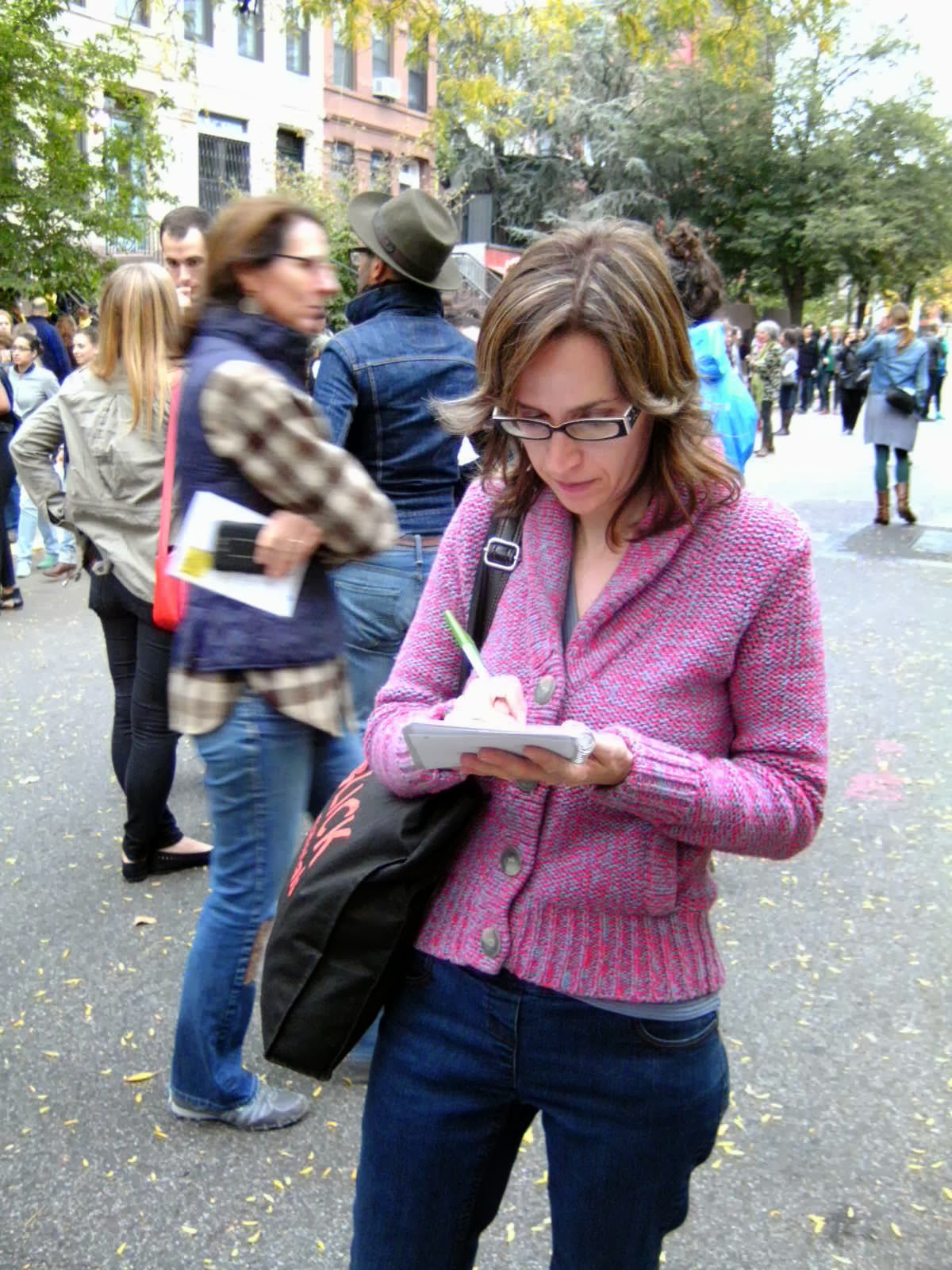
Blogger Heather Saunders taking notes about comments overheard, such as a young girl asking, “Why are there men?”

Tuesday, October 8, 2013

The Books that Shaped Art History

“…a terrific read.”

Collection development is in full swing at this time of year for academic libraries. I decided to order The Books that Shaped Art History (2013, Thames and Hudson) to help fill in any gaps in our collection. Sixteen acclaimed titles are critiqued by academics and curators in this publication edited by Richard Shone and John-Paul Stonard. The books were written in English, French, and German, and all are now available in English; the corresponding essays are exclusively in English. Substantiating the selection is the fact that the 16 authors are repeated throughout many of the essays; for example, Nikolaus Pevsner studied under Heinrich Wölfflin, whose approach to formalism influenced Kenneth Clark, who wrote Bernard Berenson’s obituary, and so on.

“A roadmap of sorts for reading art history” (p. 7), the entries are chronologically organized, from the end of the nineteenth century to the end of the twentieth century. Thus, the reader gets a sense of how art history has evolved—for example, moving from judgments about formal qualities, like Roger Fry praising Cézanne’s use of colour, to the tentative experimentation with and then the full embrace of a social history of art, to the extent that value judgments like Fry’s all but disappeared.

The groundbreaking 16 titles are:

Emile Mâle’s L’art religieux du XIII siècle en France: Etude sur l’iconographie du Moyen Age et sur ses sources d’inspiration, 1898; reviewed by Alexandra Gajewski—Written during a time when Medieval cathedrals were on the chopping block, this systematic exploration of these places of worship commented on multiple arts (sculpture, stained glass, and architecture) and found the perfection of form to be an “encyclopaedic account of Medieval Christian knowledge” (p. 21).

Bernard Berenson’s The Drawings of the Florentine Painters Classified, Criticized and Studied as Documents in the History and Appreciation of Tuscan Art, with a Copious Catalogue Raisonné, 1903; reviewed by Carmen C. Bambach—Based on research from original drawings (which were then undervalued and improperly catalogued, making this an impressive feat), this multi-volume publication introduced a focus on connoisseurship and the comparison of works of art to substantiate attribution, a process that had been sloppy until that point in time.

Heinrich Wölfflin’s Kunstgeschichtliche Grundbegriffe: Das Problem der Stilentwicklung in der neuen Kunst, 1915; reviewed by David Summers—Fascinated that four artists painted the same landscape differently in sync, Wölfflin used cultural-historical generalizations to explain artistic output: temperament, school, nationality, and race (which had interesting implications in light of the book being published during World War I).

Roger Fry’s Cézanne: A Study of His Development, 1927; reviewed by Richard Verdi—Back when Cézanne was only remembered by a handful of people in his hometown, Fry cast him as a modern master by deconstructing in clear language the process of abstraction his painting subjects underwent and introducing a style of art criticism that encouraged readers to scrutinize the elements and principles of design.

Nikolaus Pevsner’s Pioneers of the Modern Movement from William Morris to Walter Gropius, 1936; reviewed by Colin Amery—In this “‘gospel’ of modernism” (p. 68) that lauded Gropius and Morris for their socialist tendencies and their avoidance of ‘art for art’s sake,’ Pevsner legitimized the movement by establishing its forefathers.

Alfred H. Barr Jr.’s Matisse: His Art and His Public, 1951; reviewed by John Elderfield—Based on extensive primary research and published at the end of Matisse’s life, this monograph was so big, so thorough, and so validating that even Picasso (on whom Barr had written his Harvard thesis) was annoyed.

Erwin Panofsky’s Early Netherlandish Painting: Its Origins and Character, 1953; reviewed by Susie Nash—Panofsky made up for his poor memory (read: inaccurately described works due to time lapsed) with wit and writing finesse, in his exploration of the disguised symbolism in richly detailed Netherlandish painting.

Kenneth Clark’s The Nude: A Study of Ideal Art, 1956; reviewed by John-Paul Stonard— In addition to defining nudes as a genre, this book held mass appeal for the public (which is unsurprising since the act of writing it—of capturing the eroticism and sexual appeal of nudes—caused the author to tremble).

E.H. Gombrich’s Art and Illusion: A Study in the Psychology of Pictorial Representation, 1960; reviewed by Christopher S. Wood—In his socio-cultural examination of the purpose of art, Gombrich tried to tap into the mindsets of artists before the rise of modernism and consider how they reconciled ideas for images with visual rhetoric and expectations of patrons and other audience members.

Clement Greenberg’s Art and Culture: Critical Essays, 1961; reviewed by Boris Groys—In defending the avant-garde, Greenberg envisioned a polarity of high and low art rather than historical and post-modern art, pitching it as brilliantly self-referential in analyzing artmaking tradition and suited to audiences with a thirst for knowledge.

Francis Haskell’s Patrons and Painters: A Study in the Relations Between Italian Art and Society in the Age of the Baroque, 1963; reviewed by Louise Rice—Haskell brought patronage out from the sidelines of art history, by conducting extensive archival research and bringing to life a host of characters whose unique situations were allowed to be seen as just that, rather than imposing patterns unnecessarily (thus serving as an alternative to ideologically-driven Marxism).

Michael Baxandall’s Painting and Experience in Fifteenth Century Italy: A Primer in the Social History of Pictorial Style, 1972; reviewed by Paul Hills—Baxandall’s sensitivity to language (for example, how classical Latin and vernacular Italian phrasing affect our perception of art) extended to his ability to engage a popular audience with a style that feels like “being taken on a quest rather than presented with a cut-and-dried body of facts, let alone a theory” (p. 154).

T.J. Clark’s Image of the People: Gustave Courbet and the 1848 Revolution, 1973; reviewed by Alastair Wright—In this meticulously researched book, the neo-Marxist author presents Courbet as purposefully ambivalent towards the underdog, resulting in powerfully subversive paintings that confuse the audience and shake up their beliefs.

Svetlana Alpers’ The Art of Describing: Dutch Art in the Seventeenth Century, 1983; reviewed by Mariët Westermann—In contrasting (and ultimately defending) characteristically pleasant and detailed Dutch painting against its narrative Italian counterpart, Alpers called for a return to seeing it as descriptive and as a practical craft befitting of a map-making and telescope-inventing culture that valued exactitude.

Rosalind Krauss’ The Originality of the Avant Garde and Other Modernist Myths, 1985; reviewed by Anna Lovatt—Unafraid to adjust her methodology, terminology, and philosophical position in a continual reassessment of art history, Krauss ushered in a new era with this anthology by applying structuralist and post-structuralist theory to postmodern art and moving past the preoccupation with media and historical context of works of art.

Hans Belting’s Bild und Kult: Eine Geschichte des Bildes vor dem Zeitalter der Kunst, 1990; reviewed by Jeffrey Hamburger—Responsible for making the terms ‘cult’ and ‘Medieval’ interchangeable to some, Belting described the movement of the sanctified image from east to west, ushering in pictorial development in Western art and causing such a substantial shift that he thought of the two periods as ‘before’ and ‘after’ the work of art.

This book had me as soon as I saw its sewn-in ribbon bookmark, but it’s also a terrific read. There are some juicy stories: for example, we learn that Berenson’s nemesis, a museum director, may have been behind a six-year delay in publishing his book because of image permissions, and that Krauss had it out with a museum director in print over the terms ‘original’ and ‘reproduction’ in relation to a Rodin show.

The Books that Shaped Art History is a valuable academic resource. It contains brief biographies and publication histories for the 16 authors as well as an index. Black and white images are included of each author and each book, including front covers and page openings. It is highly recommended for librarians involved in acquisitions; art history students of any level who need to write annotated bibliographies; incoming graduate students; and professors selecting readings for undergraduate or graduate students.

Image: reproduced via fair use/dealing in 2019. Source: https://sites.duke.edu/revoltinglibrarian/2014/06/09/bookish-the-books-that-shaped-art-history-2013/

Saturday, September 28, 2013

Spring and Arnaud at Doc North

“…film as catharsis…”

Spring and Arnaud (2013) was screened at Nipissing University last night as part of Doc North. It’s a film about waiting for the other shoe to drop. In this documentary directed by Katherine Knight and Marcia Connolly, Canadian artists Spring Hurlbut and Arnaud Maggs take stock of life five years into Maggs’ diagnosis with cancer.

The underlying focus may be impending death, but luscious cinematography balances it by capturing the preciousness of life. We see sunlight bathing ceramic jugs in the heritage home they own in France and fog rolling through densely treed hills. We see Maggs carry a picnic basket to a flea market, play harmonica while Hurlbut dances, and read Emily Dickinson to her in bed. We also see them at work, making new series, rifling through their archives, and embracing so tightly in a gallery that Maggs’ arm flails. Evidence of the artists’ lifestyle, critical success, and happy marriage prompts the audience to believe Maggs when he says, “It’s [life has] been a great time, I’d say, for both of us.”

Hurlbut knew of Maggs’ work before she made his personal acquaintance. Based on its austerity and toughness, she confesses she thought, “I never want to meet this guy.” Nonetheless, she was charmed when they crossed paths at a birthday party. Hurlbut tried to call the whole thing off on the second date. Although the film doesn’t specify, perhaps it was because of age: Hurlbut was 35 and Maggs was 60. Maggs recalls having to rectify the situation quickly; he suggested a good-bye kiss. Tugging lightly at the tablecloth with his fingers and giggling, he says, “I put everything I ever learned into that kiss.” Hurlbut adds, “It was like good-bye, hello!” By the end of the third date, they were engaged.

Hurlbut and Maggs’ mutual support is the backbone of their relationship but it’s not flogged in the film. He says of her, “She blows my mind” and she says of him, “When he’s landed one of his ideas, he’s quite unstoppable.” There is a risk that the film could come off as pretentious, for as Hurlbut says, they are both fixated on “me, me, me, me.” What saves the film from self-importance is a scene involving a misunderstanding, because it leads to explanation. Hurlbut tells Maggs that she wouldn’t be interested in him if he weren’t a notable artist. He initially interprets her comment as tongue-in-cheek, which compels her to explain that she must be with someone she can respect who is driven by the need to communicate an idea, to have rich conversations, and to be engaged—as she is, so much so that reflecting on times when the engagement wanes causes her to sigh heavily. Maggs agrees that he couldn’t be in a relationship with a bad artist and reveals that he can’t separate his feelings for her as an artist and his feelings for her as a partner.

Hurlbut knew from a young age that she would be an artist, while Maggs made the transition unexpectedly at age 47. She tends towards sculpture and he to photography. Although their styles are distinctive, there is overlap in their approaches. Both love history and collecting, and both have embraced mortality as a theme on more than one occasion. For example, in Notification xiii (1996), Maggs, who deals with systems of identification, photographed 192 envelopes from French flea markets announcing a person’s death. Traditionally, this mourning stationery contained an x-mark in wax along the edges of the envelope. “It’s like crossing out the person,” he remarks. To see the series installed (as I have) is to be engulfed by grief. In a series of self-portraits taken at age 85 as “a record of my [his] existence,” he holds one of these lettres de deuil with a sad expression, dressed as the deathly pale French mime, Pierrot. Hurlbut also has a penchant for amassing antiques. In Le Jardin de Sommeil (1998) she installed 140 empty cradles and bassinets, which are strikingly empty. An even more direct statement about loss is Deuil (2005-06). These photographs document ashes from cremated human remains that the artist has arranged into constellation-like patterns. Fascinated by “what remains after death,” she began these unconventional portraits with her father’s ashes, and then used the ashes of other individuals. Ultimately, they became a way for her to cope in advance with her role of widow. She says initially she wasn’t clear about whether the series could even be considered art, which also cancels out any pretensiousness in Spring and Arnaud. Just as the photographic series developed out of necessity, the audience is able to see the film as catharsis, and not just as a tribute to their artistic legacies.

When Maggs met the artist Joseph Beuys, Maggs described himself as having all the time in the world. The film, in capturing the vivaciousness of the octogenarian, almost makes it feel that way. Two months after his retrospective exhibition ended at the National Gallery of Canada, Maggs died on November 17 of last year. He was 86.
Image: reproduced in 2019 via fair use/dealing. Source: http://firstrunfeatures.com/presskits/boxart/springarnaud_flat.jpg


Wednesday, August 7, 2013

David Carlin at Alex Dufresne Gallery


“The work then becomes a living entity…”


North Bay artist David Carlin is at once serious and silly: when we toured his mixed media exhibition, INTRANSIT, at the Alex Dufresne Gallery in Callander, Ontario, like a seasoned self-promoter, he made sure to mention his exhibition, Caged, in Englehart at the Englehart and Area Historical Museum with Lionel Venne. “My work is in two museums,” he said in a serious tone. He followed the comment with, “I must be getting fossilized,” and his giggle turned into a snort.

After a celebratory pasta dinner with much giggling, I strove to get David back into serious mode with the following questions.

H-You work in painting, printmaking, ceramics, video, collage, and probably some media I have overlooked. Do you have a favourite?

D-Not really...all the media are becoming integral factors in my work, although presently, I am enjoying video, which I find to be a medium consistent with my tendency to layer in non-video works. In recent years, I have developed a schedule of working on rough ideas for video, cutting blocks, and proof printing in Havana. Then in May when I return to Canada, I print and work on ceramic sculptures. In June, I begin the integration of the prints, sculptures, and painting into mixed media works. I also begin the final video pieces at that time.

H-Your opening is the first I’ve attended with Aboriginal drumming and smudging. When we initially spoke about that choice, you said that there is spirituality [present] before you make something. Do you see yourself as something of a facilitator of images that already exist and are just waiting to materialize, or did you mean something else by the comment?

D-The ceremony is a blessing and a way to give thanks for life...for creation. It is an important act. I think the seeds of my images grow from my life experiences. In the multitude of physical actions used in creating a work, a multitude of associations are being made. The work then becomes a living entity, one which is always changing and prompting its creator into developing its life form.

H-This is a follow-up question: when you looked at the piece,
Mothman Transformation, you said, “The more I look at it, the more I wonder if it could be a self-portrait," as if the genesis of the image were somehow out of your hands. Is curiosity a critical component in your assessment of your own work?

D- Yes...sometimes...actually, oftentimes...I ask, “What is this?
”  It may be months or years before the work speaks to me of its meaning.

Q-On occasion, you've referred to your works as ‘things’ and said, “I’m just a maker of images.” Is this democratization of art-making the result of years of working as an art teacher?

D-I think that “ART” and “ARTIST” in the eyes of many, if not most, are elevated terms that set them above others...but most people, in some way, are creators, are thinkers. I am a creator of images and a thinker. Most of my images pose questions not only to the viewer but to me as well. (I have included some commentaries in the show about me...visionary...etc.)

Although I taught “art,” I strove to make people think, to ask questions, and to evaluate.  A couple of years ago, I received a small wooden sculpture and a card from a former student. The card said, “To a great teacher who challenged us to think outside the box.” This was an important gift for me. The sculpture hangs on a wall in my studio alongside the card as a constant reminder to me...our artists, scientists, engineers, gardeners, mechanics, politicians with vision all have to think outside the box...at least sometimes!

H-You revealed that as a child, you enjoyed looking at clouds when you were bed-ridden while recovering from several operations and that even now, you look for images and associations in nature. Do you feel an affinity with Frida Kahlo [who had a long convalescence]? Do you feel an affinity with any other artists in particular and how so?

A-I did enjoy looking at clouds and also at knots in the knotty pine boards in the house that my father built. It was probably the birthing of my “surrealness.” I have an affinity for many artists from Paul Nash to [David Alfaro] Siqueiros.  Paul Nash was a poet, Siqueiros a revolutionary*. My tastes are quite eclectic. I have an affinity for Frida Kahlo's pain.

H-My favourite work in the show is
An Interesting Conversation before the Emperor of the Sun (pictured above). You reworked this piece at the eleventh hour, after a brash comment from your wife. It’s an interesting anecdote, because she's also demonstrated great support for your work. Do you care to comment on how the dynamic of your relationship impacts your work overall?

D-This is a large work done in a small space. When I put it up at the gallery, I went, “Aaaarrrgh!” It was not working, and Judith [Carlin’s wife] implied that it was not a conversation with the viewer, but bullshit, and we had a good laugh. I repainted it on the wall! We joke around a lot. I will say things like, “Judith, inspection time” or, “What do you think?” I value Judith’s opinion and sometimes I even listen! Hahaha.

H-You split your time between Canada and Cuba. How do the technical challenges impact your creative process?

D-I love my studio in Canada because it allows me to make ALL the components of my work. Facilities are limited for me in Cuba. I work on printmaking in the Taller Grafico de Guanabo in Havana with Norberto Marrero and Janette Brossard. While in Cuba, I also concentrate on video where I have a small green room for video production.

H-How do reactions to your work differ between Canada and Cuba, especially in light of the fact that the emperor (and arguably by extension, totalitarianism) is a recurring motif in your work?

D-My work has always had underlying and sometimes blatant social commentaries. So does much of Cuban art. The reactions are not much different.

H-Next on your plate is
Entrevistas, an installation that includes painting, video, and sculpture for the exhibition Reel Northern 2 at White Water Gallery in North Bay. What’s next after that?

D-Rest! I intend to work on oil paintings in conjunction with printmaking, video, and drawing.


*Carlin studied mural painting with Siqueiros in Mexico. He and his first wife, Sheila Elspeth McRae (a classmate from the Ontario College of Art), lived in Cuernavaca and Taxco in 1968.


INTRANSIT closes August 24.


Thursday, August 1, 2013

Bedtime Stories for Halifax Wildlife: D’Arcy Wilson at Point Pleasant Park

“…a powerful message.”

"To crack a nut is truly no feat, so no one would ever dare to collect an audience in order to entertain it with nut-cracking. But if...one does do that and succeeds in entertaining the public, then it cannot be a matter of simple nut-cracking." ~ Franz Kafka

After driving two eleven-hour days to Halifax to celebrate our wedding anniversary, my husband and I were in dire need of a long walk. It was fortuitous, then, that we spotted a poster for D’Arcy Wilson’s performance art hike through Point Pleasant Park on our first night there, July 31.

Wilson is an interdisciplinary Halifax-based artist and Point Pleasant Park artist in residence who is concerned with the lack of connection between humans and animals. In Bedtime Stories: Tucking in the Wildlife of Point Pleasant Park, she led a small group of adults to various locations in the wooded park, where she read children’s stories aloud to the wildlife at nightfall. In doing so, she tapped into a long line of artists like Joseph Beuys and Richard Long; the former interacted performatively with a live coyote and a dead hare, and the latter walked extensively through the wilderness. At the same time, Wilson tapped into the 21st century trend of relational aesthetics, the non-object-based experience of art where community is key. A quotation from the recent book, Spheres of Action: Art and Politics (Tate Publishing) comes to mind. Maurizio Lazzarato, in describing Kafka's character, Josephine, singing and piping for the mice people, says, "Josephine does not measure herself up to the list of artist traditions, but she plugs into the outside, into what happens. She makes art as much with small events as she does with large ones."

Wilson’s first destination was a pond surrounded by vacant picnic tables; at that hour, aside from a few dog walkers, we had the place to ourselves. We sprawled on the grass and she kneeled down, perched in such a way that her voice was directed at the water and not the void above it. She began reading Arnold Lobel’s tale of Frog and Toad and the missing button with enunciation befitting a children’s librarian or primary school teacher. Ribbits sounded throughout and conveniently, after her final goodnight wishes.

The photographer and videographer both had a privileged viewpoint, because they were able to move around and position themselves opposite the artist, who always read with her back to the audience. Documenting performance art is necessary in terms of enriching art historical research, enhancing artists’ grant applications, etc., but for the participants—the ones who, in Wilson’s words, made a big commitment by coming out—there is a trade-off. The documentation will surely convey tranquility, not capture tranquility tempered by the distraction of documentation.

Since adults are no more accustomed to being the audience for bedtime stories than animals, some of the distraction is our own doing. One individual, for instance, was spotted checking a cell phone. Folks, please power down in the face of nature and culture! I don’t mean to suggest I was a perfect audience member. When Wilson pulled out a megaphone for one of the stories, I stifled a giggle. Rather than blaming the performance for my waning attention, I chose to dig deeper and question whether I might have lost my sense of wonder. How would the child version of me react in my place? Rapt, undoubtedly. And that is a powerful realization.

Wilson, in contrast, was not short on wonder. She delivered the stories in her shoulderbag in a cheerful tone and was exuberant as she guided us from site to site. With her hair swept up in a bun, it was easy to see her expressions in profile as she marvelled at her surroundings. At one point, she gestured to the sunset and whispered, “So pretty!” As night fell, she took to reading by a headlamp, and the pages assumed a magical glow.

When the performance was over, a group of complete strangers made their way through the dark forest. Personally, I spent most of that stretch feeling grateful that I had never watched The Blair Witch Project. Finally, we arrived to the parking lot, and said goodbyes in hushed tones. Seconds later, five motorcycles careened through the street, making excessive noise. The fact that I bristled is an indication that I was indeed charmed. Image: Poster detail advertising event. Reproduced in 2019 via fair use/dealing. Source: https://www.darcywilson.org/recalling-your-presence-while-calling-your-name/jtuzkmi2d103eksc1mz17tec3os1r1