Thursday, May 8, 2014

Woman, Revolt: Ghada Amer at Cheim & Reid

"...no bravado there."

A former gallery colleague once told me that meeting her husband (of several decades and counting) felt like stepping into a warm bath. For me, that characterizes the initial and continued experience of viewing the works of Cairo-born, New York-based Ghada Amer. Years from now, I imagine it will still feel just right.

Her current exhibition of recent work at Cheim &Read (Chelsea, NYC), Rainbow Girls, closes on Saturday. It's well-rounded, featuring three floor sculptures (a new enterprise for Amer) and eight two-dimensional mixed media pieces in which thread is dominant. Since 1997, she has combined paint, which she considers to be male, with thread, which she considers to be female. Two of the eight works were made with her partner and long-time collaborator, Reza Farkhondeh, as denoted by the initialism, RFGA, in the works' titles. The Big Black Bang -- RFGA, (2013) is the largest work in the show. At 102 by 132 inches, it is a seeming response to connections drawn between Amer and Jackson Pollock. The size for Abstract Expressionist artists like Pollock was all about capturing the action of the body, but sewing is different. Occasionally, it requires a full range of motion, but often, it's a matter of teeny stitches for nimble fingers--no bravado there. This piece pulses with colour on a dark background, a tamed tangle of sperm-like threads flowing in the same direction and visually overtaking images of stitched, sexualized women underneath, to the extent that initially it appears wholly abstract. At the risk of flogging the Pollock comparison, I will say this: just as attempts to mimic his fractal-filled paintings have been likened to a plate of spaghetti, when I run out of Ziploc bags, my embroidery bag is a mess but has none of the spectacular qualities of this work.

Amer is an interesting counterpoint to the last artist whose work I reviewed, Sarah Lucas, because she is understated in comparison. In fact, in the catalogue for Rainbow Girls, Anne Creissels comments on Amer's ability to hide as much as she shares. A case in point is the egg-shaped, stainless steel filigree sculpture, Blue Bra Girls (2012), in which a female figure's thumbs meet in the negative space understood to be her groin. It seemed fitting that I was distracted by a boy dragging his skateboard around this piece (seemingly indifferent to its connotations of masturbation) or that kids were playing hide and seek around another sculpture, because there is a constant element of distraction in Amer's work. With the sculptures, you can't take in the information on the surface immediately facing you without filtering the information (presented backwards) on the opposite side of the sculpture. Similarly, distraction is inevitable in her two-dimensional works, which are a combination of overlaid threads, sexualized images, and feminist messages in Arabic and Roman letters. You cannot rest your gaze on the nipple thrust upward of a reclining female without also processing the text that says repeatedly, "I see my body as an instrument rather than an ornament." Whether this is a mantra or an unheard plea is up for debate.

Sometimes the text is in block letters coloured in solidly in black or white paint, bold like Barbara Kruger's advertising-inspired photo montages. Sometimes they seem almost noncommittal, like sketches, traces, or perforations. Their repetition, however, shows absolute commitment. It's orderly, not frantic, so it harks back to a time of sewing samplers and a preference for rote learning over critical thinking. There's another association I can't shake, undoubtedly because of the title. In elementary school, I was one of three girls to fill lined notebooks with rainbow colour schemes, declaring our adoration through repeated text for TV stars, musicians, or the boy next door. Why the celebration of schoolgirl crushes necessitated this behaviour, I have no idea, but I remember it feeling most purposeful. Even though I can't help but see Amer's strands of thread in portraits as tear-smeared mascara, even though I'm cognizant that the least optimistic phrases she uses like, "No woman can call herself free who does not control her own body" resonate in Canada where I'm writing from, I choose to see these works--with their personalized, Jenny Holzer-like truisms and quotations of the likes of Simone de Beauvoir and Amina Sboui--as celebratory.

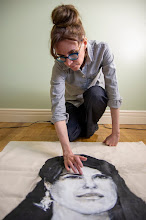
Image: Sunset with Words -- RFGA, 2013. Acrylic, embroidery, and gel medium, 48 x 50 inches. Reproduced in 2019 via fair use/dealing. Source: https://issuu.com/cheimread/docs/031314_ghada_amer_trif?mode=window&pageNumber=1

Friday, April 25, 2014

Size Matters: Sarah Lucas at Gladstone Gallery


“…gruff but poetic.”

Nud Nob at Gladstone Gallery in Chelsea, New York is British artist Sarah Lucas’ first show in the US in almost ten years.

Featuring large sculpted phalluses and phallic-shaped vegetables as well as sexually suggestive photographs, the exhibition provoked extensive gawking through the gallery’s glass doors when I was there. Of the people who entered the gallery proper, the least flummoxed was a girl around age six. Her only concern was that she wanted clarification about what the woman in the six massive self-portraits wallpapering a room was eating (answer: a banana). Also overheard was a man repeating, “It’s beautiful” when looking at an oversized phallic sculpture. In spite of the well established concept of penis envy, personally, I found myself thinking of the entry tags at the 1993 Whitney Biennial that said, “I can’t imagine ever wanting to be white.” When contemplating why she chooses this subject matter, Lucas says, “because I don’t have one” but cites plenty of other reasons that invite diverse interpretations of her work: “appropriation…voodoo economics; totemism; they’re a convenient size for the lap; fetishism; compact power; Dad; why make the whole bloke?; gents; gnomey; because you don’t see them on display much; for religious reasons having to do with the spark” (Coles, p. 51).

Lucas’ work is blunt, in keeping with the way she speaks. It’s gruff but poetic. As J. J. Charlesworth writes of her work from the 1990s (which includes said banana works as well as Chicken Knickers, the photo in full view from West 24th Street that superimposes a raw chicken on a woman’s panty-covered crotch), its sophistication lies in its vulgarity. Blush and turn away, though, and you might miss it.

One of the nuances is the evidence of the artist’s hand, and I don’t mean that in a Sarah Lucas-double entendre kind of way. Rather, the artist’s hand is revealed through asymmetrical forms and pockmarked surfaces that make for imperfect phalluses. Displayed on cubes of crushed metal cars, there’s a bit of a thumbing of the nose at machismo. Also, the evidence of labour differentiates Lucas’ sculpture from, say, minimalist sculpture (which was also very macho) and emphasizes the kind of labour that isn’t automatically associated with art made by a woman.

What you can’t miss, even if you stick to the street view, is the size of the works. It seems proportional to the cultural value assigned to sex and functions as a reference to the notion that bigger is better—an absurd ode to penis enlargers, breast augmentation, and big numbers notched on bedposts. There’s an element of playful pop mockery with the scale quoting Jeff Koons and Claes Oldenburg, but there’s a sinister quality too: if you’ve seen the movie, A Clockwork Orange, it’s unlikely you’ve forgotten a large white phallic sculpture used in a lethal rape scene of a woman.

There are smaller works as well that Lucas showed in the Venice Biennale last year. The Nuds series began as stuffed nylon stockings that stand in for human figures but look kind of like Gumby. Sometimes they appear with chairs, sometimes with toilets. Sometimes they are breasts, sometimes legs, sometimes intestines. The later versions in the show are bronze, like the large vegetables (which might be eggplant, zucchini, or butternut squash; whatever they are, they bring to mind urban myths of self-pleasure leading to hospital visits). The shift to bronze gives them a refined quality that announces, “I am Sculpture.”

As a Young British Artist who is not really so young anymore, being in her 50s, and somewhat androgynous in appearance, Lucas is well positioned to make audiences rethink the conventions of sexual desire by disrupting the privileged male gaze that has dominated art history. You might say she’s carrying the torch for the late Louise Bourgeois. Even so, the extent of the feminist dialogue she encourages has been debated. As a librarian, I have noticed that some of her articles are indexed only with ‘feminist art’ while many are indexed with practically everything but that. Her work has also been called ‘trash-feminism’. Although I have yet to encounter this term as a noun, I assume it to refer to artists like VALIE EXPORT, who entered a Munich movie theatre in 1968 wearing crotchless pants and taunting audience members. Lucas, in turn, has cut a hole in her shirt to expose her nipple in response to Marcel Duchamp’s
catalogue cover of 1941 and she has certainly used base materials to comment on sexuality in the past, like tabloid publications, cigarette buts, and old mattresses. Regardless of whether she’s a feminist, I feel an affinity with her because of her stance that we construct our reality and therefore, we should reflect on that process.

The exhibition closes tomorrow.


Sources:

Charlesworth, J. J. “Sarah Lucas Profile: From YBA to Classic Pervery—Making the Ordinary Extraordinary.” Art Review. Jan./Feb. 2013 http://artreview.com/features/sarah_lucas_profile/

Lucas, Sarah; Cook, Angus; and Fairhurst, Angus. Sarah Lucas: After 2005, Before 2012. Walther König, Köln.

Grayling, A. C. “An Uncooked Perspective on the Nature of Sex.” Tate Etc. Autumn 2005, issue 5.


Image: Installation view. Reproduced in 2019 via fair use/dealing. Source: https://gladstonegallery.com/exhibition/8487/#&panel1-4

Thursday, March 13, 2014

Shary Boyle at York University: Inspiring without re-traumatizing


“…an ‘urge to connect’”

Tuesday’s Goldfarb Lecture in Visual Arts at York University by Shary Boyle was standing room only, further to “tweets in the thousands,” as Professor Barbara McGill Balfour noted in her introduction.

Refreshingly down-to-earth, the featured Canadian artist in the most recent Venice Biennale closed the door herself when noise filtered in from the hallway, paused when latecomers arrived so they wouldn’t feel awkward, and—revealing what Murray Write called her “goofy repartee” in Canadian Art magazine (1)asked at one point, “How ‘bout that cave art?”

Boyles presentation was structured around her multi-media installation at the Biennale, providing a stylistic roadmap of sorts of how she got there. She began by sharing a film from the installation called Silent Dedication, in which an American Sign Language (ASL) interpreter signs a poetic tribute to “heroes of silence.” She cites Charlie Chaplin as an influence, calling his silent films “heartening and inspiring for keeping spirits up about humanity.” Characteristics of silent film and sign language dovetail with her art because she’s “always straining to tell a story…through gesture.” In fact, she revealed that if she weren’t an artist, she would like to be an interpreter (she has several years of training in ASL to boot).

She maximized the opportunity of exhibiting in Venice, using it as a platform to give voice to the silenced, from missing women to Pakistani activist, Malala Yousafzai. Author Sheila Heti, in describing an earlier work by Boyle, captured its essence: “…we are not merely looking at the woman here—we are the woman.” (2) Boyle explained, “I can’t speak on behalf of anybody but I can share.” 

Her approach in the Biennale installation, Music for Silence, can be traced to her tendency as a child of “finding solace in drawing” and recognizing loneliness as “exquisitely beautiful.” From a young age, she never wanted to be an artist for the sake of being an artist. She simply wants to make life more meaningful through communication. “Language is so fraught,” she observed. “Isn’t art a language?”

How does an artist transition from working out of her living room without assistants to being courted by Louis Vuitton and jet-setting to Venice to prepare an installation seen by 250,000 people? There are several answers. First, inertia. Boyle spoke of constantly pushing beyond her comfort zone and habits to “places that are mysterious.” As a primarily self-taught ceramicist, she finds enjoyment in “testing the limits of yourself and materials.” She collaborates in unconventional ways, like visiting the homes of grey-haired hobbyists to learn more about ceramics. “There’s no scene; it’s not cool,” she admits. Second, an openness to exploding the categories of art. She’s known for live drawing performances with projections of fantastical images and vivid colours complementing music of the likes of Feist and Peaches. These undertakings are driven by her admiration for the immediate impact music has on general audiences and from an “urge to connect” with practitioners of a form of expression sharing much in common with visual art. “There’s something about cross-disciplinary practice that is super-enlivening,” she says. Third, love your work, but not in an egotistical way. It would be fair to say that Boyle bonds with her work. When working with life-size sculpture, for example, she says, “You’re making a relationship,” akin to interacting with an actual person. She works from memory rather than photographs, with an appreciation for the “tenderness” that results from imperfections. She also aims to “belligerently ignore” the bias against craft because she “enjoys making things with my [her] hands.” Ultimately, in the face of trends and expectations, she says you have to think about how you want to spend your time as an artist.

As a feminist, she has made bold moves. For example, she has used unambiguous titles, like Intersex. She shared that gender has always been of interest to her. Rather than buy into the binary perspective of male-female, she asks, “Aren’t we all a combination?” Also, she “brought the taboo subject of rape into the museum” through a series of ceramics featuring mythological figures like Persephone, commissioned by the Art Gallery of Ontario.” Her work, while progressive and transgressive, is never too hard-hitting. “You don’t want to re-traumatize people,” she cautions.


This post is dedicated to Paul Kipps (1948-2014), an unforgettable professor. To borrow Boyle’s characterization of Chaplin, he was heartening and inspiring for keeping spirits up about humanity.


Sources:
(1) White, Murray. “The Mermaid’s Cave: Shary Boyle’s Path to the Venice Biennale.”  Canadian Art (2013 Aug. 2). http://www.canadianart.ca/features/2013/08/02/shary-boyle-mermaids-cave/
(2) Heti, Sheila. “No Walls.” In Boyle, Shary. Otherworld Uprising. Toronto: conundrum press, 2008, p. 68.


Image: Silent Dedication, 2013, stills, black and white 16 mm film, silent, 2:45 min. Written, directed and art directed by Shary Boyle; translated and performed by Beth Hutchison; film processed by John Price; photographed by John Jones. Reproduced in 2019 via fair use/fair dealing. Source: https://bordercrossingsmag.com/article/more-real-than-reality-an-interview-with-shary-boyle (Border Crossings image provided by the National Gallery of Canada).

Tuesday, February 18, 2014

Affects of Site: Conference on Site-Specific Art

“Affect is undeniable.”—David LaRiviere, PAVED Arts

This past week-end, Affects of Site took place on Nipissing Territory in North Bay, Ontario. Although I was unable to attend Clarke Mackey’s key note address on Friday night, I caught the panel discussions on Saturday featuring Susan Cahill, Sarah Cook, Serena Kataoka, Lieann Koivukoski, David LaRiviere, Steve Loft, Gil McElroy, Gram Schmalz, Laura Smith, Danielle Tremblay, and Dermot Wilson. For profiles, see http://www.affectsofsiteconference.com/#!speakers/cfvg.

Coincidentally, I was reviewing notes from the conference in tandem with preparing a lecture on conceptual art for a class I’m teaching this semester. The parallels between contemporary site-specific work discussed in the symposium and conceptual art a half-century earlier leapt off the page: the secondary status of the object, the active role of the spectator, the interest in semiotics, and the subversive tendency that is sometimes playful and other times utopian—all leading to questions about the relevance of the gallery system and the art market.

Site-specific art retains an element of dematerialization, often in spite of itself. For example, Sarah Cook recounted a work by Edouardo Kac she curated into a festival in Mexico City, consisting of a transgenic plant whose growth in a greenhouse was jeopardized by an earthquake. In a recent installation co-curated by Susan Cahill and Laura Peturson in North Bay, Jamie Latham’s water-filled jars featuring self-portraits were confiscated by police for chemical testing before anyone else saw them. One of Gil McElroy’s memory tables—angled picnic tables partially charred and inscribed with poetry—was only installed for an afternoon before it was stolen. Perhaps providing karmic balance is a visitor’s note scrawled on an LCBO bag pleading with passersby to not destroy a Toronto fort built over and over again with materials like rebar by Gram Schmalz and Laura Smith, dubbed the “end of the world crew” by locals (and known officially as the Physical Futures Initiative). Of course, some installations, like Ice Follies, are designed to be temporary. One morning, Dermot Wilson awoke with the vision that Lake Nipissing was like a blank canvas. Nine years later, the biennial on the frozen lake remains in full swing. Lieann Koivukoski called it “North Bay’s best kept secret,” and visiting the installations between sessions made for the best conference break I’ve ever had, personally.


Image: Drowning and Drowned Out in situ, by Jaymie Lathem. Courtesy of Near North Arts

A question that resurfaced throughout the day was whom art is intended to affect. The democractic answer need not be stated, but it was interesting to see the nature of that democracy teased out. Site-specific art maximizes audience, connecting artists and curators to a public largely unexposed to art historical rhetoric, or as McElroy put it, people who haven’t lost their sense of adventure or been trained to avoid excitement. It’s a place to move beyond what performance artist Laurie Anderson calls ingrown situations, to stop preaching to the converted. Cahill envisions a shared communal space where spectators don’t feel like they have to know the answer, but they can have their perception change as they enter the site. The word ‘can’ is important: spectatorial agency means that individual response is unpredictable. Site-specific art tends to have unstructured moments, as Schmalz noted, and there’s a range of potential aesthetic-affective responses. There were many stories of children being delighted, but in an era where Pussy Riot members could be jailed for performing in a church, I, for one, appreciate that the conversation wasn’t restricted to affects of pleasure. Serena Kataoka, for example, recalled visiting a men’s shelter with musical performers called the Subatomic Monks and experiencing sexual harassment that morphed into a positive jamming experience. She also described a peaceful protest on Queen Street in Toronto called Free Parking Space, during which she wore a cardboard car while cycling; it lead to criminal charges, which were ultimately dropped. It’s no wonder she eschews documentation of collaborative interventions. Similarly, when the Near North Media Lab took its trailer to Huntsville during the G8 summit to make work, Koivukoski said the group was under constant surveillance and that she’d never been carded so much in her life. Wilson suggested that art’s purpose is to improve the health of society, but these examples demonstrate that there’s no way to know whether it will take or not.

An example of a site-specific festival that the community really took to is Nuit Blanche, Toronto’s all-night art extravaganza. Steve Loft commented that every city seems to want their own version, which reinforces Cook’s observation that there is a “privilege of play.” So what’s a small city to do? In Sudbury, La Galerie du Nouvel-Ontario hosts an alternative art fair every other year. Some 30,000 people have taken in their installations, many from the driver’s seat of a car. Danielle Tremblay recalled that when she co-founded GNO and became its general director, they didn’t have walls for work so they went out into the community and co-opted spaces like billboards. “We were like dogs marking our territory,” she said, laughing. David LaRiviere is also a proponent of billboards in his role as director at PAVED Arts, featuring such gems as Karen Elaine Spencer’s postcards to Stephen Harper in a collaborative project with AKA. He has also pushed against the “flat affect” of advertising by putting his own work in public in the form of movie posters installed at theatres. Smith pointed out that there is a place for intimate festivals even in a large city like Toronto. The Queen West Art Crawl and Art on the Danforth can be refreshing because they don’t tend to be congested or to be associated with partying. The trick with small festivals, Koivukoski said, is that they may have a huge impact on a small community but the figures can appear inconsequential to funders who are comparing the population to larger centres. Furthermore, Tremblay noted that it’s challenging to demonstrate quality over quantity in these situations. Fortunately, from the organizer’s perspective, as David LaRiviere said, “Affect is undeniable.”

On top of the seemingly endless cycle of applying for and reporting on project grants, curators must act as cultural ambassadors to convince governing bodies that it’s a good idea to put art where the masses can see it. Also on the topic of negotiations, audience member Duane Linklater stressed that there should be consideration of the use of Indigenous land for site-specific work. Thus, cultural producers would do well to follow Gil McElroy’s lead in remembering the Hippocratic Oath (first, do no harm, etc.) when approaching site-specific work. Sensitivity to the history of places is complicated by the fact that, as Cook noted, there are “cartels of curators” traveling the globe, without a connection to specific locations. They may not, in fact, be associated with a particular gallery at all, demonstrating a shift from the traditional definition of curator as custodian of a collection. This may be for the best, as Cahill suggested that galleries aren’t necessarily the most accessible space. Yet, as Tremblay said, they’re unlikely to disappear, so curators may as well be imaginative in their use of the white cube. Even the educational responsibilities of curators are shifting, evident in the comments of the Physical Futures Initiative: Schmalz enjoys having spectators teach each other and Smith says that she and Schmalz have “learned so much from the non-artists.” Perhaps, then, curators have become more facilitators of artistic exploration.


Saturday, December 7, 2013

Hanging Man: The Arrest of Ai Weiwei

“…a natural raconteur…”—Barnaby Martin

In my recent SAMLA presentation about blogs functioning as extended artist statements, I briefly discussed renowned Chinese artist and political activist, Ai Weiwei, who used to blog up to eight hours a day. Leading up to the conference, I wanted to bone up on the details of his baffling detention, so I picked up Hanging Man: The Arrest of Ai Weiwei (Faber and Faber, Inc., 2013). It reiterates the basics reported by the media, namely that the government had kept a close eye on his activism, brought him in for questioning without revealing charges to the public, and released him 81 days later, citing tax fraud as the motivation. The book goes much deeper, showing that Ai is no stranger to controversy and that his interest in democracy and artistic freedom is well founded. For example, it describes the Stars group of which Ai was part. After their show of paintings outside the national gallery was declared illegal in 1979, Ai decided to move to New York, which he described as ‘another world’ (p. 161).

“Come and visit and we can talk about everything,” Ai said a few days after his release in July 2011 to Barnaby Martin, the journalist who wrote Hanging Man. Since Ai took an oath saying he wouldn’t talk to the media, this offer is really something. A British expat who has been based in China for many years, Martin brings the perspective of an outsider, but one who also knows the culture intimately. The local colour (example: “pancakes filled with chopped lettuce and meat of unknown provenance” served from a bicycle with a hotplate attached—p. 151) may make you want to visit China…that is, if you aren’t worried about being stopped at the airport, being told your travel plans “may damage the state security” (p. 81) and being taken to a shabby hotel and later a military compound in a van, while hooded and struggling to breathe.

The book weaves in and out of the author’s face-time with the artist. It’s not actually until page 70 that Martin gets to his chat with Ai after his release. He is skilled at building anticipation, delaying the coverage of their union by giving a detailed account of how he hoped to approach the interview and recounting earlier interviews he had had with the artist. Martin describes Ai as “a natural raconteur with a colourful turn of phrase” (p. 78). This quality and Ai’s excellent memory are maximized in the interview.

You might say that Ai came by his situation honestly: early on in his incarceration, he was told he was being charged with subversion of the State, the same crime as his father, Ai Qing, one of the most famous Chinese poets, whose works were practically required reading for the Chinese Communist Party before he fell out of favour with Mao Zedong. Martin observes that the lives of Ai Weiwei and Ai Qing are “intertwined with the great people and events of modern Chinese history” (p. 12), and that perspective informs the structure of the book. The exposition of Chinese history in Hanging Man occurs in fits and spurts, not necessarily in order. Surprisingly, the result is not disorienting; if anything, it maintains the reader’s interest, and prevents the urge to simply skip past a section on background. Historical content from the last century includes the collapse of the Qing dynasty in 1911; the 4 May movement of 1919; the establishment of the Chinese Communist Party in 1921; the Chinese civil war (1927-50); the anti-intellectualist purge of 1958 that coincided with the Great Leap Forward; the Great Proletariat Cultural Revolution of 1965; the failed assassination attempt of Mao Zedong in 1971; the Tiananmen Square massacre of 1989; and the Falung Gong demonstration of 1999. Events such as a the latter (where a silent protest led to individuals being abducted en masse and allegedly murdered, forced into hard labour, or institutionalized) read as harbingers, making the artist’s recent experience less baffling, though no less disturbing.

Martin does an equally good job of distilling complex political situations for the non-specialized reader (like the virtually non-legal status of the Chinese Communist Party) as he does deconstructing the meaning of Ai’s conceptual art pieces that encompass photography, sculpture, installation, architecture, and social media. This process subtly parallels Ai explanation of modern art and democracy to his prison guards, with whom he developed a curious bond. It brings to mind yesterday’s news coverage following Nelson Mandela’s death, in which his prison warden-turned-friend recounted sneaking Mandela’s baby grandaughter past security cameras so he could meet her. Martin is intrigued by this relationship, arguing that Ai may be exhibiting Stockholme syndrome or that the guards received orders to treat him well, knowing the whole world was watching (since some of Ai’s colleagues have not come out unscathed as he did). Martin also acknowledges the sympathy that an author can develop from spending time with someone who has experienced injustice, and describes the conversations as emotionally exhausting. For the most part, he seems to have retained the burden, producing a measured account of Ai’s experience with the police.

Hanging Man is recommended for a general audience as well as academics with an interest in art, criminal justice, or Asian studies. Image: reproduced in 2019 via fair use/dealing. Source: https://www.faber.co.uk/9780571280469-hanging-man.html

Saturday, November 9, 2013

The Blog as an Extended Artist Statement

“What, exactly, is a blog? This question is our contemporary moment’s shibboleth.”—Jonathan T.D. Neil, Sotheby’s, Los Angeles

Yesterday, at the South Atlantic Modern Language Association conference in Atlanta, Georgia, I served on the panel called, Making Feminist Meanings Across Worlds: Print, Digital, and Networked Feminisms and Women’s Studies. The following is a shortened version of my paper, “The Blog as an Extended Artist Statement.”

Renowned art critic Jerry Saltz says, “You may think your work is about daffodils; I think it’s about scrambled eggs” (1). As a feminist artist, I don’t want to risk this type of misinterpretation, so I rely on language to supplement my art practice. Many artists feel that a one-page artist statement will suffice to explain their work, but to play it safe, I’ve written Artist In Transit, an 85,000-word blog.

Digital sociologist Karen Evans writes that in the mid-90s, theorists were generally hopeful about the digital age. They perceived it as an opportunity for traditional communities to be “superseded by open, democratic, placeless cyberspaces in which equalities of wealth, class, gender and ethnicity had no purpose” (2). A few years later, blogs appeared, and took on this challenge.

In May 2009, the same month I started my blog, the power of social media to spur social activism was underscored when a blog by Chinese artist Ai Weiwei was censored, removing three years’ worth of posts critiquing the government. He was later held in police custody for 81 days, arguably related to his activism. Going back to 2009, feminist art blogging was uneven: that year, Mira Schor lamented that at times, the contributors lacked professionalism and accountability (3). My goal was to be an exception, especially because I intended the blog to be a tool for tenure consideration as an academic art librarian. In my presentation, I spoke not from the perspective of a librarian but from the perspective of a feminist artist, touching on the capacity for blogs to promote art and art criticism, to spur new art ideas, and to encourage networking within the real and virtual art world. “An artist’s statement….gives you validation [and] visibility,” (4) and I feel that blogs can function in a similar way.

Before exploring these topics, I started with the basics: What is a blog? What is an artist statement? Jonathan T.D. Neil, Sotheby’s Director in Los Angeles, writes, “‘What, exactly, is a blog? This question is our contemporary moment’s shibboleth.” (5) Perhaps an easier definition to start with, then, is that of the artist statement. Definitions of the term ‘artist statement’ are plentiful and varied, but I particularly like this one by curator and art historian G. James Daichendt: “Usually a testimony of the interests, background and goals of the artist, this document explains, justifies, or contextualizes the work of the artist…The best artist statements prepare viewers to enter and engage the work.” (6) When I started my blog, I set out to capture elements that studio professor Deborah A. Rockman associates with artist statements, namely the sources of art ideas, ranging from favourite artists to influential books and articles (7).

Artist statements resemble blogs in several ways, making for a reasonable comparison: art critic Edward Sozanski notes that artist statements reveal the psychology and personality of the artist (8) and curator Lydia Yee feels that artist statements are “an opportunity to tell a story” (9). The story I planned to tell with my blog was how my art ideas developed. Initially, to borrow the phrasing that came out of a study at Rutgers University, I was more of a ‘meformer’ than an ‘informer’ (10). As the scope of the blog broadened to include art criticism of shows relating to my own work, it became something of a feminist soapbox.

The challenge in writing about gallery shows is that as artist Kate Britton says, “social media and networked culture has rendered everyone a critic” (11). Experts waver on whether a blog is a legitimate venue for art criticism and artistic expression. However, the two artists mentioned earlier are indicative of the credibility of blogs: in 2010, Mira Schor received a Creative Capital/Warhol Foundation Arts Writers Grant to develop a blog for a year about her art as a counterpart to her latest book, and in 2011, Ai's translated posts were released as a book and endorsed by curator Hans-Ulrich Obrist and by the directors of the Tate Modern (Chris Dercon) and Yale University Art Gallery (Jock Reynolds). My hope is that if I can write well-considered, thorough reviews, people will give my studio work a chance. Although personally, I find that blogging distracts me from creating art, I do believe there’s merit in the strategy undertaken by senior artist Denise Green; long before the 2.0 era, she began writing about art to establish credibility in an art world divided by gender (12).

The blog is a way to motivate myself to keep on top of what’s happening farther afield, but it’s also a way to let outsiders know what’s happening in North Bay’s small but vibrant arts community. Some days, it feels like the return on investment is minimal, but lately, as a result of promoting others online, I have developed unanticipated and fruitful connections locally. These experiences demonstrate the importance of keeping the ‘meformer’ impulse in check, and demonstrate what Hrag Vartanian, editor of the arts blogazine, Hyperallergic, says: “The online world is as much about giving back as it is getting. And if you think you’re going to put something out there because you want it back immediately, then you are not going to get it back. But if you help people online…you’re going to get it back tenfold” (13).

Sources:

(1) Qtd. by Wojak, Angie and Miller, Stacy. Starting Your Career as an Artist. New York: Allworth Press, 2011, 18. Print.
(2) Evans, Karen. “Re-thinking Community in the Digital Age?” Digital Sociology: Critical Perspectives. Eds. Kate Orton-Johnson and Nick Prior New York: Palgrave Macmillan, 2013. 79-89, 82. Print.
(3) Schor, Mira, A Decade of Negative Thinking. Durham: Duke University Press, 2009. Print.
(4) Wojak and Miller, 131.
(5) Neil, Jonathan T.D. “Can I get a Witness?” Art Review, Oct. 2011, 139. Web. 1 Aug. 2013.
(6) Daichendt, G. James. Artist Scholar: Reflections on Writing and Research. Bristol, UK: Intellect Ltd., 2012, chapter 4. Web. 1 Aug. 2013.
(7) Rockman, Deborah A. The Art of Teaching Art: A Guide for Teaching and Learning the Foundations of Drawing-based Art. New York: Oxford University Press, 2000, 131. Web. 1 Aug. 2013.
(8) Qtd. by Grant, Daniel. The Business of Being an Artist. 3rd ed. New York: Allworth Press, 2000. Web. 1 Aug. 2013.
(9) Nieves, Marysol, ed. Taking Aim! 1st ed. Bronx, NY: Fordham University Press, 2011. Print.
(10) Naaman, Mor, Boase, Jeffrey and Lai, Chih-Hui. “Is it really about me? Message content in social awareness streams.” CSCW ‘10. February 2010: 189-192. Web. 1 Aug. 2013.
(11) Britton, Kate. “Social Media in Contemporary Art.” Das Platforms Emerging & Contemporary Art, 21, 2011. Web. Aug. 17, 2013.
(12) Green, Denise. Denise Green: An Artist’s Odyssey. Minneapolis, MN: University of Minnesota Press, 2012. Print.
(13) Nieves, 229.

Thursday, November 7, 2013

Anita Steckel at the National Museum of Women in the Arts

“Not one to mince words…”

This week, Exposure: Anita Steckel’s Fight Against Censorship opened at the Betty Boyd Dettre Library and Research Center within the National Museum of Women in the Arts (Washington, DC). En route to a conference in Atlanta, I made a four-hour detour to visit this archival exhibition. Steckel (1930-2012) was a Second Wave feminist artist and educator. Her personal papers were donated to the NMWA, and excerpts are on display until May 9, 2014.
Steckel was an easy target for censorship, because of the directness and brazenness of her work. Consider the collaged piece from 1971 in the exhibition: a colour reproduction of the American $1 bill, it had ‘Legal Gender’ handwritten along the top and Washington’s face enclosed in the shaft of a sketched penis. Equally ‘to the point’ is a photograph with an altered New York skyline. Skyscrapers are extended by Steckel’s hand with their rooftops converted into phallic heads--as if anticipating a plot on How I Met Your Mother in which the character Ted gets his big architectural break by pitching an alternative to a design that looks like a penis with its pink colour, apex, and bulbous forms at the base. Another cityscape, pictured here, shows the Empire State Building as a shaft being straddled.

At Steckel’s 1972 exhibition at Rockland Community College, “one of the less controversial works,” as The Journal News put it, was a Statue of Liberty postcard, on exhibit now at NMWA, containing a hand-drawn female symbol emerging form the fiery torch. The newspaper included an image of said work, but not the more contentious images featuring male and female genitalia. Legislator John Koman wanted to shut the show down for its reportedly pornographic nature, but after a closed meeting of trustees and pushback from students, the artist was victorious. In an unsurprising move based on the show’s title, The Sexual Politics of Feminist Art, Steckel used the experience as a springboard for forming the Fight Censorship Group. Its members included Hannah Wilke, Louise Bourgeois, Joan Semmel, and others. In its ten years of activity, they did things like pressure curators not to follow Koman’s lead, and petitioned major New York museums to open Adult Galleries, where the proverbial fig leaf could be ripped off. Like the Guerilla Girls, they were angry about the disproportionate number of female nudes to male nudes in museums, appealing to the male gaze. Steckel writes in a statement for the FCG, “If the erect penis is not wholesome enough to go into museums—It should not be considered wholesome enough to go into women.” Not one to mince words, she wrote that artists must operate in absolute freedom from censorship, to protect the right to produce works like “the open-legged whores of Toulouse-Lautrec.” She writes of the “white-gloved hypocrisy—which pretends we [women] don’t even know what is meant by a ‘dirty joke.’ Don’t know—hell—we’re the entire subject matter of all those ‘jokes’ we’re not supposed to know the meaning of.”

Her 2006 journal indicates that her dedication to the cause never wavered. She wrote, “Don’t turn lemonade into a lemon” and, “Risk Everything/ Be a Warrior.” Although she did not receive critical acclaim in her formative years as an artist, in 2006 she was mentioned in the catalogue for the high-profile exhibition, WACK! Art and the Feminist Revolution, even though she wasn’t included in the show itself. The NWMA wall text notes that this catalogue essay revived interest in her work. Indeed, in 2007, the New York Times described her as having been overlooked for too long (1). The wall text also credits the Fight Censorship Group with having created a more accepting atmosphere for women artists’ provocative works.” To Steckel et al., I say thank-you.


Sources:

(1) http://www.nytimes.com/2007/03/09/arts/design/09art.html?pagewanted=print&_r=0 March 2007. Museum and gallery listings. Image: Giant Woman on Empire State Building, 1973; NMWA’s Betty Boyd Dettre Library and Research Center; Courtesy of the Anita Steckel Estate. Reproduced in 2019 via fair use/dealing. Source: https://blog.nmwa.org/2014/01/28/anita-steckel-fighting-censorship-and-double-standards/