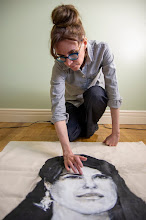
“Martha Ann Honeywell...was born without hands, yet she worked for 50 years sewing and producing silhouettes with an arm stump, her feet (with only three toes on one foot), and her mouth. Talk about a role model for me as I convalesce.”
A full season has passed since my last blog post, but my excuse is much better than lying on the beach: I have been busy narrowly avoiding paralysis and death as a passenger in a harrowing roll-over automobile crash, to say nothing of learning to walk again.
Early in my hospital stay, I was shown a photograph of my face. Two bloodshot eyes stared blankly back at me. No, not bloodshot—blood-filled; the whites had been eclipsed by a brilliant shade of cranberry. Surrounding my eyes were two purple shiners, aptly called Battle signs. The cranberry-purple combination caused children and adults alike to recoil. Eventually, the bruises migrated down my face, drooping into concentric oblongs suggestive of skin melting. It was an illusion exacerbated, at least in my mind, by skin hanging off of my bones as my weight plummeted to double digits. My unintentional gauntness caused the adult diapers I was given—designed for someone twice my size—to feel further undignified. In the intensive care unit, I made the physiotherapist chuckle by saying I wanted to make t-shirts that said, 'dignity is overrated.' It was a perspective I developed while prioritizing (read: trying to survive).
Once I was well enough to reach the restroom, I looked in the mirror but didn’t recognize myself. Then again, I couldn’t see anything clearly, since airbags had snapped my glasses in half. Curiously, I hadn’t noticed I was without glasses when I regained consciousness in the car, but I was in shock and fixated on the heinousness of dirt in my mouth. When I finally selected a replacement pair, I still didn’t look right. Even now, when someone compliments my frames, irrationally, I feel wounded. Adding to my probable dysmorphia is the fact that I couldn’t twist my torso after surgery to style my naturally wavy hair, so I got a perm. The curls look uncharacteristically tight and no amount of conditioning makes me feel like my former self. I keep having my hair cut shorter and shorter to get rid of it, and in turn, I dissociate from my appearance. At one hair appointment, I finally felt--with relief--an affinity with my appearance when I was seated in a different area and my reflection was spread across multiple tiny mirrors and fractured, like me.
I decided to buy a few accessories and items of clothing to perk myself up. But then I kept spending. I bought an Alexander Wang top with a partially open back revealing almost the whole spine, forgetting the six inch incision a surgeon made to stabilize my severe lumbar brake. (One broken bone per person is to be expected from crashing with the same force as driving off a 12-story building). By the time I remembered my scar, the garment was no longer returnable. I purchased, and kept, a BCBGMAXAZRIA dress in two sizes because who knew what size I was, really? These garments were second-hand, but still... On week-ends, I awoke at 6 am, eager to discover what online deals I might score. I withdrew from friends and allowed myself to see a collection of amiable hand-written notes from online sellers as evidence of a social network. Because I had survived against all odds, I imagined that it must have been for a reason, and the related pressure to do something meaningful (or more meaningful?) with my life was crushing. So, by shopping, I embraced the most superficial aspect of myself--although I do consider fashion/style an art form. How could I not, as a former textiles student? The truly embarrassing thing is that I embarked on this slippery slope after reading the tell-all post by stylist Stacy London about almost going broke further to having the exact same surgery. I read it and actually thought, "Shopping sounds like a good idea." That I nearly succumbed to the endorphins and dopamine associated with shopping while changing up nearly half of my wardrobe is ironic because I was ultra-responsible about withdrawing from opiates to avoid a well-known addiction risk.
When I spotted Black Out: Silhouettes Then and Now (Princeton University Press, 2018) in our new books display, my eyes welled up. Not only had I gotten black eyes when I blacked out, but pitch-blackness prompted a flashback the first night I was home from the (always bright) hospital. Awakening in the night unable to see anything, I thought I was trapped in the car again; when I realized I was safe, I was a split second away from emitting a series of five screams that had queued up in my throat. Moreover, when I encountered this book, it was as if I sensed the inclusion of relatable passages like “...vanished into the vacuum of her silhouette” (p. 57)--relatable because in addition to the details I have shared thus far, I had lost track of the number of times my personhood was flattened and reduced to black and white as I was shunted painfully onto a wooden board for an x-ray or MRI. Thank goodness this catalogue began to shift me from a vortex of interchanging self-images into the more intellectual and frugal past-time of reading.
I brought the catalogue home, but I felt unable to even peek at the introduction for two weeks, as getting back to enjoyable activities like blogging would signify moving forward. All along, though, I have told myself that I cannot get stuck for long. Another two weeks passed before I read the essays within, finishing them in an afternoon because they were so compelling. The next day (today), before I read the final section of didactic texts for works in the associated exhibition, I was reminded that it’s the one-year anniversary of the white nationalist rally that turned deadly in Charlottesville. (Activist Heather Heyer died after being hit by a car, and shortly thereafter, Lieutenant H. Jay Cullen and Trooper-Pilot Berke M.M. Bates died while monitoring the scene from a helicopter). Because race is a recurring theme in Black Out, today feels like the perfect time to come out of the shadows and resume my role as one of many bloggers seeking social justice. So, more on this fantastic catalogue...
Image: August Edouart (French, 1789-1861), The Magic Lantern, 1826-61, cut paper and wash, image: 9 1/2 x 13 3/8 in. (24.2 x 33.9 cm), sheet: 10 1/4 x 13 1/2 in. (26 x 34.3 cm). Bequest of Mary Martin, 1938. 38.145.392. Source: https://images.metmuseum.org/CRDImages/dp/original/DP141861.jpg; in public domain.
Before the advent of photography in 1839, silhouettes were a widely and wildly popular memento in the United States. In the late 18th Century, varied subjects, such as European settlers, Native Americans, and enslaved or formerly enslaved people, began to have their contours traced onto paper and cut out. The small portraits existed at the liminal divide between art and craft because they could be produced for only a few pennies and in a range of settings, from taverns to art galleries, by both artisans and artists. Techniques also varied: some silhouettes were produced by candlelight, and others had greater precision thanks to a machine called the physiognotrace.
As a democratic art form, silhouettes could even be generated by the subject. However, to have one’s silhouette made by another hand introduced a performative element, functioning as a means to construct self-identity, which was important in an era of asserting political independence, as argued by Asma Naeem, Associate Curator of Prints, Drawings, and Media Arts at the Smithsonian National Portrait Gallery, who organized the Black Out exhibition. My phrasing of ‘another hand’ isn’t entirely accurate, incidentally. One of the better known silhouettists, Martha Ann Honeywell, was born without hands, yet she worked for 50 years sewing and producing silhouettes with an arm stump, her feet (with only three toes on one foot), and her mouth. Talk about a role model for me as I convalesce.
As Naeem points out, at a time when slavery was contested, oddly, an aesthetic flourished that rendered everyone black. That’s not to say there weren’t racialized differences in representation. For example, superfluous details were added by the best known silhouettist, Auguste Edouart, to depictions of white people, like props of sophistication (tea cups, sheet music, etc.). In contrast, depictions of enslaved people, which were made for reasons like aiding recovery if they escaped, featured minimal physical attributes. Also, the identities of enslaved people were often obliterated in silhouettes, as demonstrated by the scrawling of “Mr. Shaw’s Blackman” above a portrait. Abolitionists tended to promote their cause by referencing silhouettes of enslaved people with details added using chalk or colored pencil, representing some recovery of identity. There were also occasional celebratory silhouettes of African Americans, such as Rev. Abssalom directly, the first African American Episcopal priest. Another example of limited celebration is the art historical oversight of contributions by silhouettist Moses Williams, a former enslaved person. Although he produced tens of thousands of silhouettes with the physiognotrace, attributions to him have been lacking.
The history of silhouettes in scholarly essays by Naeem, Penley Knipe, Alexander Nemerov, Gwendolyn DuBois Shaw, and Anne Verplanck provide context for the four contemporary artists featured in the Black Out exhibition: Kristi Malakoff, Camille Utterback, Kumi Yamashita, and Kara Walker.
The catalogue’s design, by Ray Brooks (Fold Four, Inc.) is noteworthy. Black matte paper, similar to what would be used for silhouettes, is included in the front and back matter (before the half/Bastard title and after the colophon). The catalogue title is cleverly written in a font without negative space (there is no triangular space for a capital ‘A,’ for example), as is the title of each essay. Although silhouettes would translate well into black and white, they are included in full color. The images are of a generous size, often bleeding to the edges or occupying a portion of the accompanying page. There are some gems, like a lesbian double portrait in which two life partners face one another, and Edouart’s complex work, The Magic Lantern (1826-61), containing 10 silhouetted figures, which is featured on the inside front and back cover and opposing pages.
Thank-you for reading. It’s good to be back.
Top image: Gearing up for an 8-hour ambulance ride. Outside for the first time in over a week, I am trying to take in the sights through my sister's old pair of glasses, and delighting in the fresh air.
Sunday, August 12, 2018
Sunday, March 11, 2018
Our Anthropocene: Eco Crises at the Center for Book Arts
“...collect data ‘to demonstrate that you can.’” ~ Heidi Neilson
Nor’easter be damned, the roundtable discussion on March 2 at the Center for Book Arts in New York with artists Nuno Henrique, Heidi Neilson, Tara O’Brien, and Ian van Coller went on as planned. My windswept hair and soaked jeans proclaimed the power of the natural world—a fitting complement to the current exhibition and theme of the evening, Our Anthropocene: Eco Crises.
In the Latin-derived word, ‘anthropocene,’ the root meaning ‘human’ has elbowed its way to the front of ‘cene,’ which conveys geological time. Indeed, the current geological age known as the anthropocene is defined by humans, for better or for worse. The show’s curator, Gary van Wyk, commented, “There comes a point where it’s our presence that affects things,” citing as an example plastic on beaches that has become embedded in rock formations and created an unnatural hybrid. My mind flashed back to stones from an Italian beach that I pocketed in my twenties. I continue to be transfixed by the shards of rooftops from the cliffside wedged within, their rough edges smoothed over time to appear completely normal. When van Wyck shared his example, my souvenirs that travelled full-circle by being displayed back in my house struck me not as free but as representing a hidden cost.
Van Wyk cautioned the audience, “We’ve created an era that threatens our existence on planet Earth.” He identified a host of environmental issues that warrant our attention, from disappearing species to the contamination of the food supply. He observed that the poignancy of the works in the exhibition encourages the contemplation of environmental concerns. Executive director and Center for Book Arts curator Alexander Campos echoed this sentiment, stating that the works in the show have captivating power and tackle important issues, not to mention being “aesthetically wonderful.” Van Wyk added that given some politicians’ dismissive attitude about science, artists’ roles are especially important. Artists can interface with scientists to connect audiences to otherwise inaccessible concepts. Whether employing strategies like beauty or propaganda, van Wyk asserts that artists “can...have quite a substantial impact.”
When Philadelphia-based Tara O’Brien was asked if she felt hopeful about the environment, she replied that she tries to live responsibly, minimize her ecological footprint, and not think about it too much. In terms of the latter comment, she is actually incredibly thoughtful, having created powerful conceptual bookworks, which she shared with the audience. The exhibition features Documentation (2 Volumes) (2005), a book-like structure consisting of rectangular Plexiglas enclosures, intended for the planting of grass seeds. She mused that it would be terrible if the only way to experience grass were through a book. She elaborated that people should experience grass in various ways, like whistling with a blade between one’s thumbs. In Natural Elements, also from 2005, she exhibited an ice sculpture in the shape of a book. Once it melted, viewers could only take in the work as a pool of water. In making the work, she pondered how glaciers—for which the work is a metaphor—would be explained after they disappear entirely. As a book conservator, she witnesses decay and the power of intervention on a regular basis. She is particularly taken by old atlases, expressing fascination with the way people use to think and how they managed overall. “Today, we have science and still can’t figure out [so much],” she lamented. She wants viewers to reflect on “how much we need to work and take care of it [the natural world].” This impulse relates to her former vocation as an educator. Her experience teaching informed the creation of a book made from soap that was inscribed the words, “Knowledge is Power, Knowledge is Dangerous.” Chillingly (I say as a librarian), she offered viewers the opportunity to wash the words away.
Ian van Coller has been “obsessed with books” since college, so it is not surprising that he became a book artist. The biggest book he has made, Kilimanjaro: The Last Glacier (Doring Press, 2017) which is 50 inches wide, is on display in the exhibition and is pictured here. With this folio size, he wanted to mimic the effect of visiting a glacier since many people will never witness one firsthand. Providing a version of that experience encourages people to care about the vulnerability of glaciers. The degree of melting “is truly astonishing,” van Coller says, “right before our eyes.” At Kilimanjaro, he predicts glaciers will be present for only another 30 years. When they are gone, “it will be such a loss.” He describes glaciers as “the ultimate archive” because they reveal change over time, much like trees and coral. Van Coller began his photography career working in portraiture and he brings that earlier focus to bear in Kilimanjaro: The Last Glacier. Interspersed with gorgeous photographs of glaciers are portraits of the native Tanzanian porters who carried travel gear—including a toilet—for himself and his scientist-collaborator, Douglas Hardy, up Mt. Kilimanjaro. Although based in Bozeman, Montana, van Coller was raised in South Africa, and his upbringing affected his experience of the racial dynamic. He felt uncomfortable because of the “very colonial” sensation of having people of color serving van Coller and Hardy, and he included their portraits to honor their work. Van Coller commented that art and science used to be strongly connected but now, science has become “very narrow.” He wants to help scientists—whom he sees as natural artists—become artists again. If the two groups seem distinct, consider that he sees them both as problem solvers.
New York-based Heidi Neilson stated that she wants to “connect planets and people.” Although it sounds like a lofty goal, she described exactly how she has delivered. For example, in 2007, she co-founded SP Weather Station with Natalie Campbell. From the rooftop of Flux Factory in Long Island City, this interdisciplinary project enabled visitors to collect weather data to supplement the institutional gathering of data. They offer related programming, like a fundraiser for an air quality monitor, with cheekily named items like Ozone Holes: Donuts for the Future. The project is an example of “citizen science,” which Neilson described as the prerogative of lay people to participate in research that becomes part of the scientific record. She wants to collect data “to demonstrate that you can.” Referring to Neilson’s work, van Wyck observed that there can be a performative component of activism. The work exhibited at the Center for Book Arts, Beachball Antennas (2016), is an example: Neilson “hit the beach” to interact with passersby, but not with typical beachballs. She “performed beach ball surgery” by adding antennae to receive weather data through HAM radio signals. Using weather-to-image software, she displayed the results on a laptop for visitors in what she described as pop-up installations. Her work demonstrates van Wyk’s stretching of the concept of artist books for the exhibition, which he mentioned in the introduction to the roundtable. Overall, though, her oeuvre relates to the print tradition. For instance, she commented that our storage of data has changed, as it used to be contained in books and is now primarily digital. This is a concept she has explored in works like Outernet Library Branch Wave Farm (2016), which included a single print book (about libraries), with the rest of the featured content being exclusively digital and decidedly outside of the Internet. The artist's website explains that https://outernet.is is "an expanding library collection of data broadcast from a network of satellites in space...[that] allows its users to participate in the selection of what it contains. An outernet library receiving station collects transmissions and stores files locally...[to be] accessed by witeless devices within range of the station." This intriguing work is relevant to the current threat to net neutrality.
Nuno Henrique, also a New York-based mixed media artist, has three works in Our Anthropocene. His work is rooted in his birthplace and previous home, Madeira Island in Portugal. He is fascinated by its history, such as the fact that the ancient forests managed to survive the ice age, but almost became extinct under colonial Spanish control in the 15th Century. Today, only a sliver exists. Henrique’s work is a retrospective archive of sorts, as he has made botanical drawings of numerous species from the forest, such as flowers and fruits, in addition to depicting subjects from the animal kingdom like snails. He emphasized that it “is important to create this memory” as a record of what is lost. He is especially interested in the island’s dragon trees (Dracaena draco), which became extinct after its sap was relied on for dye and medicine. Because his work is about obsolescence, he said, the tone is more elegiac than scientific, even though it is based on research. To reference the past, he has studied manuscripts and maps from atlases from the period of colonial control, and he uses older techniques like calligraphy. The harshness of the history of the forest contrasts the intricacy of his work, whether in calligraphy or in subtle contours delicately carved out of paper that underscores why he considers his artist books to be sculptural. Although he said, “our time will come” because scientists have warned it’s already too late, paradoxically, he remains hopeful that “there are solutions in science.” Since he calls the forest a “space for meditation,” it seems the answers may be contained there as well.
Our Anthropocene runs until March 31. Other exhibiting artists besides Henrique, Neilson, O’Brien, and Van Coller are the Alma Collective (Christoph Both-Asmus/ Owanto/ Robbin Ami Silverberg/ Andreas Wengel/ Hervé Youmbi), Thorsten Baensch/ Karin Dürr/ Carolin Röckelein/ Zoe Zin Moe, Sammy Baloji, Julie Dodd, Stephen Erasmus, Daniel Knorr, Guy Laramée, Gideon Mendel, Barbara Milman, Sara Parkel, Susan Reynolds, Shu-Ju Wang, Käthe Wenzel, Thomas Parker Williams, Michelle Wilson, and Philip Zimmermann. The exhibition catalog is available through pre-order.
Photo: top - l. to r.: Ian van Coller, Nuno Henrique, Gary van Wyk, Heidi Neilson, and Tara O’Brien.
Labels:
Gary van Wyk,
Heidi Neilson,
Ian van Coller,
Nuno Henrique,
Tara O’Brien
Tuesday, January 30, 2018
Dana Schutz and Nell Painter in Conversation at the Cleveland Museum of Art
“Don’t leap to simple answers. Stick with it!” ~ Nell Painter
On January 20—the day following the crowded opening of Dana Schutz’s Eating Atom Bombs exhibition at the Transformation Station in Ohio City—the Cleveland Museum of Art hosted a discussion between the artist and Nell Painter. Schutz has ties to Cleveland as an alumna of the Cleveland Institute of Art. She is perhaps best known as the creator of the controversial work, Open Casket (2016), which is a posthumous portrait of 14-year-old, African American Emmett Till, whose 1955 murder inspired Rosa Parks’ civil rights activism shortly thereafter. A resident of Chicago, Till was abducted and lynched by white supremacists while visiting family in Mississippi because of his perceived flirtation with a white woman. Till’s mother wanted the world to see his battered body; JET magazine published images from the funeral home and temple and authorized reproduction in several publications that--like JET were geared to black readers. Schutz, who is white, based the portrait on JET’s documentation.
When Schutz was lambasted for the painting, she was defended by Painter, who is an artist, the author of The History of White People (W. W. Norton & Co., 2010), and the former director of Princeton University’s African American Studies program. Public protest began at the opening of the Whitney Biennial curated by Christopher Lew and Mia Locks when African American artist, Parker Bright, stood in front of Open Casket to prevent others from viewing it while wearing a t-shirt that said, “Black Death Spectacle.” Self-described mixed black artist Hannah Black then wrote an open letter signed by multiple artists, calling for the painting’s removal and destruction so that it would not enter the art market. (Schutz has clarified that this work from her personal collection is not for sale). Tension escalated on both sides, especially online, with Schutz’s email account being hacked and a falsified apology published online, and the hashtag #FreeDanaSchutz emerging.
The CMA event was Schutz’s first public appearance since the aftermath. CMA Director of Education and Academic Affairs, Cyra Levenson introduced the “historic conversation,” highlighting the museum’s commitment to providing a “safe and brave space” to engage with art and artists. Reto Thüring, co-curator of Eating Atom Bombs with Beau Rutland, emphasized the museum’s responsibility to present a forum to create dialogue, even if revisiting this “impassioned debate” is painful.
My motivation in summarizing this conversation is to provide a written record for research purposes, to contribute to our understanding of socialcultural evolution.
Painter and Schutz discussed another work in the biennial briefly, THE TIMES THAY AINT A CHANGING, FAST ENOUGH! (2017) by black artist, Henry Taylor, which depicts Philando Castile after being shot fatally by a Minnesota police officer at a traffic stop while reaching for his identification. Just as Painter pointed out that Taylor’s work is art and commentary, Schutz’s work falls into both categories. It follows that the controversy was two-fold: the fact that Schutz made the painting in the first place, and the manner in which she depicted Till’s visage.
Painter and Schutz debated the familiarity of the photographic image to the general public. Schutz commented that it has a large presence but Painter countered that the source photo “is not a huge document in the world,” though ironically, Schutz has given it a larger presence. Painter opined that in 1955, “what happened to black people wasn’t considered the news.”
Some criticism of Open Casket has been tied to assumptions about the truthfulness of photography. Painter, who has incorporated photos in her mixed media work about race and gender, questioned this association. She stated that photographs capture a moment or part of a moment, or a particular vantage point, but they aren’t the whole truth. Therefore, she is troubled by the charge that Schutz’s representation of Till is “somehow not true” because of its departure from the source through gestural abstraction. Schutz shared that she doesn’t look to paintings for historic truth. She mentioned Jacques Louis David as an example of artists deviating from reality. Although she didn’t have an opportunity to expand, David made numerous adjustments for his patron, Napoleon Bonaparte, like who was present for which historic events. This thread of the conversation led Schutz to assert that perhaps history painting is really about the present, which informs our understanding of the resonance of Open Casket.
Schutz shared that she almost didn’t make or exhibit the work in question. The artist, who often makes political paintings, explained that she painted Open Casket in the summer of 2016, when “you couldn’t believe the rhetoric” of federal politics. She elaborated that it was as if someone had turned over a rock, revealing disturbing power dynamics. “As a white person in America, you feel implicated,” she says, and this rawness made her feel connected to Till as a subject. Like CMA Assistant Director of Academic Outreach, Key Jo Lee, commented to me afterwards, “…whiteness as a category can never be invisible again” for as Painter noted, “In the US, everything happens in a racialized context.” Schutz did ask herself, “Who am I as an artist,” referring to her whiteness, but she felt that audiences “had to see that [image]” in the interest of justice and accountability. Whether the initial publication of the photographs functioned as acceptance of its future recirculation was considered in the conversation. Schutz felt spurred on by the fact that Till’s mother said that she wanted “‘all the world’ to witness the atrocity” (emphasis Schutz’s). (2) She also felt that the tragedy of “what was done to an innocent child in America” warranted that it “be...art.” However, Schutz felt that Till was an impossible subject. Because of the photographic documentation, in making what she considered a “double image,” she wondered, “Where do I begin?” Schutz is drawn to the seemingly impossible, though. She described the process of abstract painting as finding a subject through a haze. Because the reaction to Open Casket was extreme, Schutz mused, “Maybe no one should have made work in 2016.” Her impression was that in the US, the painting was shocking to white audiences and relatable to black audiences, but Painter cautioned against generalizing. Similarly, Painter advised the audience when interpreting Schutz’s work, “Don’t leap to simple answers. Stick with it!”
Painter stated, “We need more...knowledge” about African-descended artists, urging audience members to look at the catalog for the Tate Modern’s Soul of a Nation: Art in the Age of Black Power (available, incidentally, at the CMA’s Ingalls Library), reinforcing Schutz’s observation about the power of survey shows.
In an institution whose mission statement embraces all people, making space—literally—for critical conversations like this one that drew over 500 people will hopefully contribute to shifting the impression Painter had growing up of art museums: she recalls encountering one parasol painting after the next and seeing only “rich white people.”
Painter’s memoir, Old in Art School: A Memoir of Starting Over, is forthcoming from Counterpoint Press. Schutz’s exhibition at the Transformer Station continues until April 15, 2018.
(1) “Nation Horrified by Murder of Kidnaped [sic] Chicago Youth,” Jet, September 15, 1955, 6-9.
(2) Ibid.: Mutilated face of victim was left un-retouched by mortician at mother's request. She said she wanted 'all the world' to witness the atrocity." 9. Photo: Schutz (l.) and Painter (r.). Courtesy of Key Jo Lee.
Sunday, November 19, 2017
The Time is Now: Revisiting The Women’s Convention in the Context of an Anthology about Feminist Art

“Artists are the gatekeepers of truth.” ~ Paul Robeson
In Feminism and Art History Now: Radical Critiques of Theory and Practice (I.B. Tauris, 2017), edited by Victoria Horne and Lara Perry, one of the points of discussion in a conversation between Angela Dimitrakaki and Lara Perry is the opting out of feminism by female artists. Some artists will concede to being a feminist but will not take on the label of feminist artist, even when their subject matter is women. Some of them are closet feminists, Dimitrakaki’s term for those who steer clear of politics in art to protect their professional status. Whatever the motivations, opting out is a tendency that has been on my mind since I wrote a text for a forthcoming publication* about deceased Canadian painter, Eleanor Mackey, who eschewed the ‘f word’ despite clearly articulating her concern for women’s rights and despite being active in left-wing politics generally. I focussed on her life during the Second Wave of feminism, and over half a century later, I find myself wondering if she would take a different approach were she alive today. I dedicate this post to her.
Attention is commanded by the cover design of Feminism and Art History Now. Against a background of faint brushstrokes, the whole title appears in gray letters except the word ‘now,’ which is emphasized by red type. Conveying a sense of urgency, it seemed suitable reading for the road trip back from the inaugural Women’s Convention (Oct. 27-29) in Detroit, Michigan. The convention, which was hosted by the Women’s March, was a call to action with the theme, Reclaiming our Time. Rather than summarize each of the essays as I set out to do initially, I will tie them back to the convention and by extension, the problems beyond the gallery system. The reason is that blogging about feminist art without acknowledging pressing issues for women feels like more than a luxury; it feels like a version of opting out.
Part I. Writing | Speaking | Storytelling
In “An Unfinished Revolution in Art Historiography, or How to Write a Feminist Art History,” Victoria Horne and Amy Tobin write of the importance of coming together in British feminist art history. The collective model (think consciousness raising sessions) has provided a safe place to unpack ideas outside of mainstream institutions. The problem is that early iterations focussed on gender-based oppression at the expense of other concerns like oppression based on race and class. This essay prompted me to remember the opening and closing remarks of the convention. A collective spirit was fostered from its onset, when activist Rosa Clemente asked audience members to stand (literally) with those who had loved ones in Puerto Rico, still in a state of devastation after Hurricane Maria; the projection of the crowd, numbering in the thousands, showed strangers placing their hands on the shoulders of one such woman. In the closing remarks, national co-chair for the Women’s March, Tamika Mallory observed that she had not necessarily found feminist gatherings to feel safe in the past and she thanked women of color for attending the convention. She revealed that she felt very conflicted by the disproportionate representation of women of color in the march in the days leading up to the largest known single-day protest in American history. Mallory cautions against splintering off within the movement and reminded the audience that collectively, “we are able to pull together our resources.”
In “I Want a Dyke for President: Sounding out Zoe Leonard’s Manifesto for Art History’s Feminist Futures,” Laura Guy analyses artist Zoe Leonard’s imploring speech for more diversified leadership in the UK. Because Leonard lists attributes associated with lack of privilege, I thought of an eye-opening exercise in the convention in which audience members called out all the ways they were ‘have nots,’ followed by all the ways they were ‘haves.’ For example, access to health insurance was identified by conference participants, and it was also identified by Leonard. Although Leonard has never identified the text as a manifesto, Guy notes that it has a manifesto-like quality because it projects into the future based on current circumstances. Reading this, my mind flashed back to a speech-writing workshop I attended at the convention. One woman’s contribution was, “I want to live in a world where when I say I’m dating someone new, the first thing people ask isn’t, ‘Who is he?’” This “politics of futurity” as Guy puts it, became contagious, appearing in other sample speeches. Leonard sees the text as a template to be co-opted, and frankly, I’m surprised that there wasn’t a pop-up reenactment at the convention.
“Our Stories are Our Life Blood: Indigenous Feminist Memory and Storytelling as Strategy for Social Change,” is written by artist, Cherry Smiley, who is from the Nlaka’pamux (Thompson) and Diné (Navajo) Nations. Because one of the first works she describes is about the Indian Act in Canada, I recalled the opening prayer at the convention. This Canadian prayer-song about missing and murdered aboriginal women was led by Indigenous women from various tribes and nations (Sarah Eagle Heart, who is Lakota from Pine Ridge Indian Reservation; Anathea Chino from Ana Pueblo, New Mexico; Gina Jackson, Western Shoshone, Te-Moak band, Nevada; Jennifer Fairbanks, Piikani and Anishinaabe from Montana; and Ali Young, who is Navajo). As the audience sung along, initially I thought of an Indigenous student of mine whose sister was almost abducted in Canada, and then I thought of the late Annie Pootoogook, whose suspicious death in September 2016 is still under investigation. Smiley relates Indigenous storytelling to Second Wave consciousness-raising. She finds that storytelling allows her to imagine a world free of systemic oppression. There is power in remembering, Smiley says, in feeling the strength bestowed by one’s ancestors and in counteracting forced identities with one’s own constructed identity. As Carla Storry Read, Principal & Executive Coach at Reed & Associates, stated at the convention, “Own your own narrative.”
Part II. Visibility | Intervention | Refusal
In “Making Visible Lee Krasner’s Occupation: Feminist Art Historiography and the Pollock-Krasner Studio,” Andrew Hardman considers the reinscribing of gender norms at the historic site of the house and barn studio in Long Island once shared by Jackson Pollock and his wife, Lee Krasner. Hardman observes that Krasner’s domestic responsibilities and/or proclivities compete with her artistic accomplishments through the emphasis of certain spaces and artifacts over others. The fact that I came away their gift shop with a spider plant descendent of Krasner’s own spider plant supports this perspective. Although Krasner doesn’t make me think of anything in particular at the convention, the fact that the author is one of two male contributors to the publication made me think of the dearth of men at the convention. Only one man, Abdul El-Sayed—who is running for Governor of Detroit—was slated as a speaker. Actually, Bernie Sanders was also scheduled but he withdrew due to a scheduling conflict and some surmise, due to controversy. (This is an oversimplification, but the controversy would be akin to women being offended that I have begun this post with a quotation from a man). In the audience, there was a smattering of men, which led to some noteworthy interactions. For example, when people divided into caucuses based on state, a man came right out and asked if men were welcome. The answer was affirmative.
Giovanna Zapperi’s “Challenging Feminist Art History: Carla Lonzi’s Divergent Paths” examines an Italian art critic and later feminist who was on the fringes of both categories. Her interest was in inserting the self in feminist writing. In interviewing artists for her 1969 publication, Autoritratto, she probed not just their opinions about the art world, but also their views on politics. Additionally, she included personal photos of interviewees and she wrote about details of their personal lives. This made me think of one of my favorite breakout sessions, Speechwriting the Resistance. Professional speechwriters Kate Childs Graham and Clare Doody walked the audience through how to structure a personal story to use in a speech, by monitoring qualities like humility and brevity. With a tag team approach that maintained momentum, they explained that “statistics stick in your head but stories stick in your heart.”
I now return briefly to Dimitrakaki and Perry since their dialogue completes Part II. In the dialogue entitled, “This Moment: A Dialogue on Particpation, Refusual and History Making,” Perry suggests seeing reluctant feminists as allies and striving for empathy rather than feeling distressed about their choices. This recommendation caused me to think of another favorite breakout session, Becoming an Effective Ally: An Interactive Workshop, facilitated by Whitney Parnell, CEO of the nonpartisan organization, Service Never Sleeps. She promoted allyship as a lifestyle, whether it’s navigating uncomfortable discussions at a family dinner or staging an intervention on public transit to shut down sexual harassment. She gave tangible advice, much of it involving empathy, for connecting with those who have opted out via a neutral stance; those whose opinions are not in alignment with your own but are not completely opposite (what Sally Kohn called “the moveable middle” in another excellent session); and those whose opinions are oppositional to your own.
Part III. Spatiality | Occupation | Home
Elle Krasny’s “The Salon Model: The Conversational Complex” looks at how curated conversations developed alongside exhibitions in modern Berlin and Vienna. In bourgeois homes, salons were frequented by both genders, but they were facilitated by women. They also became a creative outlet for women. She argues that the idea of conversation as an art form was quashed by men because it depended on multiple voices and therefore conflicted with the concept of individual genius. This made me think of the plurality of voices at the convention, not just among the speakers, but among the audience. I was surprised by the number of facilitators who paused their presentations to ask participants to communicate with the person beside them. In the first breakout session I attended, the hierarchy normally associated with conferences was obliterated in a touching moment of spontaneity. A single facilitator, Cathy McNally, had several empty chairs beside her onstage, which would have accommodated a traditional panel. When the room became packed, rather than turn people away, she invited several of them to take a seat onstage. Even with her back turned to them, as she was standing in front, she gave them the opportunity to speak when she offered up the mic to the audience in the final stage of what teachers call ‘think, pair, share.’
Hannah Hamblin’s “Los Angeles, 1972/ Glasgow, 1990: A Report on Castlemilk Womanhouse” examines installations about women’s relationship to the home and complementary workshops for women and children, both held in a tenement building. Castlemilk Womanhouse was a project conducted by Women in Profile, a feminist arts group, as an homage to Womanhouse, a student installation in a California mansion spearheaded by Judy Chicago. The Second Wave feminist artist was unimpressed and seemed to regard the Glasgow Womanhouse as an act of appropriation that diminished authorship. However, as Hamblin shows, the artists did not make a derivative work. Plus, they were able to take Womanhouse to a new level by working more collectively and avoiding the top-down model that Chicago had used, and by broadening their concept of feminism to account for class-based oppression and not just gender-based oppression. This made me think of the closing plenary of the convention, when National Association for the Advancement of Colored People (NAACP) Executive Director Donnell R. White said of the importance of intersectional feminism to different demographic groups, “You can’t extract one from the other.”
Kristen Lloyd’s “If You Lived Here...: A Case Study on Social Reproduction in Feminist Art History” is about Martha Rosler’s 1989 exhibitions and associated programming at the Dia Art Foundation’s Manhattan gallery. In this commentary on gentrification and homelessness, Rosler refrained from sugarcoating the situation; one wall quotes the mayor saying people should move if they can’t afford to live there. Because Rosler collaborated with so many individuals and organizations in an activist manner, If You Lived Here... defied categorization. Lloyd notes that as a result, it has been written out of art history—including feminist art history—until recently. This essay made me think of Detroit, with its swaths of uninhabitable housing, as the site for the convention. In the opening remarks, Michigan Women’s March Michigan president and founder, Phoebe Hobbs, commented, “Detroit defies narratives. Detroit is strong and fragile and complex and fierce....We’ve got every ugly flavor of injustice that America has to offer. But above all, we are fighters.”
Part IV. Temporality | Ghosts | Returns
In “Temporalities of the Feminaissance,” Francesco Ventrella bemoans the trope of “progress, loss and return” that is applied to female artists. The urge to portray women artists as being in the shadows before finally being discovered is expressed by academics, journalists, and curators alike. An example is the Venice Biennale (2005), entitled Always a Little Further. Based on its title alone, it privileged the new over the old and put a high premium on progress. In looking at Italian exhibitions, she finds context is often missing. Artists are presented in a void, without connections across space or time. I admit that I have found it challenging when lecturing to move past the default narrative of the underdog woman artist. My justification for perpetuating the narrative was that glossing over their erasure and focussing only on their accomplishments doesn’t push against systemic oppression. I began to reconsider this conundrum when I attended the breakout session, Build Her Up; Don’t Tear Her Down: Avoiding Standing in Our Own Way. Car designer and Michigan senate candidate, Mallory McMorrow, recalls her interactions as an award-winner with the press. Rather than being asked about her work, she was asked about her gender, and it hit me how dismissive this approach can be.
Kimberly Lamm’s “Gestures of Inclusion, Bodily Damage and the Hauntings of Exploitation in Global Feminisms (2007)” looks at the Brooklyn Museum’s blockbuster feminist show, curated by Linda Nochlin, who died recently, and Maura Reilly. In spite of an transnational focus, hauntingly, it reinforced colonial stereotypes. For example, the catalogue begins with a juxtaposition of two images: Tracey Rose’s Ciao Bella Ms Cast: Venus Baartman and Adrienne Marie-Louise Grandpierre-Deverzy’s The Studio of Abel de Pujol. The first is a photo of the black artist as a seemingly savage women naked and sexualized in the wilderness. The second is a painting of seemingly civilized white people (specifically, women in a painting class taught by a man, the artist’s husband) indicating “the presumptions of masculine superiority and feminine submission” (p. 238). The combination prompted me to recall one of the most memorable #metoo stories shared at the convention. Piper Carter, the first black female photographer for Vogue described being thrown down on a hotel bed containing her negatives by her boss and having to continue working with him. She shared that this was but one of many personal examples, and she expressed that there is a tradition of black women’s bodies being seen as there for the taking. “If you complain,” she says, “you are the one with a problem.” Thus, the convention’s goal of “centering the most marginalized voices,” as she articulated it, is critical.
In Catherine Grant’s “Learning and Playing: Re-enacting Feminist Histories,” she explores two works of art that exemplify Berthold Brecht’s concept of the ‘learning play,’ which involved activities preceding and succeeding the play itself. One is Killjoy Castle, by Deirdre Logue and Allyson Mitchell, which was exhibited in Toronto, where they live. The campy lesbian funhouse was later referenced in the UK through a film and an installation of gravestones memorializing defunct feminist organizations made in collaboration with the curator. The other work is a tribute by Olivia Plender and Hester Reeve to the little known Emily Davidson Lodge, from c. 1940. In a zine, they note that they have reinstated the organization. Few details about the lodge are known. Grant outlines her play-by-play research quest to corroborate that the lodge commemorated a suffragette and that members attended to “the needs of the hour.” My takeaway, given that Grant identifies Brecht’s value in revealing change and the potential for change, is that feminism is constantly evolving and many initiatives will fade into memory, making it all the more important to document diligently. A photograph showing the tombstones from Mitchell and Logue memorialize, among other things, a march, which is my segue to say that I hope the details I’ve shared in this post will contribute in some way to the understanding of Reclaiming our Time organized by the Women’s March.
In the printed programme for the convention, a quotation from Paul Robeson caught my eye: “Artists are the gatekeepers of truth.” When one is a gatekeeper (and in the library world that I inhabit, it’s a term that is applied frequently), there is a sense of obligation. There is simply no opting out.
*If you access my essay in the catalog, please note that there was supposed to be a statement noting that some personal details were removed at the request of the family. Unbeknownst to me, the publisher did not include this statement on the final version.
Images: top - Women's Convention. Photo by Heather Saunders; second from top: cover reproduced via fair use from https://www.bloomsbury.com/us/feminism-and-art-history-now-9781784533250/
Tuesday, September 19, 2017
For Freedoms Immigration Town Hall at MOCA Cleveland
“...we are powerful together.” ~ Navid Tavoli
On Sunday September 17, the Museum of Contemporary Art Cleveland hosted the first in a four-part series of For Freedoms town halls. Each of the town halls will focus on one of President Roosevelt’s inalienable rights* and this particular one explored freedom from fear through the lens of immigrants’ experiences. Panelists onstage included Leen Midani, who is originally from Syria; Glory Bisett, who is originally from the Congo; Hany ElHibir, who was born in Kuwait and who lived in multiple countries before the US; Navid Tavoli, who is originally from Iran; and Murat Gurer, who is originally from Turkey. Panelist Abraham Cruzvillegas, who hails from Mexico, was seated front row center in the audience. Jorge Sanchez, who immigrated from Colombia, was the moderator.
For Freedoms bills itself as the “first ever artist-run Super PAC.” It is the brainchild of artists, Hank Willis Thomas (who introduced Sunday’s town hall along with Dan Moulthrop of the City Club, a partner for the event) and Eric Gottesman. The approach, called the Question Bridge—which Thomas introduced at a discussion involving African American men at the Cleveland Museum of Art (shout out to my new workplace!)—involves only taking questions from audience members who identify directly with the main speakers. At the MOCA, those who didn’t self-identify as immigrants were asked to refrain from asking questions. When trying to decide whether to attend the event, I mulled over the approach. I will admit to having felt a slight pang. I thought, “But I’ve volunteered with immigrants. What if I had something to contribute?”. However, reflecting on the television show, Dear White People, whose main character is a captivating radio host, I could see that having the mic completely out of the hands of those in power can be eye-opening, and that the Question Bridge was a reasonable way to subvert marginalization.
There was a time lag before I realized that I am more immigrant than non-immigrant, because I live in the US on a non-immigrant visa that can entail the intent to immigrate. That I didn’t realize my own arguable eligibility to participate in the discussion reveals my privilege (as a Caucasian person from Canada). I pass for an American and home is a day’s drive away. What do I know of being restricted by the Muslim ban, having a bystander not help during a medical crisis because of racism, or being a victim of war and trying to find forgiveness for murder—heartbreaking stories about which the panelists shared? Nothing. To say that I am immune to fear, though, would be inaccurate. Earlier this week, I had a dream that I was shot deliberately for my political beliefs. But dreams and waking life are apples and oranges; actually, an entirely new metaphor is needed because they are so disparate. Sanchez notes that that “picking one’s battles is a luxury.”
Thomas aims to “bring people together through what divides us.” It’s a noble goal, and the personal accounts shared by the panelists could melt the iciest of hearts, but only if they are heard. Midani says, “...we can’t run away from these topics,” but it seems that many people do just that, refusing to see that as Bisett says, “The US is for everybody.” Moulthrop recognized the value in having immigrants remind non-immigrants of fundamental rights. ElHibir shared an anecdote about not knowing which box to check on an immigration form to indicate his ethnicity, because he didn’t feel that any of them were the right fit; these are the types of details that someone who has lived here for a long time might not twig to without hearing it from a newcomer. Still, if the audience was filled with immigrants and pro-immigrant citizens, as I imagine was the case, does an event like this effectively preach to the converted? Gurer advised against “stay[ing] in your own corner and complain[ing].” Does an event like this perpetuate the corner or does it expand its reach by virtue of the institutional connection? MOCA Deputy Director, Megan Lykins Reich, spoke of providing a “safe space” for these discussions, to bring the community together. As Tavoli said, “...we are powerful together.” The content was raw, and I imagine there weren’t a lot of dry eyes in the audience, but there was certainly laughter, affirmative snapping, and applause in response to the panelists’ spirited determination.
Because For Freedoms has also conducted activities that dovetail more with the traditional programming of galleries, such as participating in exhibitions and performances, I found myself wondering if the role of art would surface in the discussion. Although it did not, I understand that this was addressed in a For Freedoms town hall that took place last November, three days before the federal election. At any rate, it got me thinking about the radical Marxist perspective that making art about social justice is too removed and that it’s preferable (probably too gentle of a term) to be an activist rather than an artist-activist. Degrees of removal have been on my mind since I wrote a catalog essay about the fable-inspired drawings of animals by Canadian artist, Amanda Burk, for her solo show at the Thunder Bay Art Gallery. The artist identified concerns with American politics as a motivating factor in her work, and I explored the connection head-on. Fables have been palatable historically because of their distance from the issue at hand, and there’s something to be said for using whatever tools will elicit a response. On the other hand, there’s also merit to dealing as directly as possible with a subject, even if the connection to an institution’s mandate might seem tenuous. Just as Sanchez emphasized that there is no right way to be an immigrant, there is no right way to be an artist.
*in addition to freedom from fear, these include freedom from want, freedom of speech and freedom of thought, conscience and religion
On Sunday September 17, the Museum of Contemporary Art Cleveland hosted the first in a four-part series of For Freedoms town halls. Each of the town halls will focus on one of President Roosevelt’s inalienable rights* and this particular one explored freedom from fear through the lens of immigrants’ experiences. Panelists onstage included Leen Midani, who is originally from Syria; Glory Bisett, who is originally from the Congo; Hany ElHibir, who was born in Kuwait and who lived in multiple countries before the US; Navid Tavoli, who is originally from Iran; and Murat Gurer, who is originally from Turkey. Panelist Abraham Cruzvillegas, who hails from Mexico, was seated front row center in the audience. Jorge Sanchez, who immigrated from Colombia, was the moderator.
For Freedoms bills itself as the “first ever artist-run Super PAC.” It is the brainchild of artists, Hank Willis Thomas (who introduced Sunday’s town hall along with Dan Moulthrop of the City Club, a partner for the event) and Eric Gottesman. The approach, called the Question Bridge—which Thomas introduced at a discussion involving African American men at the Cleveland Museum of Art (shout out to my new workplace!)—involves only taking questions from audience members who identify directly with the main speakers. At the MOCA, those who didn’t self-identify as immigrants were asked to refrain from asking questions. When trying to decide whether to attend the event, I mulled over the approach. I will admit to having felt a slight pang. I thought, “But I’ve volunteered with immigrants. What if I had something to contribute?”. However, reflecting on the television show, Dear White People, whose main character is a captivating radio host, I could see that having the mic completely out of the hands of those in power can be eye-opening, and that the Question Bridge was a reasonable way to subvert marginalization.
There was a time lag before I realized that I am more immigrant than non-immigrant, because I live in the US on a non-immigrant visa that can entail the intent to immigrate. That I didn’t realize my own arguable eligibility to participate in the discussion reveals my privilege (as a Caucasian person from Canada). I pass for an American and home is a day’s drive away. What do I know of being restricted by the Muslim ban, having a bystander not help during a medical crisis because of racism, or being a victim of war and trying to find forgiveness for murder—heartbreaking stories about which the panelists shared? Nothing. To say that I am immune to fear, though, would be inaccurate. Earlier this week, I had a dream that I was shot deliberately for my political beliefs. But dreams and waking life are apples and oranges; actually, an entirely new metaphor is needed because they are so disparate. Sanchez notes that that “picking one’s battles is a luxury.”
Thomas aims to “bring people together through what divides us.” It’s a noble goal, and the personal accounts shared by the panelists could melt the iciest of hearts, but only if they are heard. Midani says, “...we can’t run away from these topics,” but it seems that many people do just that, refusing to see that as Bisett says, “The US is for everybody.” Moulthrop recognized the value in having immigrants remind non-immigrants of fundamental rights. ElHibir shared an anecdote about not knowing which box to check on an immigration form to indicate his ethnicity, because he didn’t feel that any of them were the right fit; these are the types of details that someone who has lived here for a long time might not twig to without hearing it from a newcomer. Still, if the audience was filled with immigrants and pro-immigrant citizens, as I imagine was the case, does an event like this effectively preach to the converted? Gurer advised against “stay[ing] in your own corner and complain[ing].” Does an event like this perpetuate the corner or does it expand its reach by virtue of the institutional connection? MOCA Deputy Director, Megan Lykins Reich, spoke of providing a “safe space” for these discussions, to bring the community together. As Tavoli said, “...we are powerful together.” The content was raw, and I imagine there weren’t a lot of dry eyes in the audience, but there was certainly laughter, affirmative snapping, and applause in response to the panelists’ spirited determination.
Because For Freedoms has also conducted activities that dovetail more with the traditional programming of galleries, such as participating in exhibitions and performances, I found myself wondering if the role of art would surface in the discussion. Although it did not, I understand that this was addressed in a For Freedoms town hall that took place last November, three days before the federal election. At any rate, it got me thinking about the radical Marxist perspective that making art about social justice is too removed and that it’s preferable (probably too gentle of a term) to be an activist rather than an artist-activist. Degrees of removal have been on my mind since I wrote a catalog essay about the fable-inspired drawings of animals by Canadian artist, Amanda Burk, for her solo show at the Thunder Bay Art Gallery. The artist identified concerns with American politics as a motivating factor in her work, and I explored the connection head-on. Fables have been palatable historically because of their distance from the issue at hand, and there’s something to be said for using whatever tools will elicit a response. On the other hand, there’s also merit to dealing as directly as possible with a subject, even if the connection to an institution’s mandate might seem tenuous. Just as Sanchez emphasized that there is no right way to be an immigrant, there is no right way to be an artist.
*in addition to freedom from fear, these include freedom from want, freedom of speech and freedom of thought, conscience and religion
Wednesday, April 19, 2017
Cameron Armstrong at Ferneyhough Contemporary
“Maybe we can’t draw flesh from reverie...” ~ Patti Smith
Cameron Armstrong, my fellow White Water Gallery board member over the past year, died unexpectedly in March at the age of 47, shortly before his solo show was scheduled to open at Ferneyhough Contemporary in North Bay, Ontario. The family’s wish was for over over (April 1-19) to proceed—an excellent choice and a fitting tribute, judging by the nearly impenetrable crowd at the opening.
Gallerist Joan Ferneyhough describes Armstrong’s style as a “layered approach” involving “several ongoing images.” (1) In 2007, Armstrong explained that his work features a combination of graphic and painterly imagery, with the former acting as a counterpoint. (2) To elaborate, typically in Armstrong’s paintings, the majority of the canvas is consumed by a close-up of a face, an object or objects (sometimes a still life), or a scene from nature. These dominant images tend to be rendered in grey and white or an understated combination of colours, in a painterly style reminiscent of Gerhard Richter. The muted palette and loose application of paint infuse his work with an ephemeral quality. The dominant images “reveal themselves slowly,” says Ferneyhough. They feel like they could dissolve if it weren’t for the presence of virtual anchors. Functioning as anchors—or perhaps ‘stabilizers’ is a better term—are tag-like markings; scribbles; dribbled paint (evocative of abstract expressionism); lines (both diagrammatic lines and those that feel excerpted from hard edge painting); cartoon-like elements; and representational images, such as a contoured crowd scene recalling Peter Max’s Yellow Submarine illustrations. Ferneyhough says, “It’s like he had this mental stockpile of images from 70s television and he continually drew from that.”
Also in 2007, Armstrong noted that the anchoring elements were the starting point for his work. (3) Although they are small, they feel like they have elbowed their way to the surface of the painting. Compared to the larger image consuming the majority of the canvas, they appear more finished, with thick outlines and punchy contrast. Because of placement and finish, they push the focal point backward, and what might otherwise be considered the foreground becomes the background. Meanwhile, because the largest image is depicted close-up, three-dimensionality gives way to two-dimensionality, compromising the recession of space. Effectively, Armstrong collapses the picture planes, continuing the cubists’ quest from over a century ago in a most intriguing manner.
Art historical connections date back much farther than last century. Like marginalia on illuminated Medieval manuscripts, these “‘pseudo abstract’ portions emerging from the sides” (4) as Armstrong described them, act as curious interjections. For example, Ferneyhough says of the tag-like elements in Armstrong’s paintings, they prevent the work from becoming “too precious.” Having lived with a painting of Armstrong’s for the past decade—a sideways portrait of Patti Smith (who was a key influence for Armstrong)—I have found the visual anchors to be a source of constant surprise. When I try to picture the work precisely, inevitably, some detail eludes me. I suspect it’s because the multiple components compete for my attention when viewing the work and the multiple components compete with my memory later on. The inability to keep the entire work in my mind’s eye is a metaphor for the glut of images we encounter in the era of Pinterest. On a more somber note, it speaks to the role of memory in grief. When I was working at WWG and Armstrong’s father died, I shared with the artist how surprisingly vivid my dreams were of my deceased father, and I let Armstrong know that I wished the same for him. Vivid, precise: if only they were one and the same. But to quote Smith, “Maybe we can’t draw flesh from reverie nor retrieve a dusty spur, but we can gather the dream itself and bring it back uniquely whole.” (5)
Recently, the artist had revealed to WWG director, Serena Kataoka that he was experimenting with reversing his process. (6) One can assume that he meant the equivalent of swapping ‘bring to front’ with ‘send to back,’ in Adobe Photoshop parlance. Whether the totality of images in a single work was planned in advance throughout his oeuvre, Ferneyhough says, “I suspect that he let the paintings take him where they wanted.” Where this new approach would have taken him, unfortunately, we can only imagine.
The closing date has been extended to April 22.
Images:
Armstrong in his studio, 2004. Courtesy of Liz Lott.
The Viewmaster General, 2014, oil on panel, 42 x 42 inches. Courtesy of Ferneyhough Contemporary.
Sources:
(1) All quotations of Joan Ferneyhough: personal communication, 8 April, 2017.
(2) “Close your eyes around me” statement, Oct. 2007. Although Armstrong states that this is his approach from that point in time onwards, these statements arguably apply to previous works as well.
(3) A Retrospective of North Bay and Surrounding Areas, http://www.virtualmuseum.ca/sgc-cms/histoires_de_chez_nous-community_memories/pm_v2.php?id=story_line&lg=English&fl=0&ex=00000300&sl=9707&pos=1
(4) Ibid.
(5) Smith, Patti. M Train, 2016, p. 251.
(6) Kataoka, Serena. Personal communication, 10 April, 2017.
Cameron Armstrong, my fellow White Water Gallery board member over the past year, died unexpectedly in March at the age of 47, shortly before his solo show was scheduled to open at Ferneyhough Contemporary in North Bay, Ontario. The family’s wish was for over over (April 1-19) to proceed—an excellent choice and a fitting tribute, judging by the nearly impenetrable crowd at the opening.
Gallerist Joan Ferneyhough describes Armstrong’s style as a “layered approach” involving “several ongoing images.” (1) In 2007, Armstrong explained that his work features a combination of graphic and painterly imagery, with the former acting as a counterpoint. (2) To elaborate, typically in Armstrong’s paintings, the majority of the canvas is consumed by a close-up of a face, an object or objects (sometimes a still life), or a scene from nature. These dominant images tend to be rendered in grey and white or an understated combination of colours, in a painterly style reminiscent of Gerhard Richter. The muted palette and loose application of paint infuse his work with an ephemeral quality. The dominant images “reveal themselves slowly,” says Ferneyhough. They feel like they could dissolve if it weren’t for the presence of virtual anchors. Functioning as anchors—or perhaps ‘stabilizers’ is a better term—are tag-like markings; scribbles; dribbled paint (evocative of abstract expressionism); lines (both diagrammatic lines and those that feel excerpted from hard edge painting); cartoon-like elements; and representational images, such as a contoured crowd scene recalling Peter Max’s Yellow Submarine illustrations. Ferneyhough says, “It’s like he had this mental stockpile of images from 70s television and he continually drew from that.”
Also in 2007, Armstrong noted that the anchoring elements were the starting point for his work. (3) Although they are small, they feel like they have elbowed their way to the surface of the painting. Compared to the larger image consuming the majority of the canvas, they appear more finished, with thick outlines and punchy contrast. Because of placement and finish, they push the focal point backward, and what might otherwise be considered the foreground becomes the background. Meanwhile, because the largest image is depicted close-up, three-dimensionality gives way to two-dimensionality, compromising the recession of space. Effectively, Armstrong collapses the picture planes, continuing the cubists’ quest from over a century ago in a most intriguing manner.
Art historical connections date back much farther than last century. Like marginalia on illuminated Medieval manuscripts, these “‘pseudo abstract’ portions emerging from the sides” (4) as Armstrong described them, act as curious interjections. For example, Ferneyhough says of the tag-like elements in Armstrong’s paintings, they prevent the work from becoming “too precious.” Having lived with a painting of Armstrong’s for the past decade—a sideways portrait of Patti Smith (who was a key influence for Armstrong)—I have found the visual anchors to be a source of constant surprise. When I try to picture the work precisely, inevitably, some detail eludes me. I suspect it’s because the multiple components compete for my attention when viewing the work and the multiple components compete with my memory later on. The inability to keep the entire work in my mind’s eye is a metaphor for the glut of images we encounter in the era of Pinterest. On a more somber note, it speaks to the role of memory in grief. When I was working at WWG and Armstrong’s father died, I shared with the artist how surprisingly vivid my dreams were of my deceased father, and I let Armstrong know that I wished the same for him. Vivid, precise: if only they were one and the same. But to quote Smith, “Maybe we can’t draw flesh from reverie nor retrieve a dusty spur, but we can gather the dream itself and bring it back uniquely whole.” (5)
Recently, the artist had revealed to WWG director, Serena Kataoka that he was experimenting with reversing his process. (6) One can assume that he meant the equivalent of swapping ‘bring to front’ with ‘send to back,’ in Adobe Photoshop parlance. Whether the totality of images in a single work was planned in advance throughout his oeuvre, Ferneyhough says, “I suspect that he let the paintings take him where they wanted.” Where this new approach would have taken him, unfortunately, we can only imagine.
The closing date has been extended to April 22.
Images:
Armstrong in his studio, 2004. Courtesy of Liz Lott.
The Viewmaster General, 2014, oil on panel, 42 x 42 inches. Courtesy of Ferneyhough Contemporary.
Sources:
(1) All quotations of Joan Ferneyhough: personal communication, 8 April, 2017.
(2) “Close your eyes around me” statement, Oct. 2007. Although Armstrong states that this is his approach from that point in time onwards, these statements arguably apply to previous works as well.
(3) A Retrospective of North Bay and Surrounding Areas, http://www.virtualmuseum.ca/sgc-cms/histoires_de_chez_nous-community_memories/pm_v2.php?id=story_line&lg=English&fl=0&ex=00000300&sl=9707&pos=1
(4) Ibid.
(5) Smith, Patti. M Train, 2016, p. 251.
(6) Kataoka, Serena. Personal communication, 10 April, 2017.
Labels:
Cameron Armstrong,
Gerhard Richter,
Patti Smith
Tuesday, April 11, 2017
Mierle Laderman Ukeles at the Queens Museum
“...Ukeles prompts us to critique ourselves...”
For quite some time, I’ve been meaning to write about Mierle Laderman Ukeles: Maintenance Art at the Queens Museum (Sept. 18 2016 to Feb. 19 2017). However, with being appointed Director of the Ingalls Library at the Cleveland Museum of Art, I’ve been sidetracked by the visa process, packing, seeking accommodations, etc. (the mundanity of which makes me think of Ukeles, who highlights labor and everyday concerns in her work). One of many appealing aspects of the CMA for me personally is its founding mission to serve all people, demonstrated by temporary initiatives like partnering with public transit during last year’s centennial celebrations as well as the ongoing policy of free admission. Thus, I was duly impressed that the Queens Museum offered free admission to current and past employees of the New York Department of Sanitation and their families for the duration of Ukeles’ retrospective.
Mierle Laderman Ukeles
Touch Sanitation Performance, 1977-80
"Handshake Ritual" with workers of New York City Department of Sanitation
color photograph
60 x 90 inches
Courtesy of the artist and Ronald Feldman Fine Arts, New York
The connection to the Department of Sanitation is that Ukeles has been artist in residence there for almost 40 years. She is perhaps best known for a performance coordinated with them, involving all the “sanmen” in New York City. A dot matrix printout at the Queens Museum conveys her intent with this pivotal work, Touch Sanitation (1979-80): “For eleven months, I circled the city to face and shake hands with, and thank every sanitation worker, hoping to create a vision of the[ir] endless work energy...” Works like this or her ‘ballets’—which feature heavy machinery moving like synchronized swimmers (diggers bow to the audience!)—might seem merely celebratory in isolation. However, Ukeles has also exposed society’s dismissive attitude towards sanitation workers, making her exploration more nuanced. Initially on a gallery window and later at the Queens Museum via archival material, she shared a selection of derogatory comments sanitation workers had been on the receiving end of, including racial slurs, curse words, class-based slights, and comparisons of sanitation workers to refuse. She looks at the labor of not just sanitation workers, but also of other undervalued laborers like museum security guards and mothers. Ultimately, Ukeles prompts us to critique ourselves, and since society is slow to move beyond stereotypes, it gives her work a timeless quality (especially now, with frequent discussions about classism in the US). From a contemporary perspective, this evaluation of the self and of society is more unsettling than reconsidering what constitutes art. As context, in her 1969 manifesto, she committed to highlighting unglorified activities—many of them household chores—and “flush[ing] them up to consciousness, [by] exhibit[ing] them, as Art.” (1) Perhaps unsurprisingly, she thought of Marcel Duchamp as a grandfather. (2)
The exhibition, curated by Larissa Harris and Patricia C. Phillips, features works from 1962 to 2016 and is the first show of its size at the museum. Much has been written about this riveting exhibition, so I’ll focus on her early feminist work.
Mierle Laderman Ukeles
Dressing to Go Out/Undressing to Go In, 1973
Queens Museum Installation, 2016
black and white photos mounted on foam core with chain and dust rag
55 x 42 1/4 inches
Photo: Megan Paetzhold
Courtesy of the artist and Ronald Feldman Fine Arts, New York
In the spirit of social realist photography, Ukeles used the camera to underscore the challenges of being a mother and an artist. And, as many feminist artists did, she turned the lens on herself to embrace the personal as political. Another contemporary spin on social realism was adding a performative element that evolved into participatory art. The series entitled matter-of-factly, Dressing to Go Out/Undressing to Go In (1973), documents the artist assisting her children; significantly, Ukeles is cropped partly or completely out of many of the images, referencing the invisible nature of much of mothering labor. Maintenance Art: Personal Time Studies (1973), meanwhile, shows how integrated mothering is with art-making: in this textual record of Ukeles’ daily activities, like a pendulum swinging, she describes her child’s bowel movement, then turns her attention to a woodcut, then nurses her child, then chooses an image for an exhibition catalogue, and then visits the playground. The boundary between her art about domestic labor and her art about sanitation is sometimes blurred. For instance, in Maintenance Art Event XI: “Washing” (1974), the act of her cleaning the sidewalk outside of the feminist gallery, A.I.R., then based in Manhattan, alludes to the tendency for women to do the lion’s share of housework in that era as much as it references the act of keeping public spaces clean. In all of the documentation images of this performance, her poses are utilitarian instead of distorted for male pleasure, and in shots containing male onlookers, they appear to be transfixed by her labor rather than her body. These images contrast how women had been objectified traditionally in art, yet an element of inequality lurks because of her laboring amidst those who are at rest. Similarly, in one of the images from Washing/ Tracks/ Maintenance: Inside (1973), she scrubs the floors of the Wadsworth Atheneum in Hartford, Connecticut on all fours, at the base of an ancient marble statue of a female nude (Venus with Nymph and Satyr by Pietro Francavilla, 1600), juxtaposing realism and idealism; the nude Venus figure clutches fabric to create a pleasant effect of drapery pulled across her figure, while Ukeles, dressed in a simple t-shirt and pants, clutches a cloth to clean the floor. Ukeles is not fetishizing labor, Helen Molesworth clarifies (3), similar to her avoidance of mere celebration in her ballets and Touch Sanitation.
Mierle Laderman Ukeles
Washing, June 13, 1974
In front of the A.I.R gallery on Wooster Street Soho
Courtesy of the artist and Ronald Feldman Fine Arts, New York
Mierle Laderman Ukeles
Hartford Wash: Washing, Tracks, Maintenance (Inside), 1973
Part of Maintenance Art performance series, 1973-1974
Performance at Wadsworth Atheneum, Hartford, CT
Courtesy of the artist and Ronald Feldman Fine Arts, New York
The catalogue, published by DelMonico Books·Prestel, contains an introduction by Laura Raicovich (President and Executive Director, Queens Museum) as well as essays by both of the curators and Lucy R. Lippard (who curated Ukeles into an important conceptual art exhibition in 1973, c. 7, 500), plus interviews by Tom Finkenpearl (past President and Executive Director, Queens Museum) with the Department of Sanitation commissioners. Also included are writings by Ukeles, a selected work history, selected bibliography, and a wide assortment of high quality images.
(1) Phillips, Patricia C, Mierle Ukeles, Tom Finkelpearl, Larissa Harris, and Lucy R. Lippard. Mierle Laderman Ukeles: Maintenance Art, 2016. New York: Queen's Museum and Munich: DelMonico Books·Prestel, p. 211.
(2) Phillips, Patricia C, Mierle Ukeles, Tom Finkelpearl, Larissa Harris, and Lucy R. Lippard. Mierle Laderman Ukeles: Maintenance Art, 2016. New York: Queen's Museum and Munich: DelMonico Books·Prestel, p. 30.
(3) Molesworth, Helen. "House Work and Art Work." October, no. 92, Spring 2000, pp. 71-97.
Subscribe to:
Posts (Atom)