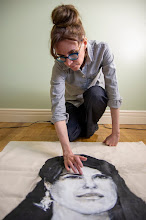
"Altogether, 12,428 minutes of footage were 'patched together like a quilt'."
Amidst graffiti that spelled ‘vomit,’ neighbourhoods of dilapidated homes, and scenes like this one my husband shot, we found ourselves in a stunningly beautiful place in downtown Detroit last week-end. We attended the final night of the summer film series at the Detroit Institute of Arts in this stellar auditorium: (click here). I was as excited about the venue as I was about the film: !Women Art Revolution, directed by Lynn Hershman Leeson (a featured artist in the exhibition whose catalogue I worked on at the Neuberger Museum of Art earlier this year, The Deconstructive Impulse).
Leeson recounts in !W.A.R. how she wrote reviews of her work pseudonymously when she was an emerging artist, resulting in her first exhibition. Her next big accomplishment was a major sale of her work, but the collector backed out upon learning her gender because he said it would be a poor investment to buy the work of a female artist. Today, that body of work by Leeson is valued at 9,000 times its original price. Look who’s laughing now. Impressively, Leeson financed the film with sales from her own work, which makes me want to promote it even more.
!W.A.R. is not unlike The Heretics, which I blogged about last year. That’s not a criticism, and it may be inevitable given that both documentaries cover similar time periods, with Leeson’s being about the development of feminist art in America and Joan Braderman’s The Heretics being about the development of a magazine in New York City about feminist art. !W.A.R. is a great counterpart to The Heretics, in part because much of the footage was filmed on the opposite coast, from her living room in Berkeley, California. Some interviews were filmed elsewhere, like the one with Judy Chicago in a bathroom noted for its decent acoustics. Many of the same artists and critics, such as Harmony Hammond and Lucy Lippard, are interviewed in both films. And both films have a quirky sensibility, complete with sound effects and playful cartoons/animations. For example, !W.A.R. shows a cartoon of Nancy Spero being forced to show her portfolio to a gallerist on the floor instead of on a nearby sculpture stand. That is the least of the unconscionable behaviour discussed in the interviews. As in The Heretics, many of the women interviewed by Leeson root the feminist art movement in social justice and general consciousness raising. For me, there are two unforgettable clips in !W.A.R.. One is Arlene Raven’s deadpan description of her effectively going on strike as a domestic servant, followed almost immediately by the collapse of her marriage; right when you might laugh at the absurdity of cause and effect, she reveals that she was raped three days later. The other clip is of African American artist, Howardena Pindell, remembering how as a child, she was tied to her cot during nap time to prevent her from using the same bathroom as the white children. The film balances these sobering tales by including interviews with the likes of Marcia Tucker, who notes that humour is the greatest tool in fighting adversity. And it is interesting to hear from artists like Faith Wilding, who didn’t feel feminist rage as a newly married woman but found herself in the movement nonetheless.
Altogether, 12,428 minutes of footage were “patched together like a quilt.” A highlight of the film is its inclusion of archival footage other than interviews. It was a real treat to see the opening of the Womanhouse installation in which CAL ARTS students each took over a room in an old house; Congress debating whether Judy Chicago’s installation, The Dinner Party, was pornographic; and protests at the Guggenheim when a survey exhibition excluded female artists and included Carl Andre, who was acquitted controversially shortly beforehand in the murder of his artist-wife, Ana Mendieta, who fell to her death from their New York apartment.
The focus of !W.A.R. is definitely on the 1970s, but it does extend to later developments, such as the creation of the Guerilla Girls (the mask-wearing educators who continue to ask pointed questions of institutions through posters, protests, and lectures to remedy the double standard facing women artists). Also included is a discussion of the major feminist exhibition, WACK!, and interviews with several contemporary feminist artists. The one that stood out for me as a librarian was Janine Antoni saying that she couldn’t find library books on any of the feminist artists her professors suggested she research.
Towards the end, film critic B. Ruby Ritch expresses concern that the survivors of the feminist artist movement are like old KGB agents, relegated to a scrapbook that no one’s interested in now. With its poignant interviews and its plethora of images by women artists, !Women Art Revolution will hopefully prove otherwise.
Showing posts with label Harmony Hammond. Show all posts
Showing posts with label Harmony Hammond. Show all posts
Sunday, August 28, 2011

Saturday, June 5, 2010
The Heretics
“[We] fell in love with each others’ minds”—Marty Pottenger
New York is a funny place. It feels so big that it could swallow you whole, but sometimes it seems as small as the rural village where I was raised in Canada. For instance, I had no idea that the friendly woman I was chatting with in the bathroom Thursday night at 92YTribeca was Joan Braderman, director of The Heretics, whose screening I was about to see. What would I have done differently had I known it was her—offered her my lipstick? Opted against using lipstick in front a more seasoned feminist than myself? I’ll say this: it was a fitting way to start an evening celebrating the camaraderie between women, and a reminder that the gap between Second Wave feminists and Third Wave feminists—insurmountable though it sometimes seems—can close in an instant.
The documentary, made by a three-person crew in multiple locations, traces the development of Heresies, a significant feminist art publication that ran from 1977 to 1992 out of New York. A goldmine for feminist art historians, it is replete with archival footage and contemporary interviews with 28 of Heresies’ key figures. Any reservations about the value of this film fall quickly by the wayside: we are reminded of the importance of institutional memory by a montage of contributors’ conflicting or nonexistent answers about where the first meeting was held. The film is effectively a piecing together of history, a kind of collaborative storytelling that establishes credence through repetition.
Watching The Heretics, we are captivated by the inception of the publication—by the list of some 300 titles considered, by the ability to mobilize without the power of the Internet, by the founders’ earnest attempts at organizational equity. We are stunned by Heresies’ perseverance in spite of resistance to a business plan, to male advertisers, and to so many conventions that keep publications afloat. And, I can’t speak for everyone, but for those of us who have lost countless nights of sleep to the publishing world (I even bumped the date of my wedding to accommodate a production schedule) in the pre-digital era, we are weirdly nostalgic for the smell of wax. Mostly, though, we are enraptured by the stories of the talented women who came together to change the world, who—as Marty Pottenger phrased it—“fell in love with each others’ minds” and capitalized on synergy.
Inspiring though the documentary may be, the content is gravely serious. A case in point is Lucy Lippard’s retelling of men and women bringing the same slides to galleries and the women being turned away while their male counterparts generated great interest. Stories like these give insight into the impetus for creating and sustaining Heresies. The serious subject matter carries over into the history of the publication itself. For example, Harmony Hammond recalls the tension of restricting the editorial team to lesbians for the lesbian issue, and Su Friedrich tells the story of how she got fired preparing the sex issue late at night in her workplace. Interestingly, despite the sobering content, the film doesn’t take itself too seriously. A saxophone plays in the background when the aforementioned sex issue is discussed and the dramatic sound of thunder accompanies the first mention of the so-called Heretics; there are many such examples. A cut-and-paste aesthetic lends a quirky sensibility to the film, which might come across as amateur if it didn’t reflect the general look of the publication.
On the surface, The Heretics is about the project that tied these women together but it functions as biography in equal measure. The interviews conducted three decades later emphasize that creating the publication was not an isolated act, but rather part of a trajectory in each woman’s life. The Heretics reveals Heresies to be natural outgrowth of the contributors’ existing commitment to feminism, but also as a catalyst for personal change.
For more on The Heretics, see http://www.wmm.com/filmcatalog/pages/c780.shtml
Subscribe to:
Posts (Atom)