Showing posts with label Judy Chicago. Show all posts
Friday, December 30, 2016
Openings: A Memoir from the Women’s Art Movement, New York City 1970-1992, by Sabra Moore
“Navel-gazing is absent from this heartfelt memoir.”
Sabra Moore’s Openings: A Memoir from the Women’s Art Movement, New York City 1970-1992 (New Village Press, 2016) describes the Texas-born artist’s experiences in Manhattan and Brooklyn back when moving there didn’t break the bank—back when artists could rent a huge loft and make a living by cobbling together small contracts with plenty of time remaining for art-making and activism to boot.
Naysayers may doubt that activism was necessary beyond the surge of Second Wave feminism in the 1960s and 1970s. Drawing on journals written since 1964, Moore provides ample evidence of lasting sexism. For example, in the 1980s, Moore visited Frida Kahlo’s house in Mexico City and noticed that the only postcards for sale featured the works of Kalho’s husband, Diego Rivera. That same decade—in the wake of Ana Mendieta’s suspicious death after falling from the 34th window of the apartment she shared with her partner, Carl Andre—a male architect “jokingly offered to push me [Moore] out of a window when we disagreed.” (1) And, in the 1990s, a friend of Moore’s, Ora Lerman, was on an art-related academic panel in which the male panelists were paid honoraria but the female panelists weren’t compensated.
Navel-gazing is absent from this heartfelt memoir. Moore, an accomplished artist, discusses her own mixed media work throughout, but with seeming sincerity, by showing how it dovetailed with her personal life, from travel to family relations. For example, in a fabric calendar, Moore recounts her abortion while volunteering for the Peace Corps, using materials and techniques familiar to her because both of her grandmothers had been quiltmakers. Impressively, Moore includes people’s reactions to her work—both compliments and criticisms—and she reveals rejections as well as acceptances for exhibition submissions and grant proposals. This dose of realism is important for art students and emerging artists because it underscores the need to be steadfast. Signs of her success are tempered; for example, in a single paragraph, Moore recalls the good news that a curator offers unlimited funds for one of her artist books, but also the less-than-good news that the Social Science Research Council wants a book from the same edition at no cost. As the late Carrie Fisher remarked, “There is no point at which you can say, ‘Well, I’m successful now. I might as well take a nap.’” (2)
Moore’s inclusiveness of other Second Wave feminist artists is exemplary. She aims to expand the canon beyond a smattering of well-known female artists like Judy Chicago. As early as the 1970s, Moore realized, “If you are not named, you do not exist” (3). She doesn’t just mention her myriad colleagues by name; she describes their work, at minimum with a single sentence, but often with more. For example, she writes poetically of Hannah Wilke’s Brushstrokes No. 6 that preceded her death from cancer: “Rows of her shorn lockets [of hair] were framed like calligraphy, creating a text we could not decipher except for its bravery.” (4) The reader need not visualize the majority of the works referenced: a colour banner of images spans the bottom quarter of the page for the entire book, except when full-page images are included.
One perspective in the contemporary art world is that it is questionable for a curator to organize an exhibition that includes his or her own work, but Moore offers a compelling argument for organizers to double as participants. Basically, joining forces was the best strategy for making headway. She identifies as an activist artist, as a practitioner “who felt a call to action for our beliefs.” (5) That call manifested in various ways for feminists: organizing shows around themes like peace, founding artist-run galleries like Atlantic Gallery, and establishing artist-run periodicals like Heresies. Moore’s work was featured in all of these initiatives.
Moore does not gloss over the trials and tribulations of collective organizing. She cites challenges such as the horizontal structure of grassroots organizing delaying decision making; a revolving door of members hindering the ability to move beyond surface level concerns; poor institutional memory; lack of credit for behind-the-scenes work; a heavy reliance on unpaid labour; in-fighting; and financial mismanagement that could cripple a fledgling organization. Yet, in the end, collective action seems to have been worthwhile. Moore portrays it as an almost transcendental experience that fostered her creative practice, broke down institutional barriers, and facilitated lasting friendships with the likes of art critic Lucy Lippard (who has written an introduction for Openings along with poet Margaret Randall).
There is a wealth of valuable information within for researchers. Unfortunately, the presentation of information demands deduction. Artists are often referred to by their first name only; for example, in the second paragraph of the preface, Moore introduces three artists by first name only and by the end of the preface, just one of those three has had their last name specified. Especially for readers who don’t read cover to cover, a subject index would clarify an individual’s last name, plus it would enhance access overall. Also, the content is presented somewhat chronologically, but the sequence of events is often jumbled. For example, the first chapter is called, “Where I/We Came In (Starting in 1970),” but she actually begins in the 1960s (in order, 1966, 1969, 1963, 1970, 1982, 1972, 1973, 1984, 1983, and 1965). Jumping around from year to year is preferable to not knowing what year Moore is referencing. For instance, early in the book, Moore says she was married in the late 1980s. Much later, she notes the month and day of her wedding but not the year, and on the next page, an approximate date of 1989 is indicated by her reproduction of an exhibition card. However, in a later chapter, she reveals her wedding was 32 years after her sister’s in 1958, which would be 1990 and not the late 1980s. Another way the reader gets lost is through the absence (or rather, delay) of segues; for example, she mentions that a colleague of hers, Linda Peer, got married while placing her and her husband-to-be‘s hands on a book about the artist Giotto. Then she describes how she met Peer and she describes her personality. The next paragraph is about Moore’s trip to Europe, but only in the final sentence does she mention Giotto as the link to the previous paragraph. Also disorienting is the inclusion of dialogue without the identification of all speakers. For instance, Moore recounts her introduction of the artist Vivian Browne to the anthropologist Jonetta Cole. The three stand looking at Browne’s work. She then writes, “‘Does it make a difference that it’s women? It makes a difference!’” (6) The first question is assumed to have been asked by Cole, but is the response from Browne or from Moore, or is Cole answering her own question? Lastly, as a Canadian I would like to see more specificity with her reference to Reconstruction Project, an exhibition that traveled from Powerhouse Gallery (now La Centrale Galerie Powerhouse) in Montreal to Eye Level Gallery in Halifax in 1987. The caption for an installation view says merely, “Canadian installations” (the clarification of the gallery is only to be found in the illustration notes in the back of the book), and one quotation about artist-run centres is attributed generically to “the Canadians.” (7) Incidentally, no, I don’t know Bob from Calgary. (8)
No editor is listed in the book’s bibliographic information. Surely enlisting the help of one would have addressed the above issues. Marilyn Lanfear’s comment is pertinent, even though it is about Moore’s text-based art and not her writing: “You don’t make it easy to read your stories.” Moore’s retort was, “People have to want to read them.” (9) Personally, I enjoyed the memoir most when I read it quickly instead of searching for connections or clarity.
Reading the epilogue was like pulling a thread even though it’s obviously intended to tie up loose ends. In Moore’s updates about her colleagues’ current activities, I was surprised to see that Howardena Pindell is teaching art at SUNY Purchase, whose faculty I follow closely because it’s my former workplace. I am quite certain that it’s the Stony Brook campus she works at instead. A factual error like this casts doubt on the accuracy of all preceding content, so I recommend that researchers who consult Openings as a primary source document corroborate details with an additional source.
(1) p. 168
(2) “15 of Carrie Fisher's Best, Most Honest Feminist Quotes.“ The Cut. Dec. 27, 2016. nymag.com/thecut/2016/12/15-of-carrie-fishers-best-most-honest-feminist-quotes.html
(3) p. 44
(4) p. 198
(5) p. 208
(6) p. 187
(7) p. 200
(8) “Bob from Calgary, We’d Like to Meet You.“ CBC News Calgary. Dec. 29, 2015.http://www.cbc.ca/news/canada/calgary/bob-from-calgary-new-york-times-1.3383896 (9) p. 246
Labels:
Ana Mendieta,
Frida Kahlo,
Judy Chicago,
Marilyn Minter,
Ora Lerman,
Sabra Moore
Sunday, March 31, 2013
From the Feminist Lending Library: Becoming Judy Chicago
“…an art critic...told her that she would have to
choose between being an artist and being a woman.”
I first encountered Jen Kennedy and Liz Linden’s book swap... in a private tour
for Bibliography Week attendees of the Center for Book Arts exhibition, Brother
Can You Spare a Stack? (January 18-March
30). I made a note to self to bring an item to put into circulation the next time I was in Manhattan. Since the intention of the book swap is to facilitate community-based knowledge production in the
face of university and library privatization (1),
the most appropriate book in my collection seemed to be a 1976 reprint of Our
Bodies, Ourselves. In this landmark
publication by the Boston Women's Health Book Collective, women shared intimate
details of their reproductive health and sexuality, forming an incredible resource in the pre-Internet era.
In exchange for donating Our Bodies, Ourselves, I picked up a biography of the artist Judy Chicago
by Gail Levin since I enjoyed her biography of Lee Krasner. Becoming
Judy Chicago (Harmony Books, 2007) may
sound like a familiar title since a book called Becoming Georgia
O’Keefe was published recently.
Back to the books in the FL, coincidentally, Our Bodies, Ourselves is mentioned twice in Becoming Judy Chicago: once as a book on Chicago’s reading list for
students, and again in a quotation accusing Chicago of never moving past the
Our Bodies, Ourselves era with her subject
matter of vulvas, birth, and other ‘female subjects.’
The biography I took home to Canada is actually a
publisher’s proof, which is interesting from an editorial standpoint (for
instance, the photos the text references are absent). As much as
Levin might cringe at the thought of an uncorrected proof falling into hands for
which it was never intended, she’d probably also dig the serendipitous
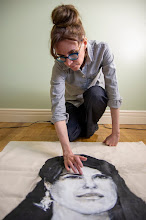
visual effect shown in this photo (see left). She opens the book with several
paragraphs describing the cover photo, in which the artist is posed as a boxer in the same ring
where Muhammad Ali trained, mocking the machismo of the art world. This publicity stunt marked both
a change in gallery representation and her name (from her married surname to a
nod to her hometown that doubled as a divestment of “male social dominance” [2]). The orange
‘give a book, take a book’ stamp of the Feminist Library on the inside front cover frames her face and
when the light shines through, it looks a bit like a halo and a bit like her face has
been reproduced on a coin. Either way, Chicago’s greatness is implied. It’s
fitting, considering that Levin champions Chicago, for example, in calling her
a pioneer of minimalism and in defending her collaboration, The Holocaust
Project: From Darkness into Light.
Personally, I struggled with Chicago’s self-importance in
her first autobiography and never made it to her second one. Levin points out
that bristling against her chutzpah is both common and unfair, and is rooted in
the genius label seeming mismatched with a woman. Indeed, an art critic Chicago
dated once told her that she would have to choose between being an artist and being
a woman. Fortunately, Levin balances Chicago’s fearlessness and pride
articulated in her personal letters and diaries—which are quoted extensively—with a measured tone. She
delves deeply into her past, but not at the sake of credibility: it was
impressive to read that Levin interviewed a female lover of the otherwise
straight artist and that she, like the two lovers, agreed to protect Chicago’s identity. She does, however, fill in a number of gaps from Chicago’s
autobiographical writings, providing names where Chicago did not.
Chicago has had a very full life. She was raised in a
secular Jewish household watched by the FBI for her parents’ communist
politics. On her father’s deathbed—when she was 13—he explained why he was a
communist, which contributed to her own social justice advocacy over the years,
encompassing the civil rights movement and feminism. She began taking art
classes at the Art Institute of Chicago at age five and although she dropped
out of UCLA briefly to join the New York art scene, she still received her
Masters of Art at age 24, at which point her work had already been covered by Artforum. (Even with the aid of dextroamphetamine, the timing
is remarkable.) But she was just getting started: Chicago formed the first
feminist studio program at an academic institution (at Fresno State College and
later the California Institute of the Arts, where she organized Womanhouse, a student installation that captured the nation’s
attention). Eventually, she took time off as an instructor to focus on the
monumental collaborative installation, The Dinner Party, which finally has a permanent home at the Brooklyn
Museum of Art in the Elizabeth A. Sackler Center for Feminist Art. She has been
married to three artists—widowed by the first when she was 24; divorced from
the second after ten years of marriage; and happily married to the third since
1985. She reinvested all of her finances in her art, waiting until she was in
her fifties to purchase a home (a former railroad workers’ hotel that she and
her husband renovated along with professionals).
The book breezes through the later years, making it feel
like Levin's coverage of Chicago's life needs to be divided between two volumes, like her own take on her
life. All in all, though, it’s a good read.
(1) http://www.brooklynmuseum.org/eascfa/feminist_art_base/gallery/Kennedy_Linden.php?i=2937)
(2) Qtd. on p. 2
(1) http://www.brooklynmuseum.org/eascfa/feminist_art_base/gallery/Kennedy_Linden.php?i=2937)
(2) Qtd. on p. 2
Saturday, July 14, 2012
The legacy of Judy Chicago
“…the Feminist Art Program, an experiment that tested the limits of education.”
On my final bus ride between Toronto and Kingston, I finished reading Entering the Picture: Judy Chicago, The Fresno Feminist Art Program and the Collective Visions of Women Artists (Routledge, 2012). Just as I read about artist Sylvia Savala’s father dictating what she should be when she grew up (legal secretary), just as I was thinking, “We’ve come a long way, baby,” a young man behind me barked at his girlfriend to shut up. I rotated my torso with exaggeration and glared icily. When he asked, “Can’t you just leave me alone and send me a [expletive] text?” I considered inviting her to sit beside me. I decided against it, not only because it could make things worse for her later, but because I too was vulnerable: as a woman travelling alone at night, arriving to a closed bus station with no one to meet me, I wasn’t about to take him on*. With regret, I state the obvious: there’s still a lot of work to be done.
Judy Chicago is a woman who knows how to get a lot of work done. Through the California Institute of the Arts, she facilitated Womanhouse, the first feminist installation by 26 female students, which graced the cover of TIME Magazine. She also spearheaded The Dinner Party, the first massive installation reflecting the vision of a single woman, which ended up debated in Congress. But before all that, at a state university campus in rural Fresno, California in 1970, she launched the Feminist Art Program, an experiment that tested the limits of education.
Chicago’s teaching method was the outgrowth of experiments she’d made along the way while teaching art part-time beforehand, like silencing all the men in the classroom so the women could be heard. The fifteen young women under her tutelage in the Feminist Art Program wore work boots and learned to renovate a studio as well as any man. The intuitive curriculum she fashioned promoted self-analysis using Simone de Beauvoir’s The Second Sex. Through consciousness-raising sessions, the women made leaps and bounds in their artistic development.
If this all sounds too good to be true, a little too much like Mona Lisa Smile—the film in which Julia Roberts plays an unconventional art history teacher who introduces her students to modern art and (in the process) feminism—then I’m not delving deep enough. The collective opinion of Chicago’s students was that the being in the program was incredible, but it was also risky. They got themselves into dangerous situations like interviewing rape victims in seedy neighbourhoods in the middle of the night for an audio work. Their emotional states were also at risk. Former students recall Chicago prying into their personal lives, but also pushing them away by insisting, “I’m not your mother!” and throwing a bottle of wine at the wall in one of their many group dinners. They were intimidated by her: one student admitted feeling pressured to make so-called vulvic art, a staple of Chicago’s oeuvre. Others embraced this trendy subject matter with aplomb; witness the CUNT cheerleaders. Having Chicago as a matriarch may have been a tumultuous experience, but her alumnae also recall her devotion to teaching and her generosity, like slipping a twenty dollar bill to a needy student and never expecting it back.
One thing is certain: Judy Chicago has made a major impact on women artists. One says she’ll never forget the time she heard her give a presentation, and another admits she treated her advice as if it had come from God. There are accounts from many women in this book, which is a collection of conference presentations for a symposium celebrating the 40thanniversary of the establishment of the program. Some of them knew Chicago very well, others interacted with her peripherally while engaged in parallel projects, and some were part of the next generation when Chicago moved the program to the California Institute of the Arts. We even hear from Chicago herself, who shares great anecdotes, like the San Francisco Museum of Art making so much money in the bookstore when The Dinner Party debuted that they bought a computerized cash registered and named it after her.
Reflective of conferences in general, some of the writing is superb, but some of the entries meander and trail off. All in all, though, it’s a good read.
*The following month, a similar situation arose and I did intervene by engaging the female and calling campus security. This time, the woman ignored me and the man told me to go (expletive) myself. It seems to be a losing battle.
Reflective of conferences in general, some of the writing is superb, but some of the entries meander and trail off. All in all, though, it’s a good read.
*The following month, a similar situation arose and I did intervene by engaging the female and calling campus security. This time, the woman ignored me and the man told me to go (expletive) myself. It seems to be a losing battle.
Labels:
Heather Saunders,
Judy Chicago,
Sylvia Savala
Sunday, March 21, 2010
Doing Away with Penis Envy
“The Visible Vagina...reminds us of offensive tropes throughout art history...but it also reminds us of the victories...”
It may have been a poor choice to view the closing of The Visible Vagina, a joint exhibition in New York at Francis M. Naumann Fine Art and David Nolan Gallery, on the same day that I saw the new MoMA retrospective for Marina Abramović’s The Artist is Present. Provocative though the works in the 75-artist show may be, it was difficult to see representations of genitalia as riveting in comparison with actual genital contact at the MoMA.
When I say ‘actual genital contact’, what I mean to say is ‘accidental genital contact.’ Google ‘Imponderabilia MoMA’ and you can read a variety of tales like the following. I decided to brave the narrow walkway between two nude actors facing one another in Imponderabilia, originally performed in 1977 by Abramović and her then lover and artistic collaborator, Ulay (for image and background, please see http://www.medienkunstnetz.de/artist/abramovic+ulay/biography/). While I worked myself up to the challenge, I watched a number of gallery visitors go first, most of them employing strategies like averting their eyes or putting a handbag through first as if to confirm that it was safe. The most common strategy was to turn sideways, which made it easier to go through unimpeded. I felt it was important to avoid this last strategy. My reason was that I didn’t want one performer to be free of voyeurism at the expense of the other, especially because both sexes were represented. As a feminist, should I not aim for equal treatment? (That may seem ridiculous, but it is what was going through my mind at the time). I wonder what stance I would have taken had the actors both been female, which is another combination Abramović has used. Like most people who have written about the experience, I found the process of making it through to the other side thrilling and panic-inducing. I believe the exact words I whispered were, “My hip made contact [with the male actor’s penis]. There was definite bumpage.”
If we can’t get past this discomfort and shrill fascination with the human body in its raw state, do we have any hope of appreciating artwork that is one step removed from corporeality? Or is representing the body rather than using the body proper the way to go? In a general sense, it may not be a question worth asking because both already exist in the art world, and both have been well received. It’s apples and oranges, really. For me personally, though, it is more an issue of deciding to stick with a singular fruit regimen or broaden my diet. I still haven’t done the performance I blogged about planning last summer. At the time, I blamed the uncooperative weather, but the truth is, I’ve been stalling because I don’t relish the idea of putting my body on display for my art.
I decided to wait until the end of The Visible Vagina to write about it, in part because I wanted to see what the fall-out would be like. Reading online comments about the show early on, I was amazed by the fixation on the title. It seemed that every commentator was quick to point out that the vagina can’t technically be seen sans speculum and therefore The Visible Vulva would be a more logical choice. Did this virtual equivalent of wrist slapping occur because the organizers were male, or was it an unconscious means to gloss over the actual content of the show because of a collective discomfort with the human body?
It’s not just me imagining widespread discomfort with the human body, and specifically the female body. As television network resistance to the ad campaign released this past week for U by Kotex (http://www.youtube.com/watch?v=FRf35wCmzWw) revealed, ‘vagina’ is unwelcome in our public lexicon. If a picture is worth a thousand words, the equivalent 98,000 inferences (i.e., 98 works x 1000 words) to a woman’s private parts in The Visible Vagina are powerful indeed.
My overall impression is that by all accounts, The Visible Vagina is comprehensive. It emphasizes the range of work featuring female genitalia in multiple media throughout art history (encompassing modern artists, Second Wave feminist artists, contemporary artists, and both male and female artists). It can’t be reduced to a peep show because the subjects are shown in states of indifference in addition to pleasure. It reminds us of offensive tropes throughout art history, like the truncated female nude, but it also reminds us of the victories, like Judy Chicago’s Red Flag (1971), a close-up photolithograph of a woman removing a used tampon (television networks, take note: the art world already paved the way for public acceptance of the pudenda some 40 years ago). It includes works that are diminutive/life-size and ones that compelled me to conclude that size does matter. A personal highlight was fibre artist Allyson Mitchell’s installation, Hungry Purse: The Vagina Dentata in Late Capitalism (2006-07). Evocative of a tented harem decorated in grandma’s crocheted blankets and other cozy throw-backs from the 70s, this mammoth rendition of the vagina was exquisite and walking into its mouth felt more delightful than unsettling. (For images, please see http://www.allysonmitchell.com/visualart/hungry_purse/index.cfm).
For the faint of heart, the exhibition can be experienced through the catalogue, which includes Anna C. Chave’s valuable essay, “Is this Good for Vulva? Female Genitalia in Contemporary Art.”
Subscribe to:
Posts (Atom)