Showing posts with label Kent Monkman. Show all posts

Tuesday, June 23, 2015

Just Dream!


Dream Big conference (May 27-30)

Since the massacre at Charleston’s Emanuel African Methodist Episcopal Church, I have been finding it difficult to feel optimistic about social justice, in both a general sense and in terms of racism in particular. It is perhaps fortuitous that I am behind schedule in writing about the keynote speakers for the Dream Big conference (May 27-30) in North Bay, because much of the discussion focused on advocacy for marginalized groups.

Yesterday in Detroit, I spotted the following mural with a helpful message by Father Greg Boyle: “At some point, we forgot that we all belong to each other.”
The text and mother-child image caused me to think back to the keynotes and how they all addressed their youth. charles c. smith, a “poet, organizer, change agent,…iconoclast” who teaches at the University of Toronto, recalled being “very aware” that he was the only black kid in his class. Lee Maracle of the Sto:Loh nation, who is an instructor at the University of Toronto and a recent recipient of the Ontario Premier’s Award for Excellence in the Arts, did not learn to read until age 9 and as a result of the residential school system, she visited the hospital often for malnutrition. Kent Monkman, an internationally exhibiting queer artist who is also known as Miss Chief (his “very glamorous” alter ego), recounted what it was like to grow up in Winnipeg, where “the harsher reality of First Nations people coming out of the colonialism process” was apparent. Multidisciplinary artist Paul Walty was a child of the postwar boom and as a result, grew up an “optimist of sorts.” He didn’t grow up marginalized, but he embraced diversity as an adult by learning French and immersing himself in the Francophone community, including a current term as president of the arts organization BRAVO. He feels that monolingualism limits tolerance.

The location of the conference in a city of 53,651 that I’m proud to call home, gave a geographic focus to the theme of dreaming big. Walty addressed this most directly, stressing that artists should not see cities as the only sites for creativity; he sees cities as lodestones and is nourished by the hinterlands, he said. Maracle emphasized that the arts are a source of economic vitality for cultural centres, with an excellent return on investments. Value can’t be assessed in economic terms alone, though, evident in her example of the healing value of art for social change, with singing in canoes reducing alcoholism. She explained that in “difficult circumstances…you come to love it [art] more than the world the way it is.” She added that the job market is in flux, making creativity vital. Monkman spoke similarly about the need for adaptability. He said that First Nations culture was “never static” and dreaming big was how it survived. smith spoke of the importance of redressing “historically entrenched inequities,” broadening the “narrow Eurocentric view,” and seeking reparations for injustice.

The need to dream big is easy to see, but it’s less easy to implement.

smith shared that jazz and science fiction opened doorways into a “very hostile white world,” but helped him understand himself. In black aesthetics, he explained, a “radically different view of ourselves” is postulated. The disparity between the view from within and without is underscored in an example he gave of a recent study by Wolf Brown, which revealed that the funding black people receive is out of proportion with their active involvement in the arts.

Walty realized that he wasn’t suited to his vocation of archaeology, so he turned to drawing, finding a way to retain elements of his background such as the grid. He was told by gallerists that drawings lack presence, so he made his black and white figurative drawings large enough to fill galleries floor to ceiling so their presence could not be denied. He didn’t depend solely on galleries; he had shows in people’s apartments and houses and hired buses to transport guests there.

Monkman wanted to make “the language of painting something that belongs to a Cree person.” Ultimately, he phased out the Cree text from his work and expanded his goal to empower two-spirited people. He created large paintings of romantic landscapes, subverting tradition by including Miss Chief in them. They function as an alternative to Eurocentric art with its “very one-sided point of view of the history of North America.” His work became censored at the Royal Ontario--in the First People’s Gallery of all places--where it was intended to be in dialogue with Paul Kane’s work. It was “too hot a topic, too hot a button,” he said.

Photo: Kent Monkman, courtesy of Liz Lott Photography

Maracle wrote her autobiography and was told by a publisher, “Indians can’t read.” She took to the streets to ask Aboriginal people if they would read the book if she taught them to read. After gathering signatures from 3,500 people—which would constitute a best-seller—she approached Frontier College to provide literacy tutoring and got a book deal for Bobbie Lee, Indian Rebel from Women’s Press in Toronto.

So, how should we dream? Maracle said that when people ask her, she says, “Just dream!” She notes that dreaming big costs money but many artists are impoverished. It doesn’t take a lot to encourage creativity and care for burgeoning artists. She recalled visiting a bindery in Vancouver regularly with her children to gather discarded paper for projects; a Portuguese baker on the same block would offer them doughnuts. There’s a misconception, she says, that starving artists spurs their creativity, so we need to urge “Canada to dream big with us and put some money where our mouths are.”

smith called for a more united front, with more gatherings like Dream Big. That requires access to resources, he pointed out, which is something to be conscious of as the Canada Council for the Arts restructures its funding model. We need to support artist-run centres, like White Water Gallery, which organized Dream Big. Monkman stated that artist-run centres were where his work gained traction, and this support was “very important” to him. Walty spoke of the creative spark he has experienced in group residencies organized by Galerie du Nouvel Ontario, an artist-run centre in Sudbury, including Art en movement, which I blogged about in 2012. He considers ARCs to be “the research and development arm of art.” If these types of institutions lose funding, he commented, “we are [effectively] saying the past isn’t worth anything.” Defunding them would be unwise and destroy the community, he said.

As I was wrapping up this post, CBC Radio was on, with Carol Off quoting Senator John Matthew's tweet, “Removing #ConfederateFlag w/out changing hearts and minds will not get rid of racism” (1). It made me think back to something Maracle said: “We make very quiet revolutions, artists, revolutions of the heart.” She elaborated that she has seen revolutions turn violent, and what we need is to change hearts. The Dream Big conference reminded me that art has the power to do just that.

(1) June 19, 2015. @caroloffcbc

Sunday, March 3, 2013

Rare & Raw at the Leslie-Lohman Museum of Gay and Lesbian Art

“...exciting intersections dealing with queer representation.” – Steph Rogerson

The College Art Association conference was worth every second of the twenty hours it took me to reach Manhattan by bus and train from North Bay. One of the events I attended was a curatorial tour of the annual CAA Queer Caucus for Art exhibition. Rare & Raw at the Leslie-Lohman Museum of Gay and Lesbian Art in Soho (the first and only dedicated LGBT art museum in the world) features work by Tom of Finland, G.B. Jones, William E. Jones, Will Munro, Kent Monkman, Nina Levitt and Tara Mateik. Once curators Steph Rogerson, Kelly McCray, and I returned to Canada, we chatted about the exhibition.


H - Since you’re both Toronto-based, have you ever co-curated with one another before?

K - Steph and I have been working together on projects since the 2006 XVI International AIDS Conference in Toronto. The initial curatorial project developed for the AIDS conference was called In Tents City. Images from local, national and international artists were projected onto carport tents for a month-long period. We re-mounted this exhibition at the Theatre Centre a year later.

Other projects included the InterAccess Electronic Media Centre in Toronto. It was a film screening called Rare & Raw.  The title of the Leslie Lohman exhibition was derived from this particular event.  We selected queer films from the early 1900’s to the 1970’s that were projected to a Toronto audience both inside the gallery space and to street level audiences through linen-covered windows.


H - Can you comment on your choice of title?

K - Rare & Raw fits perfectly with our intention to feature what we consider to be rare works of iconic artists and ephemera from archives exhibited in an accessible raw state and contextualized alongside or through the eyes of contemporary artists.

S - We wanted a title with a visceral feeling, like something you could taste or touch.


H - Do you think the exhibition functions differently in a museum with a mandate to support LGBTQ artists and issues than it might in a more generic venue?

K - Yes. For example, when the Rare & Raw exhibition ran into New York Art World politics, the Leslie Lohman museum staff supported the exhibition and needs of the curators above and beyond the call of duty.

S - I agree. The specific mandate of LLM allows us as curators to explore LGBTQ themes without fear of censorship or concern about “offensive” content. 


H - I read in Art Journal that the Queer Caucus for Art used to be called the Gay and Lesbian Caucus. The earlier version of its name was in keeping with the times if you consider that, say, the first book of its kind was called Gay Art: A Historical Collection. As the field has become more inclusive, encompassing bisexual, trans, and intersex individuals, do you find it challenging as curators to give adequate representation while balancing other (aesthetic, thematic, etc.) concerns?

K - I feel fortunate to be working with Steph in that the two of us are able to agree on a balance of the aesthetic outcome with the necessary representation of varying sectors of communities. We have a strong trust in one another and our varied experiences that allows for a rich outcome.

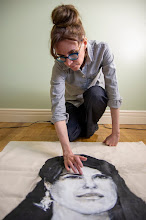
Image: Kent Monkman in front of work by Will Munro. Reproduced in 2019 via fair use/dealing. Source: Google images; original source (now defunct): https://www.leslielohman.org/?s=kent+monkman

S - Queer communities are continually evolving and part of being queer means being open to change. Inclusivity is part of queer discourse and its politics. There is engaging work being produced by queers around the world – case in point the brilliant Kent Monkman. Kelly and I are a great team and process ideas, images, meaning, and feeling about work with great candour. We are committed to creating exciting intersections dealing with queer representation.


H - Steph mentioned that the exhibition is dedicated to the late Will Munro, “the guy who made nighttime so much fun.” What do you think he would have made of the show?

K - I think Will would have set up one of his music/performance nights where all would be invited to dance beneath the glow of his mirrors. 

S - Will would have shit his pants with joy. His work looks beautiful and paired with William E. Jones’s Tearoom, both works speak to each other and create an elevated experience.


H - Were there any difficulties getting the Canadian works across the border?

K - We used a very reliable local shipper who is quite experienced with customs and cross border “situations.” I also ensured that the artwork from Canada was well packaged/wrapped/crated to make it more difficult to take issue with the pieces.


H - Zoe Leonard’s The Fae Richards Photo Archive, 1993-1996 was removed from the exhibition at the request of its owner early on in the exhibition. I’m reminded of the Robert Mapplethorpe court case where only a fraction of the offending photos were discussed, prompting one director to note, “Pictures speak to each other; they become part of a totality” (1). Back to the Leonard series, did you get a sense of viewers’ response to it before it was taken down?

K - Hard to say; the opening was packed, but we did get indications from people later that they felt fortunate to have been able to see the work and were quite appreciative of the curatorial efforts to exhibit elements of the Fae Richards Photo Archive.

S - People were very excited about The Fae Richards Photo Archive. Some had seen it years ago and for others it was new. The Fae Richards Photo Archive was an important component to the show. Its removal is a slap in the face to the other artists in the show, us as curators and LLM, the only institution of its kind in North America. The removal of this piece was based on conflicting demands that the museum and we bent over backwards to appease. The work was removed for reasons of capital and commerce, although that was never directly stated. We were “New York-ed” by powerful art people. What’s so painful about it is that Zoe Leonard has built her career on the back of queer politics as a member of Act Up & Fierce Pussy. I have admired her work for decades. Pulling The Fae Richards Photo Archive out of a queer show, in a queer venue, curated by politicized and passionate queers makes me angry, but even deeper than that is a profound sadness. Zoe Leonard broke my heart.


H - Archives are referenced a lot these days in art. This was true of the panel discussion at Leslie + Lohman that followed your tour, where Nina Levitt spoke about responding intuitively to archival images and Ken Moffat spoke about desiring the archive. Do you think the archive as an institution or concept has a unique resonance with queer artists?

K - I believe there is a growing awakening that is happening throughout, where many communities are beginning to realize the significance of the past and attempting to reclaim/re-contextualize history for present and future generations.

S - The archive is a valuable topic right now. From exhibitions, such as Lost and Found: Queerying the Archive curated by Jane Rowley and Louise Wolthers, to authors such as Ann Cvetkovich and Heather Love, to massive creative outreach in queer archives, such as The One Institute & Archives in LA, the attention on queer pedagogy, queer memory and feeling is at a fascinating point that has the potential to raise awareness about the past in order to possibly have greater understandings of the future.


H - Has “queer subversion” become a redundant collocation?

K - Yes – it is now queer to be “un - queer”.

S - I hope not! Because we have civil liberties in Canada, it’s easy to forget the rest of the world, gay bashing and abuses of power. Subverting, questioning and challenging the status quo continues to be important, specifically with issues of capital and commerce. Queers have become embedded in the corporate ladder, globalization and the race for economic power in ways that need, even demand, fresh discourse.

K - To clarify, what I am saying is that the “new normal” is beginning to incorporate a queering of the “normal.” The dominant culture is no longer dominant in Western society – even though there is still much pressure to accept that it still is.  It isn’t.


The exhibition closes March 31.


(1)            Qtd. In Kaufman, Ben L. “Mapplethorpe Issue before Court,” The Cincinnati Enquirer, June 21, 1990. The Cincinnati jury acquitted the Contemporary Arts Center director, Dennis Barrie, of obscenity charges related to the 1989 exhibition of photographs by Robert Mapplethorpe.


Kelly McCray is founder of BANKonART.net and co-founder of ArtBarrage.com. Steph Rogerson is a PhD candidate in Communication and Culture at Ryerson University.