Saturday, January 15, 2011
An unforgettable project
“…it makes Masik look like she is audaciously aligning herself with the victims, or that she is regrettably obtuse.”
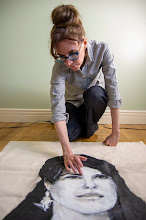
Yesterday was the first I had heard about Vancouver-based Pamela Masik’s large-scale painted portraits of 69 missing and murdered women from Vancouver’s Downtown Eastside (six of whose gruesome fates are attributed to convicted killer, Robert Pickton). Tomas Jonsson alerted me to the fact that the MOA, formerly the Museum of Anthropology, announced on January 12 that it would not be exhibiting Masik’s series on the University of British Columbia campus next month as planned. As I climbed into bed shuddering, my mind went to three divergent places: (1) to the public library I worked at as a teenager, where the head librarian decided against buying a book by a murderer because she wanted to deny royalties, though my mother counters that it was a biography of, not by, a murderer; (2) to my third year of art school, when a classmate with no apparent personal association to cancer made a piece about breast cancer, undoubtedly requiring incredible composure from our teacher—a breast cancer survivor—to not react personally; and (3) to the movie, Art School Confidential, in which the main character passes off portraits of murder victims as his own, ultimately implicating himself in their deaths because the actual artist created them as trophies containing incriminating evidence. What’s the point of my scattered reaction? Tackling this subject matter is likely to get an artist in hot water, and highly sensitive subject matter of any kind may be impossible for a public institution to contend with and for anyone personally involved to accept. My interest is in the artist’s approach to her work, not in that of the MOA (for my thoughts on censorship at art museums, click here).
In short, Masik has been criticized for being the spokesperson for marginalized communities she has limited experience with, and exploiting their memories for personal gain without adequate consultation with the victims’ families. Her side of the story is that someone needs to speak up about women going missing; that she is in a position to speak for them—as a woman’s shelter volunteer, as their neighbour, and as a woman; and that she has respected the wishes of family members, many of whom were touched by the memorial.*
I didn’t want to lash out against a fellow female artist unduly, so I read her website thoroughly along with each of her 80-plus blog posts, determined to understand her point of view. My objectivity was shaken almost instantly when I read her description of herself as a prolific national treasure in the making. This self-aggrandizing continued with her characterization of The Forgotten Project (the series in question) as ‘hauntingly beautiful’ and other paintings as ‘stunning.’ With this degree of confidence, it seems almost inevitable that she would have great expectations for a series that took nearly five years to create. Indeed, she wrote in August 2009 that there would be no denying The Forgotten Project. The MOA cancellation would have come as quite the shock, then, especially after the series garnered attention during the Olympics. At the same time, it’s not like there is no precedence in this arena: take, for instance, Marlene McCarthy’s Murder Girls series (also massive portraits, but in this case, of matricidal adolescents) which her former gallery would not show in 1995, causing a three-year lag before they were exhibited elsewhere.
Masik has been taken to task by writers like Meghan Murphy (The F Word) and Francisco-Fernando Granados (FUSE) for posing in front of these portraits, creating a gut-wrenching contrast to the battered women. Indeed, she is featured in exactly one-third of the 39 images in the photo gallery on the website, www.theforgotten.ca. Thirty years ago, it might just be her beauty that would offend (think Hannah Wilke), but today’s pluralistic feminism accounts for race, socioeconomic status, sexual orientation, etc.—factors other than strictly gender. According to her critics, Masik is cut from a different cloth than the victimized women. Thus, the juxtaposition of her against their faces stings.
Whether the posing is out of arrogant pride, sincere attachment, or a combination of the two, cannot be known. Reading her blog posts, I did notice a deep attachment to the portraits. Not only does she personify her paintbrush (Mar. 14, 2010) but she seems unable to separate the paintings from herself (“I was the brushstroke”, Jan. 10, 2009; “The paintings become me”, Nov. 11, 2008). She also has a history of including herself in her work, both in performance art, and in her paintings. When she unveiled a portion of The Forgotten Project in her studio, the promotional material mentioned a painting from another series that shows her naked body with pornographic (her phrasing) undertones. Given that sex trade workers are among the victims in The Forgotten Project, imagine the chilling reaction of loved ones. Also imagine the reaction to Masik detailing the physical wear and tear of making the series—her bleeding fingers, torn rotator cuff, and ‘broken’ body. Surely what she is implying is that she has poured herself into the series, but stating it in that manner makes Masik look like she is audaciously aligning herself with the victims, or that she is obtuse. When she laments the lost opportunity to say good-bye to the first painting from the series to be exhibited as it was crated and sent off to an art fair, it strikes me the same way. A more direct and abrasive attempt at empathy is her insistence that she “know(s) the pain and suffering” (June 27, 2009) of the victims’ loved ones. But someone who is grieving or empathetic wouldn’t compare herself to a child awaiting Christmas morning (Sept. 11, 2009). When she calls Pickton an opportunist (Feb. 15, 2010)**, it’s hard not to balk at the irony of her wording.
*For background reading on the controversy, see The Province, FUSE,
dpi, and The F Word.
**From the video, The Forgotten Project (Chris Morrow). All other dates in parentheses refer to Masik’s blog posts.

Sunday, January 2, 2011
Correspondence Course
“…these exchanges…serve as reminders of the messiness of autobiographical art making. For instance, a film about Schneemann’s lover is screened well after the marriage has ended…”
Three notes about myself: (1) I am of the age that I barely remember carbon paper (from having not-for-profit art jobs at offices equipped with outdated credit card machines, and before that, from my father’s high school biology exams recycled for scrap paper. “What should you do if someone has a heart attack?” one asked. A precocious child, I scribbled, “Call the hospital.”) (2) I consider myself lucky to be part of the final generation to know the joys of giving and receiving hand-written letters, a practice I upheld well into the email era (with no one more than my librarian friend, Laura Wray). (3) I am at an early enough point in my art career that I can forgive myself for not retaining all of my related correspondence, though I vowed redemption after reading of Marina Abramović’s thorough archive in When Marina Abramović Dies (James Wescott, MIT Press, 2010).
In spite of my relatively unblackened fingers, my support of the postal system, and my librarian-archivist values, I am—how shall I say—bewildered? awed? inspired? by the simple strategy employed by artist Carolee Schneemann. She has preserved each and every outgoing letter in carbon copy as well as the letters she has received, providing a stunning overview of her career as it moved beyond painting to encompass feminist film and performance incorporating her body*. A goldmine for researchers not only for its source material but also for its footnotes, Correspondence Course (Duke University Press, 2010) is a selection of these letters from 1956 to 1999 excerpted by art historian Kristine Stiles. As a recreational reader, I wondered how much I would gain from reading the letters since the introduction does such a good job of distilling the next 490 pages.
If you fancy yourself to be a grammarian, prepare yourself for Schneemann’s unconventional approach to writing. In fact, consider pouring yourself a glass of wine. Initially, I was perplexed by Schneemann’s liberties with language, such as nouns shoved together and not in a legit, noun cluster kind of way. Once I gave in to the impulse to skim, however, I quite enjoyed creative liberties like “$till between jobs” (p. 373). You get a strong sense of Schneemann’s artistry permeating her language, especially in correspondence with former students with whom greater convention would be expected. Her effusive writing is, in a word (ahem), refreshing in the academic context. The letters to and from her peers range from mutual encouragement to necessary clarifications. (Admittedly, it’s great to see a woman standing up for herself in an articulate, if occasionally abrasive, manner). They demonstrate the importance of what may seem to be clichéd advice given to aspiring artists, that it is prudent to ‘get out there’ and establish a network. Her frankness about difficult issues like finances may also serve emerging artists well, so they understand the choices involved in an art career. Unsolicited mail from artists inspired by Schneemann is also noteworthy, demonstrating her worth beyond awards bestowed from the top-down.
Schneemann’s letters to lovers are engaging, especially their poetic language. There are passages I read and reread to make sense of them—to determine, for example, if she was referring to the recipient or a new lover (i.e., a third party). I was strangely satisfied with the inconclusive nature of it all. It reminded me of the whispered ending of the movie, Lost in Translation, when Bob (Bill Murray) bids farewell to a tearful Charlotte (Scarlett Johansson): we aren’t privy to the details of what is said, and what can be imagined is more powerful. In the same way that an effective work of art does not provide all of the answers, Schneemann’s writing is open to interpretation, and os sometimes entertainingly blatant in its double entendres. Also striking about these exchanges is that they serve as reminders of the messiness of autobiographical art making. For instance, a film about Schneemann’s lover is screened well after the marriage has ended, which she accepts graciously. With the passage of time, these letters also emphasize the ability of romantic love to survive in a new form (Schneemann’s letters to her first ex-husband are particularly touching in this regard). Her descriptions of her beloved cats also underscore the myriad kinds of love that exist.
That Schneemann kept copies of the letters she sent begs the question of whether she may have had one eye on the future the entire time. That is to say, on a subconscious level, did she construct herself differently knowing that someone other than the primary reader might someday judge her? Who is to say? What I do believe is that there is a synergism to the collection, especially when the parties comment on the impact of receiving the previous letter or the joy it brings them to write the next installment. The whole of Stiles' Correspondence Course is more than the sum of its parts.
*Note: I am reticent to summarize her career in a single sentence, so please, read the book.
Friday, December 24, 2010
An Object of Beauty
“If Yeager has a true love, it is art, not men.”
Everyone must know a Lacey Yeager. The main character in Steve Martin’s new novel, An Object of Beauty (Grand Central Publishing, 2010), is a self-involved, brazen, sexy young woman who uses her wiles for professional gain. She’s the kind of woman who leaves her female competitors in the dust and leaves her male onlookers dumbfounded. Good things befall her, from real estate to art investments. When a friend questions her financial success that accompanies her upward mobility from the bowels of an auction house to international travel as an art consultant, she attributes it to magic. A cynic looking closely might notice her batting her lashes, but would fail to detect her cutting corners professionally—such is the combination of cute and cunning.
Several pages in, I concluded that I needn’t continue reading for a fuller understanding of Yeager’s character because there simply couldn’t be one. Understanding Yeager is impossible except by constructing a composite of her relationships and seeing her impact on those around her. Take, for instance, the narrator Daniel Franks. A reserved art critic, he is her former classmate and one-time lover. Tired of his boring relationships, he lets Yeager use him to provoke jealousy with extra-long hugs in front of her suitors. The reader can empathize with Franks, but not with Yeager, which is the case with at least one other male character in the book. An example is when Yeager, in a drug-induced state, fondles Franks and he describes his awkwardness, to which she is utterly oblivious in the moment and thereafter. Interestingly, Franks only surfaces intermittently, making him part omniscient narrator, part character who is directly involved in the protagonist’s life. His intermittent appearance also emphasizes Yeager’s inability to get close to anyone. If Yeager has a true love, it is art, not men.
The starring role that art plays in the novel is the main reason I read on, though I persevered for other reasons too: because of confidence in Martin’s creativity; because of a promising plot that delivered; and because of a disturbing impulse akin to staring at victims of an automobile accident (I was curious to see what kind of havoc Yeager would wreak). Aside from the usual reasons to indulge in fiction, there are incentives for art lovers. The book is peppered with colour reproductions of works of art integral to the story. For those less familiar with art, Martin’s Art History 101 is stellar. He also encapsulates the quirkiness of the contemporary art world with gem-like descriptions such as ‘high-craft OCD.’ The expository sections aren’t overly long, nor are they obvious in performing this function. Two notable examples are Martin’s inclusion of 9/11 and the 2008 recession. Both of these driving forces in the art market coincide with Yeager’s major career moves, one being the opening of a gallery and the other being a major investment in foreign art; this strategy allows Martin to explain their substantial effect by tracing the fallout for Yeager. She is such a spitfire that these factors can’t suppress her for long. Ultimately, she falls from grace not because of these external forces, but by her own doing, which turns the book into a morality tale.
With the New Year approaching, and with it requisite self-assessment, I tried shifting the question from whether I know a Lacey Yeager (I do) to whether there is some Lacey Yeager in me. Here’s my admission: we share an appreciation for contrivance. Every move she makes is calculated and loaded, even down to her wardrobe choices. My approach to my blog is similarly controlled. If I know I’m going to attend a certain exhibition, I tailor my reading materials so I can write a post that is enhanced instead of disjointed. Thus, you can imagine my disappointment when I only made it two-thirds of the way through An Object of Beauty on my last road trip two weeks ago. It was my first time returning to New York since I moved in September, and it would have been the perfect complement since the book is set in Midtown, Uptown, and Chelsea. Alas, I was unable to get back to the book right away because I was immersed in papermaking and book binding at Sheridan. I had to face the disappointing reality that I would be reading the New York-based book on a flight to Hawaii, which was totally mismatched. As the flight was about to descend, I stowed the book because turbulence was expected and I felt it would make me an irresponsible librarian to cling to a hardcover that was a potential projectile. I picked up United Airlines’ publication, Hemisphere begrudgingly. And there it was: synchronicity. An interview with comedian Judd Apatow described how he met Steve Martin as a teenager and ended with the line, “Steve Martin is the funniest man in the world.” Mahalo, Steve Martin. (That’s ‘thank-you’ in Hawaiian).
Mele Kalikimaka! (Merry Christmas!)
Source: David Carr, “The Hemi Q & A: Judd Apatow”, Hemisphere, December 2010, pp. 64-67. Print.
Tuesday, November 23, 2010
In defense of the lethargic bride
“…chances are she’s going to be bitter”
It’s a toss-up as to which commuting incident was more alarming today: (1) making my way through a crowd of squealing Justin Bieber fans on a narrow platform in Toronto, ready to fend off potential trampling with my safety whistle…if only it weren’t somewhere deep within my purse OR (2) reading this in a Metro article: “…a girl should start working out as soon as she thinks the guy is about to propose.” I cannot in good conscience deconstruct the group behaviour of the Bieberettes, for I am a former NKOTB fan. (That is to say, as a pre-teen, I walked five kilometers on a regular basis to the general store for New Kids on the Block collectable cards and had my first and only foray into ‘fan fic’). Thus, I will turn my attention to the Metro.
I’m not sure what possessed me to read an article on bridal fitness. It’s probably because after a ten-year hiatus, I’ve started jogging regularly. (I’ve joked that the reason I gave up jogging was that it raised my metabolism so much that I was eating dinner twice a night, which was impractical. The part about two dinners is true but there were other reasons I stopped jogging). Pragmatism cannot be overrated, and I appreciate that brides may want to maintain a specific size because of gown alterations. However, the article didn’t seem to appeal to women’s pragmatic side. Rather it capitalized on their insecurities. A case in point: “…every fat bulge, is meticulously captured on high-def camera.”
Why should a prospective bride feel pressured to become more fit (read: slender) anyway? After all, if her beau—or belle—loves her enough to propose, subsequent changes in physical appearance should be irrelevant. If it’s for others’ impressions, like Facebook friends or wedding guests, may I suggest that the bride reassess her values and how much she loves herself? External validation is not the best kind, as intoxicating as it seems. Also, can we please leave behind the assumption that it is the man who must propose? I know several women who have waited for years to be asked that magical question. If a woman pushes herself because she expects something in return and the man—not being a mind reader—doesn’t deliver, chances are she’s going to be bitter. (Indeed, several months after I made this post, Ana Perez from Chicago threatened her boyfriend that if he didn't propose, she would call 911...which she did, prompting criminal charges. Actually, in this case, working out would probably take the edge off, though therapy would be a useful complement).
I thought society had started to move away from idealizing the female figure, based on buxom models like Doutzen Kroes and Portia De Rossi’s autobiography on anorexia, Unbearable Lightness. However, I changed my stance after purchasing my first bridal magazine for art research. I was stunned that every bride featured, without exception, was waif-like. If this is the type of visual input facing today’s bride, it’s no wonder she feels pressured to shed a few pounds.
 The piece I made wasn’t about body image. It was an investigation of positive and negative space; a juxtaposition of contemporary bridal imagery and ancient religious garb; and a commentary on a verse from the Apocrypha (“A silent wife is a gift from the Lord. Sirach 25:14) used in a reading at our convalidation ceremony. [Click image to enlarge sample for larger piece, aprx. 1 m x 1 m].
To sum up, I was not an aerobic bride, nor am I am a silent wife. I hope that the Bieberettes—those children with ringlets and eye makeup you may have spotted on tonight’s train—grow up to realize that self-assertion and self-acceptance trump vanity.
*Source: Romina McGuiness, “Wow at Your Wedding”, Metro News, November 23, 2010, p. 27. Print.
Friday, October 8, 2010
You like it WHERE?
“...it makes gender specific sex fodder for humour, which is where I get my knickers in a knot."
A new viral campaign on Facebook has been gaining momentum, resulting in updates from women such as, “I like it on the kitchen counter” and “I like it on the floor beside the bed.” Personally, I used to be indifferent but now I prefer the latter. For any gentlemen still in the dark, these comments refer to handbags, not hand…er, never mind. One can’t help but imagine female friends in the act as a result of these naughty-sounding status updates, reminding us of the power of visualization (which interests me as an artist because it reinforces the power of the visual).
As a feminist artist, I’m obviously interested in female power but I dare say this campaign wields none of any consequence. Although its predecessor (January’s bra colour updates) expressed some semblance of girl power by rationalizing itself with an apparent goal of bringing attention to breast cancer, this campaign makes no such claim. In fact, the Facebook message chiding women to participate uses as its incentive the fact that the previous viral campaign made it into the news. May I point out that not all content in the news is newsworthy? A cow on the loose made it into my hometown paper recently. Enough said.
On the surface, the updates seem like an empowering and fun form of sharing female sexuality à la friends Carrie, Miranda, Charlotte, and Samantha in Sex and the City. Ultimately, though, there’s no meaningful disclosure (except of details that might interest burglars on a tight schedule). It actually underscores society’s lack of openness about sexuality. Plus, it makes gender-specific sex fodder for humour, which is where I get my knickers in a knot. Like the bra colour updates, this campaign titillates men by being coy. The locker room-like disclosures lack any sophistication that would point to ironically evening the score of gender imbalance. I am left wondering, what would be the reaction if men started a similarly covert campaign to state where they like their wallet at the end of the day? Surely they'd be chastised. Or maybe they’d seem prudish in comparison (“I like to keep it in my pants”).
Perhaps what really bothers me is the interchangeability of a purse for female sexuality, adding an element of commoditization. It’s just another way that women’s bodies and sexuality are consumed and it doesn’t make it palatable to this writer just because the woman is the seller.
Thursday, September 9, 2010
Writing off women
“...it’s possible that the viewer might take in the book first and move upward to her décolletage.”
It’s been almost two months since I’ve made a post. My life has taken on a greater degree of chaos while I’ve balanced two overlapping roles: outgoing art librarian at Purchase College north of Manhattan and incoming textiles student at Sheridan College southwest of Toronto. The colleges are eleven hours apart if traffic is good. Apartment hunting, writing an entrance exam, battling mold on items in storage…it has all been a whirlwind. My new commute involves the Go Train instead of the Metro North Train. The main difference is access to stray copies of the free Metro newspaper, which I decided to skim yesterday.
My attention was caught by the headline, “Writing off women?” The brief article is about the relegation of female-authored fiction to chick lit. My intention is not to comment on that issue, but to comment on the presentation of it. Unfortunately, the online version of the article does not include the image I discuss below.
An accompanying photo takes up more room than the text of the article. It shows a young, blond, Caucasian woman lying stomach down on the grass while reading a book. It made me yearn for summer, which—at least in Canada—seems to have disappeared amazingly fast. Then I looked closer. The caption mentions Pulitzer Prize winning author, Elizabeth Strout, but does not clarify if the woman is her. The real Elizabeth Strout is about 30 years older, though similarly blond and Caucasian. This image, presumably a stock photo, is a curious choice.
Our fresh-faced reader could do wonders for libraries as a poster child for literacy. Clad in all white (tank top, pants/shorts, and even her bra, whose strap is visible), she exudes innocence. Her mascara-laden lids and lips saturated with colour guide the viewer’s eye towards her ample cleavage and finally, to the book. That, after all, is the real object in the image, right? Or, because she consumes only the top right corner of the image and the rest is grass, it’s possible that the viewer might take in the book first and move upward to her décolletage. Either way, she rivals the book as the focus.
Interestingly, the book’s pages appear virtually empty. One page is entirely white while its opposing page has a blur of text. I am reminded of Reese Witherspoon’s vapid character in Pleasantville discovering words in the previously blank classics that filled her high school library. I’m also reminded of Medieval Books of Hours, those ornate volumes that women—often illiterate women—toted as accessories of sorts. If I think that far back into art history, I may as well reflect on her demure expression, a commonplace strategy to make female subjects seem capable of being overcome. Her gaze is fixated on the book, and not on the onlooker. She is up for grabs.
As a librarian and as a feminist, I am perplexed by the sexualization of reading in visual culture. I don’t mean to imply that beautiful and sexy women don’t read. However, if the editors are attempting to empathize with, or at least, represent the viewpoints of female authors bothered by male dominance in the industry, they would do well to use an image that doesn’t fall into gender traps, or perhaps they could feature one of the three women mentioned in the article/caption.
Source: ----, “Writing women off?”, Metro News, September 8, 2010, p. 31. Print.
Wednesday, July 14, 2010
Feminist's advisory
“…if you are considering becoming a feminist or are trying to convert someone, the most effective book is The Beauty Myth by Naomi Wolf…”
Yesterday at orientation, the father of an incoming student asked me, “Does anyone still read books?” After finishing Click: When we knew we were feminists (Eds. Courtney E. Martin and J. Courtney Sullivan, Seal Press, 2010) last night, I have a belated answer: Third Wave feminists. Maybe it’s because I’m a librarian, but one of the salient features I noticed in this collection of intriguing essays by women from my generation was the emphasis on books.
The book reveals a pivotal moment or experience that converted each of these women to feminism. The majority of the contributors mention at least a few authors or specific works, and almost all of those works are monographs. Most are recommendations, but equally interesting are the contributors’ ‘anti-recommendations’, if you will (i.e., sources they find troubling). For example, Jillian Mackenzie laments that her female friends and acquaintances bought He’s just not that into you: The no-excuses truth to understanding guys (Greg Behrendt and Liz Tuccillo, Simon Spotlight Entertainment, 2004), hook, line and sinker. These Third Wave feminists persuade and dissuade the reader in the realm of TV, film, and music too, but that’s far less frequent than the references to monographs. Thus, I chose to call this post ‘Feminist’s advisory’; it’s a play on the library term ‘reader’s advisory’, the process of recommending sources to library users.
Below is a bibliography I’ve compiled. Why? Click does not include full citations, so if you’d like to do some summer reading, this list should expedite things. Also, I was curious what a quantitative analysis would reveal. The bottom line is that if you are considering becoming a feminist or are trying to convert someone, the most effective book is The Beauty Myth by Naomi Wolf, and the author not to be missed is bell hooks. Actually if you cross-reference the list of recommended books with the list of recommended authors, Gloria Steinem is equally popular as Wolf and hooks.
A few notes on my process: Some of the references are to books in the contributors’ parents’ personal library, but I’ve included them if they are mentioned with a hint of admiration. I’ve left out any works that are presented in a neutral or negative way, which has necessitated personal judgment, but for the most part, the endorsements are pretty clear-cut. A few of them, like the book on ADHD, only make sense in the context of the essays, so consider any confusion to be an enticement to read Click.
A feminist bibliography gleaned from Click: When We Knew We Were Feminists
Online Sources:
Eds. Valenti, Jessica; Valenti, Vanessa; Mukhopadhyay, Samhita; Friedman, Ann; Martin, Courtney E.; Pérez, Miriam Zoila; and Merritt, Pamela. Feministing. 2004 to present, http://www.feministing.com (Endorsed by 1 contributor to Click, who is also an author-editor of Feministing).
Articles:
Banks, Sandy. “A Younger View of Feminism”, Los Angeles Times April 10, 2009. Print. (Endorsed by 1 contributor to Click)
O’Reilly, Jane. “The Housewife’s Moment of Truth.” Ms./New York Magazine, December 20, 1971. Print. (mentioned in introduction as inspiration for the book title; also endorsed by 1 contributor to Click)
Quindlen, Anna. “Public and Private” (column), New York Times, 1990-1992. Print. (Endorsed by 1 contributor to Click)
Rich, Adrienne. “Reflections on “Compulsory Heterosexuality,” Journal of Women's History 16.1 2004, 9-11. Print. (Endorsed by 1 contributor to Click)
Magazines:
Ed. (founding) Pogrebin, Letty Cottin. Ms. , New York Magazine, Ms. Foundation for Education and Communication, Liberty Media, 1971-present. Print.(Endorsed by 3 contributors to Click)
Ed. (founding) Pratt, Jane. Sassy, Matilda Publications, Lang Communications, and Petersen Publishing, 1988-1996. Print.(Endorsed by 1 contributor to Click)
Books:
*juvenile:
Lindgren, Astrid. Pippi Longstocking. New York: Viking Press, 1950.(Endorsed by 1 contributor to Click)
Thomas, Marlo. Free to be…You and Me. New York: McGraw-Hill, 1974.(Endorsed by 1 contributor to Click)
*adult:
Atwood, Margaret. The Handmaid's Tale. Boston: Houghton Mifflin, 1985. Endorsed by 1 contributor to Click)
Baumgardner, Jennifer, and Richards, Amy. Manifesta: Young Women, Feminism, and the Future. New York: Farrar, Straus and Giroux, 2000. (Endorsed by 1 contributor to Click)
Bordo, Susan. Unbearable Weight: Feminism, Western Culture, and the Body. Berkeley: University of California Press, 1993. (Endorsed by 1 contributor to Click)
Boston Women's Health Book Collective. Our Bodies, Ourselves: A Book by and for Women. New York: Simon and Schuster, 1976. (Endorsed by 1 contributor to Click)
Brown, Rita Mae. Rubyfruit Jungle. Plainfield, Vt.: Daughters, Inc., 1973. (Endorsed by 1 contributor to Click)
Collins, Jackie. Lucky. New York: Simon and Schuster, 1985. (Endorsed by 1 contributor to Click)
Estrich, Susan. Sex and Power. New York: Riverhead Books, 2000. (Endorsed by 1 contributor to Click)
Faludi, Susan. Backlash: The Undeclared War Against American Women. Publication: New York: Crown, 1991. (Endorsed by 1 contributor to Click)
Fitzgerald, F. Scott. The Great Gatsby. New York: C. Scribner’s Sons, 1925. (Endorsed by 1 contributor to Click)
Friedan, Betty. The Feminine Mystique. New York: W.W. Norton, 1963. (Endorsed by 2 contributors to Click)
Gordon, Mary. The Company of Women. New York: Random House, 1980. (Endorsed by 1 contributor to Click)
Hill Collins, Patricia. Black Feminist Thought: Knowledge, Consciousness, and the Politics of Empowerment. New York: Routledge, 2000. (Endorsed by 1 contributor to Click)
Kelly, Kate and Ramundo, Peggy. You Mean I’m not Lazy, Stupid or Crazy?!: A Self-Help Book for Adults with Attention Deficit Disorder. New York: Simon & Schuster, 1993. (Endorsed by 1 contributor to Click)
Moraga, Cherríe, and Anzaldúa, Gloria. This Bridge Called my Back: Writings by Radical Women of Color. New York: Kitchen Table, Women of Color Press, 1983. (Endorsed by 1 contributor to Click)
Morrison, Toni. The Bluest Eye. New York: Plume Book, 1994. (Endorsed by 1 contributor to Click)
Pipher, Mary Bray. Reviving Ophelia: Saving the Selves of Adolescent Girls. New York: Putnam, 1994. (Endorsed by 3 contributors to Click)
Steinem, Gloria. Outrageous Acts and Everyday Rebellions. New York: Holt, Rinehart, and Winston, 1983. (Endorsed by 1 contributor to Click)
Susann, Jacqueline. Valley of the Dolls: A Novel. New York: Grove Press, 1966. (Endorsed by 1 contributor to Click)
Wallace, Michele. Black Macho and the Myth of the Superwoman. New York: Dial Press, 1979.(Endorsed by 1 contributor to Click)
Walker, Rebecca. To be Real: Telling the Truth and Changing the Face of Feminism. New York: Anchor Books, 1995. (Endorsed by 1 contributor to Click)
Walker, Alice. In Search of our Mothers’ Gardens: Womanist Prose. San Diego: Harcourt Brace Jovanovich, 1983. (Endorsed by 2 contributors to Click)
Wolf, Naomi. The Beauty Myth: How Images of Beauty are Used Against Women. New York: W. Morrow, 1991. (Endorsed by 4 contributors to Click)
Book Chapters:
Higginbotham, Anastasia. “Chicks Goin’ At It.” In Listen Up: Voices from the Next Feminist Generation. Seal Press, 1995: 11-18. (Endorsed by 1 contributor to Click)
Chernik, Abra Fortune. “The Body Politic.” In Listen Up: Voices from the Next Feminist Generation . Seal Press, 1995: 103-111. (Endorsed by 1 contributor to Click)
Authors/poets mentioned (but not specific works by them):
Bella Abzug (Endorsed by 1 contributor to Click)
Simone de Beauvoir (Endorsed by 1 contributor to Click)
James Boswell (Endorsed by 1 contributor to Click)
Patricia Hill Collins (Endorsed by 1 contributor to Click)
Andrea Dworkin (Endorsed by 1 contributor to Click)
T. S. Eliot (Endorsed by 1 contributor to Click)
Ralph Waldo Emerson (Endorsed by 1 contributor to Click)
Susan Faludi (Endorsed by 2 contributors to Click)
Betty Friedan (Endorsed by 1 contributor to Click)
Nancy Friday (Endorsed by 1 contributor to Click)
Charlotte Perkins Gilman (Endorsed by 1 contributor to Click)
Nikki Giovanni (Endorsed by 1 contributor to Click)
Nathaniel Hawthorne (Endorsed by 1 contributor to Click)
bell hooks (Endorsed by 4contributors to Click)
Zora Neale Hurston (Endorsed by 1 contributor to Click)
Kumari Jayawardena (Endorsed by 1 contributor to Click)
Audrey Lorde (Endorsed by 3 contributors to Click)
Catherine MacKinnon (Endorsed by 2 contributors to Click)
Chandra Mohanty (Endorsed by 1 contributor to Click)
Uma Narayan (Endorsed by 1 contributor to Click)
Pat Parker (Endorsed by 1 contributor to Click)
Katha Pollitt (Endorsed by 1 contributor to Click)
Adrienne Rich (Endorsed by 1 contributor to Click)
Margaret Sanger (Endorsed by 1 contributor to Click)
Gloria Steinem (Endorsed by 3 contributors to Click)
Henry David Thoreau (Endorsed by 1 contributor to Click)
Mark Twain (Endorsed by 1 contributor to Click)
Alice Walker (Endorsed by 1 contributor to Click)
Cornel West (Endorsed by 1 contributor to Click)
Virginia Woolf (Endorsed by 1 contributor to Click)
Elizabeth Wurtzel (Endorsed by 1 contributor to Click)
The contributors aren’t arrogantly name-dropping these authors. They seem to genuinely appreciate the role of the written word in shaping their feminism. For example, Marni Grossman remembers reading prolifically during her recovery from anorexia and Jillian MacKenzie describes reading as revelatory.
That made me reconsider my own conflicted relationship with theory. Here’s my theory about theory: I feel that many people, myself included, are confounded by theory but they feel pressured to include it in academic essays. As a result, obscure theorists are touted more than they might be otherwise. Through a kind of skewed citation analysis, the theorist joins the canon. Although I don’t shirk my responsibilities to add theory to our library collection, personally, I’m more inclined to turn to Gilmore Girls than Guattari to contextualize my art. I feel there’s a more direct connection and that it’s more democratic (read: accessible). Before you say anything, GG fans, I acknowledge that popular culture and scholarly theory aren’t mutually exclusive, and that the show’s writers just worked Betty Friedan’s death into the script immediately and impressively.
As to how all of this relates to my artwork, last week I updated my artist statement to incorporate theory so it would be better suited to an exhibition I’m applying to. I was researching the Other in a feminist context, which naturally led me to Simone de Beauvoir’s The Second Sex. I found a few token passages, and reluctantly added it to my pile of summer reading, figuring it’s a classic I should be more familiar with. Only a few days later, I was watching The Truth About Cats and Dogs, in which the male love interest gives the unwitting female love interest a copy of de Beauvoir’s Letters to Sartre. I searched online to learn more, and I became captivated by the couple’s relationship, which is not unlike my own marriage, at least in terms of an unconventional living situation (I have a long distance marriage) and in terms of mutual support of creative endeavours (we’re both artists). Suddenly I was adding this tome of love letters to my summer reading, along with de Beauvoir’s autobiography, Memoirs of a Dutiful Daughter. Once de Beauvoir went from being a theorist to a person in my mind, I felt more open to reading her theory. Maybe that’s why I enjoyed the stories in Click so much.
Subscribe to:
Posts (Atom)