Monday, April 4, 2011

SlutWalk: A protest outside police headquarters

“…don’t confuse a dress for ‘yes’

Today Dan Savage posted a video on Slog called What Guys Think of Modesty. (1) The pious maker, identity313, implores females to—I kid you not—“have your dad screen your wardrobe,” lest they “lead men down to death” by revealing “skin that should not be on display” and acting as “bait.” I’m at a bit of a loss, since my dad is dead. I guess I should defer to my husband?

Well, Mr. identity313, this post is for you:

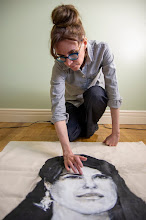
Over 3,000 people gathered at Queen’s Park yesterday for SlutWalk. To the casual (or cynical) observer of women donning corsets, thongs, and fishnet stockings, it might seem like an in-your-face flaunting of the right to sexual pleasure without judgment. Although there were cheers for “hot, consensual sex” (2) and a reclaiming of the pejorative term ‘slut,’ that assessment would overlook the all-important irony of the march, which ended outside the Metro Toronto Police headquarters. Artist in Transit blogger in a dress from Forever 21 outside Metro Toronto Police headquarters

Organized by five women, SlutWalk was a reaction against a Toronto Police Constable advising York University students in January that women “should avoid dressing like sluts in order not to be victimized.” (3) Although the comment was retracted, and reportedly addressed by Metro Toronto Police (4), the incident indicated a need to redress outdated, offensive, and—frankly—dangerous viewpoints. In the first of 70+ SlutWalks, protestors turned this advice on its head by wearing whatever they liked, ‘slutty’ or not. The idea was to put the onus for corrective behaviour on perpetrators and to stress women’s right to agency without being subjected to sexual profiling. As the marchers walked through blocked-off streets, they chanted, “Whatever we wear, wherever we go, yes means yes and no means no.” Or, as one sign summed it up: “Don’t get raped!” edited as ‘Don’t rape!’

I remember the first time I was called a slut because of my clothing. It was on an elementary school trip to Canada’s Wonderland. The stranger’s comment was probably provoked by my bicycle shorts, which I actually thought were extremely practical for a day of getting soaked on rides. I couldn’t have been older than twelve, back when the extent of my involvement with boys was dancing arms’ length apart inside a supervised and well-lit classroom. Slut indeed! I have to admit, there is part of me that feels I won the lottery: I grew up in a country where I was not prevented from going to school because of my gender, nor do I run the risk of being shot at during a peaceful demonstration, as happened recently to Ivory Coast women. Is it really so untenable that every time I am sexually harassed, I evaluate my clothing and whether it played a role? (I know the answer is affirmative, but still…). Another reason I felt uncertain about my place at the protest is because of my position as a feminist artist: I believe that gendered stereotypes matter and that clothing matters, and that the two intersect. I am just as concerned about a baby sleeper that says, “Your crib or mine?” as I am about the padded, push-up triangle bikinis introduced last month by Abercrombie and Fitch for their kids’ line. If I feel clothing is loaded, do I belong at a protest that argues the opposite? (Obviously, there is a difference between how we dress and socialize our children and how we dress ourselves once we’ve already been socialized. I suppose the common ground between my artistic concerns and the protestors’ concerns is in pointing a finger at society and wanting the best for females).

Personal conflict aside, there was every reason for me to attend SlutWalk. For one thing, it’s a high profile event, and I feel that is a better approach than Denim Day, which I blogged about last year. (5) It’s easy not to notice an apparently activist pair of jeans, but it’s impossible to ignore sobering signs like “Dykes don’t need correcting” and “I was wearing a sweater + pants. Was it my fault too?” Others, which quoted Mahatma Ghandi or appropriated the look of John Lennon and Yoko Ono’s famous poster with ‘RAPE CULTURE IS OVER! if you want it’, underscored SlutWalk’s pacifist mandate while rooting it in a trajectory of historically important protest. The signs were easier to take in than the speeches, because random chanting competed for attention, not to mention the men standing on the rooftops of cars holding questionable signs like, “We love sluts.” Organizer Sonya Barnett rallied the crowd by saying, “We need and expect better.” Jane Doe, a survivor who sued Toronto Police in 1986 for negligence, called on Mayor Rob Ford and the MTP to restructure police training and to be accountable to high-risk groups like transgender people, women with disabilities, Aboriginal women, and sex trade workers. And, I can’t remember who made this comment, but as a librarian, I don’t want to leave it out: a female student shouldn’t have to think twice about staying late at the campus library. Agreed.

Scanning the crowd, I was mesmerized by the women whose clothing bordered on art, like the strapless dress made entirely of caution tape. In the realm of performance art, there were a lot of outfits, such as a wedding dress, a retro housewife dress, and parasols toted by goths, which put the ‘demur’ in ‘demure’; that is, they balked at the adjectival meaning of ‘sedate’ in favour of the verb meaning ‘to object.’ Impressively, the crowd didn’t have the Lilith-Fair-like ratio of women to men that I was expecting. I felt a compulsion to hug each of the many men in the crowd (save for the ones on top of the cars) who came out in support of friends, lovers, sisters, and mothers, or just to give a face to the men who don’t confuse a dress for ‘yes’. Alas, I held back, because I wouldn’t want to be called a, you know, slut.

POST SCRIPTUM: Thanks to Statcounter, Ive learned a lot about my blog. For instance, this is my most popular post to date, which is interesting because its less art-focussed than my usual posts. Another thing Ive discovered is that somewhere out there in cyberspace, people (i.e., not singular) conduct image searches for sluts at Canadas Wonderland. I feel vindicated, thinking of them arriving here accidentally and getting a dose of feminism.

(1) What Guys Think of Modesty
(2) Jane Doe
(3) www.slutwalktoronto.com
(4) For the perspective of the police, click here
(5) To view that post, please copy this link (for some reason the URL can't be linked): http://artistintransit.blogspot.com/2010/04/redress-through-dress.html

Thursday, March 24, 2011

Erin Finley at Hallwalls Contemporary Arts Center

"...as Andy Warhol told the Velvet Underground..."

I shuffled off to Buffalo on Friday to hear an artist talk by Erin Finley that coincided with the opening of her exhibition at Hallwalls. The show consists of “knockout drawings” featuring “coyly transgressive subjects,” to borrow curator John Massier’s wording. He described the act of seeing her work in person during a studio visit as startling, because reproductions couldn’t do them justice. One could imagine that he was referring to the teeny narratives surrounding the main action, which are rendered intricately with a cartographer’s pen. Or maybe he was thinking of the glint of light hitting a sparkly baby Jesus atop Marlon Brando’s head or on a glittering Louis Vuitton sandal in a self-portrait of the artist with maxipad wings exposed.

What I recall most vividly from visiting Finley’s Calgary studio and later, her present Toronto studio, was the denseness of imagery cluttering the walls. Early 80s Madonna hung alongside an oversized colouring book picture of Alice in Wonderland and across from a leaflet for the theatre production of Legally Blonde that Finley picked up while exhibiting at CBGBs. It was as if she had gorged on popular culture and hurled onto the wall, where her entire visual schemata was seeping into the works created below. Thus, it was fitting that she began her artist talk with an overview of images that inform her current work, which ranged from Miley Cyrus with her pants around her ankles to documentation of torture in Guantánamo Bay.

The content of her irreverent drawings makes them au courant, yet they possess a timeless quality by virtue of their style. There are several artists that come to mind whose purposeful disregard for drawing conventions makes them easily confused for one another; this aesthetic, however suited to quirky subject matter, runs the risk of a pressing expiration date. Finley’s deftly drawn and equally imaginative works stand in contrast. It doesn’t hurt that she inserts references to art history, like Borromini’s architecture, Mannerist proportions, and Greco-Roman stories, situating her work firmly in the realm of art and preventing it from being confused with children’s book illustrations like the work of some of her artist contemporaries.

In the context of this blog, I would be remiss to discuss Finley’s work without tackling the prickly issue of feminism, for she is a self-described feminist. At best, feminism is a contentious issue, but it is even more so with her work. A case in point: Rape fantasy (2010) features a scraggly haired girl lying on the ground while reading a short story of the same name by Margaret Atwood. Though her back is arched and her naked bottom is thrust in the air like a cat, she appears absolutely in control. The toe of her running shoe digs into the ground, giving her the ability to sprint away if need be. Her male-like torso, devoid of cleavage, is suggestive of superheroism, conjuring images of Buffy the Vampire Slayer slamming a classmate’s head into the steering wheel when he makes a pass at her after locking the door against her will. There are numerous representations of androgyny in the exhibition, notably in self-portraits, which address the malleability of gender head-on. At first glance, works like Portrait of the artist as a suicide bomber (2010) may seem aggressive and not just because of connotations of terrorism. However, she credits children’s literature as a source for this so-called magical imagery. This perspective casts them in a tender light and reminds us of the endless possibilities that exist in children’s minds before they place limitations on themselves because of gender. And, just as androgyny avoids prescriptive behaviour, so does a portrait of two men kissing, Simon + Jimmy (2007), which she showed in her presentation. Finley noted that the viewer does not watch them perversely. If anyone is the voyeur, it is the birds and the bees in the background, which underscores the naturalness of this encounter. Her inclusiveness of queer sexuality and her prevention of voyeurism are ultimately feminist.At the end of her talk, I asked what her barometer was for gauging whether her subjects were too lukewarm or too far-gone, expecting a self-conscious answer (like wanting to provoke a reaction from family members but not wanting to hide the work from them). Instead, she had the perfect quotation on the tip of her tongue that fused art history with pop culture: as Andy Warhol told the Velvet Underground, “Always leave them wanting less.”

Click images to enlarge; courtesy of the artist:

Portrait of the artist in Louis Vuitton and maxi pad with wings / black and metallic ink on paper / 2011

Portrait of the artist as a suicide bomber / ink on paper / 2010

Simon + Jimmy / Chalk, pencil, cosmetic blush, oil paint on paper / 2007

Thursday, March 17, 2011

Mona Hatoum at the Power Plant


“I’m interested in trauma,” she said, but not in “point[ing] a finger at the source of the trauma.”

Having gone a year and a half without making a cocoon sculpture until recently, I had to dig out some old artist statements and remind myself what they used to mean to me. The crux of the engagement has always been in establishing a contrast between seducing and repelling the viewer, a tendency I hadn’t heard another artist talk about at great length until Tuesday night. When feminist artist Mona Hatoum spoke at the Power Plant in Toronto, this was a strategy she referenced repeatedly.

Hatoum explained that she stumbled upon the combination of fear and fascination with her installation work, much of which recontextualizes familiar objects. One method of recontextualizing is playing with scale in sculpture, making for highly accessible works to even the most novice viewers. For example, La Grande Broyeuse depicts a food grinder, and looks enchantingly quirky (somewhat like a creature designed by Tim Burton, towering over the viewer). Similarly, a massive cheese grater (Grater Divide) has an appealing smooth, shiny surface. It would be easy to pass these works off as derivative of Claes Oldenburg’s oversized familiar objects rendered in soft sculpture if it weren’t for their menacing connotations. The grater’s protrusions and the grinder’s capacity to fit more than a morsel of food are disturbing indeed. Collectively, they create the sensation of a domestic environment that is no safer than the turbulent world outside, but does that reading stem from the fact that she is a woman representing objects from the kitchen, and from her personal history as a transnational artist born in Beirut to a Palestinian family? The question period at the end of her talk made it clear that she defies essentialist readings.

After taking a semester in Sheridan’s Crafts + Design program this past fall, I was particularly taken by Hatoum’s forays into the realm of craft: a historical map of Palsetine embroidered in hair on a pillowcase is as haunting as her grenades made of coloured glass. Sometimes it’s not the object itself that creates the push and pull of repulsion and seduction, but its positioning, whether it’s a series of barbed wires dangling above the ground precariously, or a world map made on the floor with marbles that threaten to dislocate. The latter work she described as possessing a “double aspect of fragility and danger.”

Although the “internal contradictions” she mentioned could be seen as referring to works that contain this duality, Hatoum actually used the term in relation to viewers. This concept is apparent in her description of the work, Incommunicado, a cradle with a base of cheese wires stretched across; she noted that you could view it from the perspective of the victim or the abuser. I feel an affinity with this work in particular, as I spend a lot of time scouring second hand stores for baby clothing for my art. The kind of objectivity Hatoum demonstrates eludes me personally, as I seem fixated on the victim’s stance when making art. “I’m interested in trauma,” she said, but not in “point[ing] a finger at the source of the trauma.” Again, I felt a little stuck in my ways when I heard that, as I am an unabashed finger pointer. It will be interesting to see if this open-mindedness will come with time. Perhaps the lesson I should leave with is that balance is key. A visual reminder of that lesson is Plus and Minus. She described this kinetic work, which creates and destroys lines as it rotates, as opposites co-existing side by side. It also seems like a fabulous metaphor for art history (and Hatoum did concede that she likes to make art historical references in her work). Art history is not a neat and tidy additive process. Maybe it doesn’t matter if one artist’s approach is different from another artist’s approach, whether it’s Oldenburg in relation to Hatoum or Hatoum in relation to this blogger. Their legacy is in the traces.

Please see http://www.whitecube.com/artists/hatoum/viii/ for images.

Saturday, January 15, 2011

An unforgettable project


“…it makes Masik look like she is audaciously aligning herself with the victims, or that she is regrettably obtuse.”

Yesterday was the first I had heard about Vancouver-based Pamela Masik’s large-scale painted portraits of 69 missing and murdered women from Vancouver’s Downtown Eastside (six of whose gruesome fates are attributed to convicted killer, Robert Pickton). Tomas Jonsson alerted me to the fact that the MOA, formerly the Museum of Anthropology, announced on January 12 that it would not be exhibiting Masik’s series on the University of British Columbia campus next month as planned. As I climbed into bed shuddering, my mind went to three divergent places: (1) to the public library I worked at as a teenager, where the head librarian decided against buying a book by a murderer because she wanted to deny royalties, though my mother counters that it was a biography of, not by, a murderer; (2) to my third year of art school, when a classmate with no apparent personal association to cancer made a piece about breast cancer, undoubtedly requiring incredible composure from our teacher—a breast cancer survivor—to not react personally; and (3) to the movie, Art School Confidential, in which the main character passes off portraits of murder victims as his own, ultimately implicating himself in their deaths because the actual artist created them as trophies containing incriminating evidence. What’s the point of my scattered reaction? Tackling this subject matter is likely to get an artist in hot water, and highly sensitive subject matter of any kind may be impossible for a public institution to contend with and for anyone personally involved to accept. My interest is in the artist’s approach to her work, not in that of the MOA (for my thoughts on censorship at art museums, click here).

In short, Masik has been criticized for being the spokesperson for marginalized communities she has limited experience with, and exploiting their memories for personal gain without adequate consultation with the victims’ families. Her side of the story is that someone needs to speak up about women going missing; that she is in a position to speak for them—as a woman’s shelter volunteer, as their neighbour, and as a woman; and that she has respected the wishes of family members, many of whom were touched by the memorial.*

I didn’t want to lash out against a fellow female artist unduly, so I read her website thoroughly along with each of her 80-plus blog posts, determined to understand her point of view. My objectivity was shaken almost instantly when I read her description of herself as a prolific national treasure in the making. This self-aggrandizing continued with her characterization of The Forgotten Project (the series in question) as ‘hauntingly beautiful’ and other paintings as ‘stunning.’ With this degree of confidence, it seems almost inevitable that she would have great expectations for a series that took nearly five years to create. Indeed, she wrote in August 2009 that there would be no denying The Forgotten Project. The MOA cancellation would have come as quite the shock, then, especially after the series garnered attention during the Olympics. At the same time, it’s not like there is no precedence in this arena: take, for instance, Marlene McCarthy’s Murder Girls series (also massive portraits, but in this case, of matricidal adolescents) which her former gallery would not show in 1995, causing a three-year lag before they were exhibited elsewhere.

Masik has been taken to task by writers like Meghan Murphy (The F Word) and Francisco-Fernando Granados (FUSE) for posing in front of these portraits, creating a gut-wrenching contrast to the battered women. Indeed, she is featured in exactly one-third of the 39 images in the photo gallery on the website, www.theforgotten.ca. Thirty years ago, it might just be her beauty that would offend (think Hannah Wilke), but today’s pluralistic feminism accounts for race, socioeconomic status, sexual orientation, etc.—factors other than strictly gender. According to her critics, Masik is cut from a different cloth than the victimized women. Thus, the juxtaposition of her against their faces stings.

Whether the posing is out of arrogant pride, sincere attachment, or a combination of the two, cannot be known. Reading her blog posts, I did notice a deep attachment to the portraits. Not only does she personify her paintbrush (Mar. 14, 2010) but she seems unable to separate the paintings from herself (“I was the brushstroke”, Jan. 10, 2009; “The paintings become me”, Nov. 11, 2008). She also has a history of including herself in her work, both in performance art, and in her paintings. When she unveiled a portion of The Forgotten Project in her studio, the promotional material mentioned a painting from another series that shows her naked body with pornographic (her phrasing) undertones. Given that sex trade workers are among the victims in The Forgotten Project, imagine the chilling reaction of loved ones. Also imagine the reaction to Masik detailing the physical wear and tear of making the series—her bleeding fingers, torn rotator cuff, and ‘broken’ body. Surely what she is implying is that she has poured herself into the series, but stating it in that manner makes Masik look like she is audaciously aligning herself with the victims, or that she is obtuse. When she laments the lost opportunity to say good-bye to the first painting from the series to be exhibited as it was crated and sent off to an art fair, it strikes me the same way. A more direct and abrasive attempt at empathy is her insistence that she “know(s) the pain and suffering” (June 27, 2009) of the victims’ loved ones. But someone who is grieving or empathetic wouldn’t compare herself to a child awaiting Christmas morning (Sept. 11, 2009). When she calls Pickton an opportunist (Feb. 15, 2010)**, it’s hard not to balk at the irony of her wording.


*For background reading on the controversy, see The Province, FUSE,
dpi, and The F Word.

**From the video, The Forgotten Project (Chris Morrow). All other dates in parentheses refer to Masik’s blog posts.

Sunday, January 2, 2011

Correspondence Course


“…these exchanges…serve as reminders of the messiness of autobiographical art making. For instance, a film about Schneemann’s lover is screened well after the marriage has ended…”

Three notes about myself: (1) I am of the age that I barely remember carbon paper (from having not-for-profit art jobs at offices equipped with outdated credit card machines, and before that, from my father’s high school biology exams recycled for scrap paper. “What should you do if someone has a heart attack?” one asked. A precocious child, I scribbled, “Call the hospital.”) (2) I consider myself lucky to be part of the final generation to know the joys of giving and receiving hand-written letters, a practice I upheld well into the email era (with no one more than my librarian friend, Laura Wray). (3) I am at an early enough point in my art career that I can forgive myself for not retaining all of my related correspondence, though I vowed redemption after reading of Marina Abramović’s thorough archive in When Marina Abramović Dies (James Wescott, MIT Press, 2010).

In spite of my relatively unblackened fingers, my support of the postal system, and my librarian-archivist values, I am—how shall I say—bewildered? awed? inspired? by the simple strategy employed by artist Carolee Schneemann. She has preserved each and every outgoing letter in carbon copy as well as the letters she has received, providing a stunning overview of her career as it moved beyond painting to encompass feminist film and performance incorporating her body*. A goldmine for researchers not only for its source material but also for its footnotes, Correspondence Course (Duke University Press, 2010) is a selection of these letters from 1956 to 1999 excerpted by art historian Kristine Stiles. As a recreational reader, I wondered how much I would gain from reading the letters since the introduction does such a good job of distilling the next 490 pages.

If you fancy yourself to be a grammarian, prepare yourself for Schneemann’s unconventional approach to writing. In fact, consider pouring yourself a glass of wine. Initially, I was perplexed by Schneemann’s liberties with language, such as nouns shoved together and not in a legit, noun cluster kind of way. Once I gave in to the impulse to skim, however, I quite enjoyed creative liberties like “$till between jobs” (p. 373). You get a strong sense of Schneemann’s artistry permeating her language, especially in correspondence with former students with whom greater convention would be expected. Her effusive writing is, in a word (ahem), refreshing in the academic context. The letters to and from her peers range from mutual encouragement to necessary clarifications. (Admittedly, it’s great to see a woman standing up for herself in an articulate, if occasionally abrasive, manner). They demonstrate the importance of what may seem to be clichéd advice given to aspiring artists, that it is prudent to ‘get out there’ and establish a network. Her frankness about difficult issues like finances may also serve emerging artists well, so they understand the choices involved in an art career. Unsolicited mail from artists inspired by Schneemann is also noteworthy, demonstrating her worth beyond awards bestowed from the top-down.

Schneemann’s letters to lovers are engaging, especially their poetic language. There are passages I read and reread to make sense of them—to determine, for example, if she was referring to the recipient or a new lover (i.e., a third party). I was strangely satisfied with the inconclusive nature of it all. It reminded me of the whispered ending of the movie, Lost in Translation, when Bob (Bill Murray) bids farewell to a tearful Charlotte (Scarlett Johansson): we aren’t privy to the details of what is said, and what can be imagined is more powerful. In the same way that an effective work of art does not provide all of the answers, Schneemann’s writing is open to interpretation, and os sometimes entertainingly blatant in its double entendres. Also striking about these exchanges is that they serve as reminders of the messiness of autobiographical art making. For instance, a film about Schneemann’s lover is screened well after the marriage has ended, which she accepts graciously. With the passage of time, these letters also emphasize the ability of romantic love to survive in a new form (Schneemann’s letters to her first ex-husband are particularly touching in this regard). Her descriptions of her beloved cats also underscore the myriad kinds of love that exist.

That Schneemann kept copies of the letters she sent begs the question of whether she may have had one eye on the future the entire time. That is to say, on a subconscious level, did she construct herself differently knowing that someone other than the primary reader might someday judge her? Who is to say? What I do believe is that there is a synergism to the collection, especially when the parties comment on the impact of receiving the previous letter or the joy it brings them to write the next installment. The whole of Stiles' Correspondence Course is more than the sum of its parts.

*Note: I am reticent to summarize her career in a single sentence, so please, read the book.

Friday, December 24, 2010

An Object of Beauty


“If Yeager has a true love, it is art, not men.”

Everyone must know a Lacey Yeager. The main character in Steve Martin’s new novel, An Object of Beauty (Grand Central Publishing, 2010), is a self-involved, brazen, sexy young woman who uses her wiles for professional gain. She’s the kind of woman who leaves her female competitors in the dust and leaves her male onlookers dumbfounded. Good things befall her, from real estate to art investments. When a friend questions her financial success that accompanies her upward mobility from the bowels of an auction house to international travel as an art consultant, she attributes it to magic. A cynic looking closely might notice her batting her lashes, but would fail to detect her cutting corners professionally—such is the combination of cute and cunning.

Several pages in, I concluded that I needn’t continue reading for a fuller understanding of Yeager’s character because there simply couldn’t be one. Understanding Yeager is impossible except by constructing a composite of her relationships and seeing her impact on those around her. Take, for instance, the narrator Daniel Franks. A reserved art critic, he is her former classmate and one-time lover. Tired of his boring relationships, he lets Yeager use him to provoke jealousy with extra-long hugs in front of her suitors. The reader can empathize with Franks, but not with Yeager, which is the case with at least one other male character in the book. An example is when Yeager, in a drug-induced state, fondles Franks and he describes his awkwardness, to which she is utterly oblivious in the moment and thereafter. Interestingly, Franks only surfaces intermittently, making him part omniscient narrator, part character who is directly involved in the protagonist’s life. His intermittent appearance also emphasizes Yeager’s inability to get close to anyone. If Yeager has a true love, it is art, not men.

The starring role that art plays in the novel is the main reason I read on, though I persevered for other reasons too: because of confidence in Martin’s creativity; because of a promising plot that delivered; and because of a disturbing impulse akin to staring at victims of an automobile accident (I was curious to see what kind of havoc Yeager would wreak). Aside from the usual reasons to indulge in fiction, there are incentives for art lovers. The book is peppered with colour reproductions of works of art integral to the story. For those less familiar with art, Martin’s Art History 101 is stellar. He also encapsulates the quirkiness of the contemporary art world with gem-like descriptions such as ‘high-craft OCD.’ The expository sections aren’t overly long, nor are they obvious in performing this function. Two notable examples are Martin’s inclusion of 9/11 and the 2008 recession. Both of these driving forces in the art market coincide with Yeager’s major career moves, one being the opening of a gallery and the other being a major investment in foreign art; this strategy allows Martin to explain their substantial effect by tracing the fallout for Yeager. She is such a spitfire that these factors can’t suppress her for long. Ultimately, she falls from grace not because of these external forces, but by her own doing, which turns the book into a morality tale.

With the New Year approaching, and with it requisite self-assessment, I tried shifting the question from whether I know a Lacey Yeager (I do) to whether there is some Lacey Yeager in me. Here’s my admission: we share an appreciation for contrivance. Every move she makes is calculated and loaded, even down to her wardrobe choices. My approach to my blog is similarly controlled. If I know I’m going to attend a certain exhibition, I tailor my reading materials so I can write a post that is enhanced instead of disjointed. Thus, you can imagine my disappointment when I only made it two-thirds of the way through An Object of Beauty on my last road trip two weeks ago. It was my first time returning to New York since I moved in September, and it would have been the perfect complement since the book is set in Midtown, Uptown, and Chelsea. Alas, I was unable to get back to the book right away because I was immersed in papermaking and book binding at Sheridan. I had to face the disappointing reality that I would be reading the New York-based book on a flight to Hawaii, which was totally mismatched. As the flight was about to descend, I stowed the book because turbulence was expected and I felt it would make me an irresponsible librarian to cling to a hardcover that was a potential projectile. I picked up United Airlines’ publication, Hemisphere begrudgingly. And there it was: synchronicity. An interview with comedian Judd Apatow described how he met Steve Martin as a teenager and ended with the line, “Steve Martin is the funniest man in the world.” Mahalo, Steve Martin. (That’s ‘thank-you’ in Hawaiian).

Mele Kalikimaka! (Merry Christmas!)

Source: David Carr, “The Hemi Q & A: Judd Apatow”, Hemisphere, December 2010, pp. 64-67. Print.

Tuesday, November 23, 2010

In defense of the lethargic bride

“…chances are she’s going to be bitter”

It’s a toss-up as to which commuting incident was more alarming today: (1) making my way through a crowd of squealing Justin Bieber fans on a narrow platform in Toronto, ready to fend off potential trampling with my safety whistle…if only it weren’t somewhere deep within my purse OR (2) reading this in a Metro article: “…a girl should start working out as soon as she thinks the guy is about to propose.” I cannot in good conscience deconstruct the group behaviour of the Bieberettes, for I am a former NKOTB fan. (That is to say, as a pre-teen, I walked five kilometers on a regular basis to the general store for New Kids on the Block collectable cards and had my first and only foray into ‘fan fic’). Thus, I will turn my attention to the Metro.

I’m not sure what possessed me to read an article on bridal fitness. It’s probably because after a ten-year hiatus, I’ve started jogging regularly. (I’ve joked that the reason I gave up jogging was that it raised my metabolism so much that I was eating dinner twice a night, which was impractical. The part about two dinners is true but there were other reasons I stopped jogging). Pragmatism cannot be overrated, and I appreciate that brides may want to maintain a specific size because of gown alterations. However, the article didn’t seem to appeal to women’s pragmatic side. Rather it capitalized on their insecurities. A case in point: “…every fat bulge, is meticulously captured on high-def camera.”

Why should a prospective bride feel pressured to become more fit (read: slender) anyway? After all, if her beau—or belle—loves her enough to propose, subsequent changes in physical appearance should be irrelevant. If it’s for others’ impressions, like Facebook friends or wedding guests, may I suggest that the bride reassess her values and how much she loves herself? External validation is not the best kind, as intoxicating as it seems. Also, can we please leave behind the assumption that it is the man who must propose? I know several women who have waited for years to be asked that magical question. If a woman pushes herself because she expects something in return and the man—not being a mind reader—doesn’t deliver, chances are she’s going to be bitter. (Indeed, several months after I made this post, Ana Perez from Chicago threatened her boyfriend that if he didn't propose, she would call 911...which she did, prompting criminal charges. Actually, in this case, working out would probably take the edge off, though therapy would be a useful complement).

I thought society had started to move away from idealizing the female figure, based on buxom models like Doutzen Kroes and Portia De Rossi’s autobiography on anorexia, Unbearable Lightness. However, I changed my stance after purchasing my first bridal magazine for art research. I was stunned that every bride featured, without exception, was waif-like. If this is the type of visual input facing today’s bride, it’s no wonder she feels pressured to shed a few pounds.

The piece I made wasn’t about body image. It was an investigation of positive and negative space; a juxtaposition of contemporary bridal imagery and ancient religious garb; and a commentary on a verse from the Apocrypha (“A silent wife is a gift from the Lord. Sirach 25:14) used in a reading at our convalidation ceremony. [Click image to enlarge sample for larger piece, aprx. 1 m x 1 m].

To sum up, I was not an aerobic bride, nor am I am a silent wife. I hope that the Bieberettes—those children with ringlets and eye makeup you may have spotted on tonight’s train—grow up to realize that self-assertion and self-acceptance trump vanity.

*Source: Romina McGuiness, “Wow at Your Wedding”, Metro News, November 23, 2010, p. 27. Print.