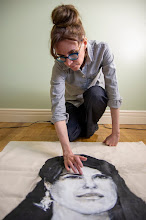
“While Long has portrayed women who really desired pregnancy, Page set out to make art about ‘everyone supposedly wanting a baby’.”
In 2005, Toronto artist Jennifer Linton made the trek to the blustery city of North Bay for a solo show I coordinated at White Water Gallery. On top of exhibiting, she gave an artist talk where her newborn baby was indisputably the youngest audience member, demonstrating that the roles of artist and mother are hardly mutually exclusive…though as artist Lindsay Page notes, they do tend to be “in direct competition.”
Fast forward six and a half years to Women’s College Hospital, where I caught up on Linton’s work the other night, while also taking in artist talks by Page and Jennifer Long. Their panel, Portrait of the Artist as a Mother: Visualizing the Unspoken, was part of the monthly Mother Outlaws’ Speakers Series organized by the Motherhood Initiative for Research and Community Involvement.
The merging of art and motherhood has arguably never been more pronounced than last month when Marni Kotak gave birth in Brooklyn’s Microscope Gallery, surrounded by a midwife, a doula, and a handful of gallery visitors. Bringing the focus back to the northern side of the border, what does it mean to be an artist-mother hybrid and what forms might it take beyond having one’s water break on a gallery floor?
The works discussed by the three artists cover the timeline of pregnancy, the postpartum state, and well into motherhood. Panel moderator Judith Mintz noted that they “challenge the myth of motherhood as celebration.” After finding that their peers mostly dismissed their concerns about mothering, they turned to art as a “safe place to have those conversations” (Linton). In stripping away the veneer, they are, in fact, outlaws of a sort.
Long’s MFA thesis revived the precursor to photographic portraits: black silhouettes in oval frames. In Swallowing Ice, she explored personal anxieties about being “on the…fence” about becoming pregnant. For example, a woman pulls a strand of hair insecurely beside repetitive text like, “What if I’m a disappointment?’”that spills out of its oval frame. She also photographed forlorn-looking friends with fertility aids such as saliva tests. As an artist focused on the pink-blue divide, I appreciated her disdain for the gendered “colour coding” of prenatal vitamins and ovulation sticks that appear in her work. She even found a pink paint chip called ‘doll’s dress.’
While Long has portrayed women who really desired pregnancy, Page set out to make art about “everyone supposedly wanting a baby.” Werewolf (see image 1 under 'Spawn' in the photography section) shows the artist standing naked in a forest with a swollen belly, with an unnerving background of scraggly branches. With this piece, she wanted to convey the severing of body and mind where bodily control is lost. Linton similarly portrayed the unnatural, with multiple self-portraits in a single ominous image. She represents herself pregnant with an animal and pregnant with inanimate objects, inspired by common dreams of expectant women.
Each of the artists have addressed the bodily realities of postpartum life. Linton made a largescale drawing, Breastfeeding Ridley, with “heroic proportions” to convey the exhaustion of the process and the transition to “flabby stretchy leakiness.” Page portrayed herself hunched over and naked, with her daughter strapped to her back (see image 9 under 'Spawn' in the photography section), bringing to mind a snapshot of Linton at her drafting table with her son slung to her front. Page describes her self-portraits as a defense against the erasure she felt in becoming a mother, as her daughter’s quickly developing physicality seemed to eclipse her own presence. Seeing Linton and Page present first on the panel made one of Long’s opening comments instantly clear: “As you step into motherhood, there’s a mourning that occurs.”
Long’s newer photos, the Fold series, don’t necessarily read as mournful, although there is a sense of loneliness because the human interaction I associate with her earlier work is gone. For example, we see a woman’s arm with milk dribbling down it, without a supportive partner or baby present to make it all worthwhile. There’s a bittersweetness to these images. A photo of half-eaten grapes bathed in sunlight reads not so much as domestic chaos as serenity. (While editing this post, I realized that the grapes may actually be halved to prevent choking. Long notes that it’s difficult for people to interpret these works as anything but images from a mother’s life, and the kind of childless naivety I just revealed undoubtedly factors into that complication). She explains that like author Alice Munro, she draws attention to the overlooked but precious in-between-moments. Her own in-between-moments are shrinking, she finds. By the time she would set up her beloved 4 x 5 camera, naptime would be over, causing her to turn to digital photography, which also eliminated the need to leave the house to buy and drop off film.
Linton also adjusted her process after becoming a mother. For example, she chose drawing over printmaking for an alphabet book because of concerns about toxicity, and also because a single hour became “weighted with meaning” and drawing required less set-up. It’s no ordinary alphabet book. To cite a few examples, C is for consumerism, Q is for queer, and T is for tattoo.
Page changed how she worked too. Her daughter became a ready “prop” but she also became engaged in the process. Page asked her to recreate a pose in which she was hidden under a chenille blanket and upended couch cushions, with one leg dangling from the couch. A second photo taken by Page shows the scene rearranged by her daughter, with her standing in front of the couch and holding a camera herself, with a man’s legs poking out from the blanket. So, in answer to the question ‘What does it mean to be an artist-mother?,’ maybe, in part, it means raising children who find self-expression and creativity to be second nature.
Sunday, November 27, 2011

Sunday, November 13, 2011
A Girl’s Guide to The Guy’s Guide to Feminism
“Problems are discussed with just the right amount of hard facts backing up the authors’ progressive viewpoints.”
The sole wedding party I’ve been in was for a male friend from art school. He is the only man I’ve known personally to describe himself as a feminist, which makes me love him even more. It makes me wonder, why haven’t more men in my life embraced the so-called f-word? Enter the book that just launched in Toronto, The Guy’s Guide to Feminism (Seal Press, 2011) by Michael Kaufman and Michael Kimmel, who are both educators, activists, and seasoned writers.
Billed as a humorous book by three-quarters of the advanced praise, it does have LOL moments. For example, the Michael Ks suggest that the reason men get out of the lion’s share of housework is fear of having ‘it’ caught in the oven door or sucked up the hose of a vacuum, while the cause for women’s historical absence from academia was the massive size of their dresses, which could not be accommodated by school desks. Also humorous is the authors’ occasional macho posturing. Thankfully, it was clearly satirical--in marked contrast to the horrifying Facebook groups that have been getting press lately, like ‘You know shes [sic] playing hard to get when your [sic] chasing her down an alleyway.’ Clearly, there is a need for The Guy’s Guide to Feminism. For me, the biggest laugh came from their website promoting the book: they write, “If you read (or write) a review...let your local Tea Party chapter know about it, which will quickly land the review on Fox News, and with all their announcers ranting and raving against it, we'll hear about it that way.”
The book takes the form of an encyclopedia—albeit a hip one complete with cartoons—with short entries arranged alphabetically. I found myself fantasizing about having a son and answering prickly questions like, “Mom, why is feminazi a bad word?” by simply turning a page. The tone is casual, with slang like ‘pussy-whipped,’ and concepts like heteronormativity simplified as ‘the male-female thing.’ Reluctant readers will surely be comforted by the absence of academic jargon (at one point, the authors even include a poem as an alternative to the “boring lecture version” and refer to the impenetrability of scholarly texts). Of course, this is all a non-confrontational lead-in to deconstruct serious problems, in the same way that my chipper dentist makes me feel at ease before drilling into my enamel; the gentle intro to hard work isn’t fooling anyone. Problems are discussed with just the right amount of hard facts backing up the authors’ progressive viewpoints. Data, like the sobering difference between female representation in parliament in countries that have affirmative action quotas versus those that do not, is kept to a minimum, so it doesn’t feel too encyclopedic. Equally modest in degree are the historical tidbits, like job ads from the 1950s that specified the gender required of applicants. The authors give us a break from their own voices with the interspersion of fictional dialogues between, for example, a sergeant and a defiant recruit hell-bent on defending women’s right to serve in the military, or between a porn producer, a director, and a feminist executive assistant. Shifting to characters doesn’t so much reduce the effect of the two Michaels up on a soapbox as break up the format for the sake of variety.
There’s plenty of practical advice for the young man, like how to deal tactfully with the bill at the end of a date, and critical advice like how exactly to identify consent between the sheets. The discussion often comes back to the question, “What’s in it for me?” but it’s never without asking, ‘Dude, can you believe this is the situation? Do we really want this for our moms, our sisters, our girlfriends, etc.?’
As an adult reader, I found myself distracted while reading entries on topics such as homophobia and honour killings by making connections to news stories like Brett Ratner stepping down from the Oscars last week after using a pejorative term for gay men, or the current Ontario Superior Court trial for the drowning of several family members in Kingston. Like the Facebook group mentioned above, these news stories underscore the relevance of the book. Another distraction was my impulse to connect unjust experiences of mine or of my friends to the topics. That made me think that this could also be a great gift for a young woman, to encourage her to reflect on how she should be treated.
The holiday season is approaching, and what’s a better gift than feminism?
Kaufman and Kimmel’s next launch date is November 22 at the always fabulous Bluestockings in New York.
The sole wedding party I’ve been in was for a male friend from art school. He is the only man I’ve known personally to describe himself as a feminist, which makes me love him even more. It makes me wonder, why haven’t more men in my life embraced the so-called f-word? Enter the book that just launched in Toronto, The Guy’s Guide to Feminism (Seal Press, 2011) by Michael Kaufman and Michael Kimmel, who are both educators, activists, and seasoned writers.
Billed as a humorous book by three-quarters of the advanced praise, it does have LOL moments. For example, the Michael Ks suggest that the reason men get out of the lion’s share of housework is fear of having ‘it’ caught in the oven door or sucked up the hose of a vacuum, while the cause for women’s historical absence from academia was the massive size of their dresses, which could not be accommodated by school desks. Also humorous is the authors’ occasional macho posturing. Thankfully, it was clearly satirical--in marked contrast to the horrifying Facebook groups that have been getting press lately, like ‘You know shes [sic] playing hard to get when your [sic] chasing her down an alleyway.’ Clearly, there is a need for The Guy’s Guide to Feminism. For me, the biggest laugh came from their website promoting the book: they write, “If you read (or write) a review...let your local Tea Party chapter know about it, which will quickly land the review on Fox News, and with all their announcers ranting and raving against it, we'll hear about it that way.”
The book takes the form of an encyclopedia—albeit a hip one complete with cartoons—with short entries arranged alphabetically. I found myself fantasizing about having a son and answering prickly questions like, “Mom, why is feminazi a bad word?” by simply turning a page. The tone is casual, with slang like ‘pussy-whipped,’ and concepts like heteronormativity simplified as ‘the male-female thing.’ Reluctant readers will surely be comforted by the absence of academic jargon (at one point, the authors even include a poem as an alternative to the “boring lecture version” and refer to the impenetrability of scholarly texts). Of course, this is all a non-confrontational lead-in to deconstruct serious problems, in the same way that my chipper dentist makes me feel at ease before drilling into my enamel; the gentle intro to hard work isn’t fooling anyone. Problems are discussed with just the right amount of hard facts backing up the authors’ progressive viewpoints. Data, like the sobering difference between female representation in parliament in countries that have affirmative action quotas versus those that do not, is kept to a minimum, so it doesn’t feel too encyclopedic. Equally modest in degree are the historical tidbits, like job ads from the 1950s that specified the gender required of applicants. The authors give us a break from their own voices with the interspersion of fictional dialogues between, for example, a sergeant and a defiant recruit hell-bent on defending women’s right to serve in the military, or between a porn producer, a director, and a feminist executive assistant. Shifting to characters doesn’t so much reduce the effect of the two Michaels up on a soapbox as break up the format for the sake of variety.
There’s plenty of practical advice for the young man, like how to deal tactfully with the bill at the end of a date, and critical advice like how exactly to identify consent between the sheets. The discussion often comes back to the question, “What’s in it for me?” but it’s never without asking, ‘Dude, can you believe this is the situation? Do we really want this for our moms, our sisters, our girlfriends, etc.?’
As an adult reader, I found myself distracted while reading entries on topics such as homophobia and honour killings by making connections to news stories like Brett Ratner stepping down from the Oscars last week after using a pejorative term for gay men, or the current Ontario Superior Court trial for the drowning of several family members in Kingston. Like the Facebook group mentioned above, these news stories underscore the relevance of the book. Another distraction was my impulse to connect unjust experiences of mine or of my friends to the topics. That made me think that this could also be a great gift for a young woman, to encourage her to reflect on how she should be treated.
The holiday season is approaching, and what’s a better gift than feminism?
Kaufman and Kimmel’s next launch date is November 22 at the always fabulous Bluestockings in New York.
Thursday, October 13, 2011
Jennifer Dalton at Winkleman Gallery
“The Colbert Report…had the poorest representation of female guests, at only 17.5%.”
While making travel arrangements for New York Archives Week, I was pleased to discover that Winkleman Gallery was only four avenues over on the same street in Chelsea as the Artists Records in the Archives Symposium where I presented yesterday on social media.
The title of Jennifer Dalton’s exhibition at Winkleman caught my attention. Cool Guys Like You is a nod to the 1988 movie, Heathers. It was one of my favourites in high school, not so much because my name is Heather but because it critiqued the popular girl clique (to which I was diametrically opposed). Even though I lived in a rural area during the pre-Internet era, I managed to find the Heathers soundtrack, which I held onto until Toronto musician David Lush had a goth garage sale in Parkdale. Anyway, back to the movie: Winona Ryder plays Veronica, a jaded student who purges her high school of the queen ‘megabitch’ (one of two named Heather) along with a few sexist jocks, after being lured to the dark side by her psychotic boyfriend, Jason, played by Christian Slater. When she battles him to try to dismantle a bomb and finally washes her hands of him, she says, “You know what I need? Cool guys like you out of my life.”
Among several text-based works in the show, there is one in which Dalton addresses the movie explicitly by commenting on gratuitousness of shower scenes and wardrobe changes. Although the show continues in a feminist vein, the title Cool Guys Like You does not refer only to men. In fact, in the press release, it is used as a gender-neutral colloquialism aimed at talk show personalities. Dalton commends Brian Lehrer, Terry Gross, Leonard Lopate, Stephen Colbert, Charlie Rose, Rachel Maddow, Bill Maher, and Jon Stewart for featuring “impressive, fascinating, intelligent guests” (1), but she is nonplussed about the number of women and ethnic minorities they interview. From the first piece I encountered in the show, To Whose Opinion Am I Listening? I learned that The Colbert Report, which I logged a lot of hours watching while living in the US, had the poorest representation of female guests, at only 17.5%. (2) In response to this disparity, the press release asks succinctly, “WTF?” Fortunately, Dalton’s exploration in visual terms is more nuanced. For one thing, she displays the data “lovingly by hand” (3). Pie charts with pencil contours and painted pastel interiors (shown here) reveal that Colbert is not the only culprit: the lion’s share of guest spots (65%+) for all these American shows go to men. Thus, the artist questions whether she would be better off not watching them.
Another way Dalton represents this problem is with horizontal rows of celebrity photos, categorized not by the talk show on which they appeared but by their vocation. In What Does An Important Person Look Like?, male guests have gold frames and female guests have—you guessed it—silver frames. (There is a surprise in one photo of a mixed-gender band with a part-silver, part-gold frame). While this might seem redundant in light of the pie charts, it is novel in introducing race as a second factor to consider in this winnowing of guests. For example, in the realm of politics, Condaleezza Rice was the sole female interviewed on any of these programs last year. Using screen captures of their interviews rather than graphs highlights that Rice was in the company of surprisingly few politicians of colour.
Politics takes centre stage in a graphite piece that could easily be called Uncool Guys, but is instead called Libido-based Idiocy and Assholery in Modern Political Scandals. Republicans and Democrats are represented along the border by the usual star-adorned elephants and donkeys, with the addition of prominent phalluses. Bill Clinton is smack dab in the middle of the timeline of impropriety. Each politician has a letter or letters following his name, which is explained by a legend. Arnold Schwarzenegger acdm, for instance, refers to “betrayed and humiliated wife,” “lied to and/or about his own children,” “creepily pursued much younger people and/or subordinates,” and lastly, “when push came to shove, lied like hell!” In this work, Dalton moves from observation to unabashed judgment. Personally, I tend to extend back to politicians the courtesy of Pierre Trudeau’s statement, “There’s no place for the state in the bedrooms of the nation” (4). Maybe it’s because I take for granted that lotharios like JFK have long slipped under the radar and preserved their reputation as—what were those qualities Dalton identified? Impressive, fascinating, and intelligent. Another work, Only in America (or, I Can’t Trust Myself), is arguably more sympathetic to the confusion of life's crossroads. It is a set of two vending machines—the type you find in shopping malls with five-cent candy—that contain temporary tattoos. One machine has a sign that says, “When you are afraid of something that usually means you should do it” and its counterpart says, “When you are afraid of something that usually means you shouldn’t do it.” While it’s hard not to chuckle at this piece, the burgeoning Occupy Wall Street protests not so far away provide a serious context of dissatisfaction with the government.
Dalton also exposes the idiocy and assholery, to borrow her phrasing, to which she is subject as an artist. Another text-based graphite work lists common questions she hears. Examples like, “What have you got against men?” and “What does your husband do that you can afford to do this?” raise the proverbial red flag. Others are more ambiguous, like queries about what it’s like to work with certain men such as gallerist Edward Winkleman. On the one hand, asking this defines a woman in relation to a man in a position of power, which is uncool. On the other hand, it seems like a reasonable question that a sincerely interested partly might ask. Its inclusion among more obviously irksome questions suggests annoyance on the artist’s part. Here’s my question: would the possibility of provoking a knee-jerk response discourage talk show hosts from inviting feminist artists, or feminists in general, to be guests? I ask that as an artist who, like Walton, is driven by having a “bee in my bonnet.” (5)
On my way out, I slipped my hand into an opening in a grey box and lowered a lever as instructed. Had I been a man with larger hands, I would have walked away with ‘cool’ stamped in a lovely black script. However, it only printed ‘ol’ on my hand, which seemed dangerously close to ‘old’ and a cruel reminder that even now, well beyond my teen years, coolness eludes me. And yet, had I been successful, I would have found that coolness of the packaged kind is fleeting.
Cool Guys Like You closes October 15.
(1) Press release, Winkleman Gallery
(2) Since I spent the past two days watching presentations about artists using archival material, I wanted to point out that this is yet another example (in case any of my symposium colleagues are reading). Dalton was able to access online archives for all of the talk shows except The Colbert Report, for which she relied on Wikipedia data.
(3) Text taken from To Whose Opinion Am I Listening?, 2011
(4) December 21, 1967, House of Commons, Canada
(5) Press release, Winkleman Gallery
While making travel arrangements for New York Archives Week, I was pleased to discover that Winkleman Gallery was only four avenues over on the same street in Chelsea as the Artists Records in the Archives Symposium where I presented yesterday on social media.
The title of Jennifer Dalton’s exhibition at Winkleman caught my attention. Cool Guys Like You is a nod to the 1988 movie, Heathers. It was one of my favourites in high school, not so much because my name is Heather but because it critiqued the popular girl clique (to which I was diametrically opposed). Even though I lived in a rural area during the pre-Internet era, I managed to find the Heathers soundtrack, which I held onto until Toronto musician David Lush had a goth garage sale in Parkdale. Anyway, back to the movie: Winona Ryder plays Veronica, a jaded student who purges her high school of the queen ‘megabitch’ (one of two named Heather) along with a few sexist jocks, after being lured to the dark side by her psychotic boyfriend, Jason, played by Christian Slater. When she battles him to try to dismantle a bomb and finally washes her hands of him, she says, “You know what I need? Cool guys like you out of my life.”
Among several text-based works in the show, there is one in which Dalton addresses the movie explicitly by commenting on gratuitousness of shower scenes and wardrobe changes. Although the show continues in a feminist vein, the title Cool Guys Like You does not refer only to men. In fact, in the press release, it is used as a gender-neutral colloquialism aimed at talk show personalities. Dalton commends Brian Lehrer, Terry Gross, Leonard Lopate, Stephen Colbert, Charlie Rose, Rachel Maddow, Bill Maher, and Jon Stewart for featuring “impressive, fascinating, intelligent guests” (1), but she is nonplussed about the number of women and ethnic minorities they interview. From the first piece I encountered in the show, To Whose Opinion Am I Listening? I learned that The Colbert Report, which I logged a lot of hours watching while living in the US, had the poorest representation of female guests, at only 17.5%. (2) In response to this disparity, the press release asks succinctly, “WTF?” Fortunately, Dalton’s exploration in visual terms is more nuanced. For one thing, she displays the data “lovingly by hand” (3). Pie charts with pencil contours and painted pastel interiors (shown here) reveal that Colbert is not the only culprit: the lion’s share of guest spots (65%+) for all these American shows go to men. Thus, the artist questions whether she would be better off not watching them.
Another way Dalton represents this problem is with horizontal rows of celebrity photos, categorized not by the talk show on which they appeared but by their vocation. In What Does An Important Person Look Like?, male guests have gold frames and female guests have—you guessed it—silver frames. (There is a surprise in one photo of a mixed-gender band with a part-silver, part-gold frame). While this might seem redundant in light of the pie charts, it is novel in introducing race as a second factor to consider in this winnowing of guests. For example, in the realm of politics, Condaleezza Rice was the sole female interviewed on any of these programs last year. Using screen captures of their interviews rather than graphs highlights that Rice was in the company of surprisingly few politicians of colour.
Politics takes centre stage in a graphite piece that could easily be called Uncool Guys, but is instead called Libido-based Idiocy and Assholery in Modern Political Scandals. Republicans and Democrats are represented along the border by the usual star-adorned elephants and donkeys, with the addition of prominent phalluses. Bill Clinton is smack dab in the middle of the timeline of impropriety. Each politician has a letter or letters following his name, which is explained by a legend. Arnold Schwarzenegger acdm, for instance, refers to “betrayed and humiliated wife,” “lied to and/or about his own children,” “creepily pursued much younger people and/or subordinates,” and lastly, “when push came to shove, lied like hell!” In this work, Dalton moves from observation to unabashed judgment. Personally, I tend to extend back to politicians the courtesy of Pierre Trudeau’s statement, “There’s no place for the state in the bedrooms of the nation” (4). Maybe it’s because I take for granted that lotharios like JFK have long slipped under the radar and preserved their reputation as—what were those qualities Dalton identified? Impressive, fascinating, and intelligent. Another work, Only in America (or, I Can’t Trust Myself), is arguably more sympathetic to the confusion of life's crossroads. It is a set of two vending machines—the type you find in shopping malls with five-cent candy—that contain temporary tattoos. One machine has a sign that says, “When you are afraid of something that usually means you should do it” and its counterpart says, “When you are afraid of something that usually means you shouldn’t do it.” While it’s hard not to chuckle at this piece, the burgeoning Occupy Wall Street protests not so far away provide a serious context of dissatisfaction with the government.
Dalton also exposes the idiocy and assholery, to borrow her phrasing, to which she is subject as an artist. Another text-based graphite work lists common questions she hears. Examples like, “What have you got against men?” and “What does your husband do that you can afford to do this?” raise the proverbial red flag. Others are more ambiguous, like queries about what it’s like to work with certain men such as gallerist Edward Winkleman. On the one hand, asking this defines a woman in relation to a man in a position of power, which is uncool. On the other hand, it seems like a reasonable question that a sincerely interested partly might ask. Its inclusion among more obviously irksome questions suggests annoyance on the artist’s part. Here’s my question: would the possibility of provoking a knee-jerk response discourage talk show hosts from inviting feminist artists, or feminists in general, to be guests? I ask that as an artist who, like Walton, is driven by having a “bee in my bonnet.” (5)
On my way out, I slipped my hand into an opening in a grey box and lowered a lever as instructed. Had I been a man with larger hands, I would have walked away with ‘cool’ stamped in a lovely black script. However, it only printed ‘ol’ on my hand, which seemed dangerously close to ‘old’ and a cruel reminder that even now, well beyond my teen years, coolness eludes me. And yet, had I been successful, I would have found that coolness of the packaged kind is fleeting.
Cool Guys Like You closes October 15.
(1) Press release, Winkleman Gallery
(2) Since I spent the past two days watching presentations about artists using archival material, I wanted to point out that this is yet another example (in case any of my symposium colleagues are reading). Dalton was able to access online archives for all of the talk shows except The Colbert Report, for which she relied on Wikipedia data.
(3) Text taken from To Whose Opinion Am I Listening?, 2011
(4) December 21, 1967, House of Commons, Canada
(5) Press release, Winkleman Gallery
Sunday, October 2, 2011
John Shipman at Nuit Blanche
“…the intention was to select an imaginary lover’s sex and gender…”
Never before have I arrived at a subway station, turned around, and left because the lineup not only filled the staircase but exceeded single file. Until last night. Hordes of people squeezed into Kipling station, presumably to head to Scotiabank Nuit Blanche, the all-night art festival in Toronto. I don’t want to sound like an old fogey, but I have fond memories of walking through the drizzling rain with my sister in the first year of Nuit Blanche. Bumping into mutual acquaintances before all the hype, it felt, dare I say, magical? I would compare the next visit to my first experience at a music festival wherein I got caught in a Ministry mosh pit—I remember grasping for hands in the crowd of art lovers at the University of Toronto and feeling empathy for those afflicted by claustrophobia. That experience caused me to avoid attending last year, even though I was in a show at Red Head Gallery. This year, I decided to wise up and brave the crowds once again.
After failed attempt #1, my husband and I returned home and set out again at midnight. Arriving at a heritage church at about 12:45 am, I thought to myself wryly, “Well, I’ve never been to church this early on a Sunday.” I was too tired to laugh at my own joke, let alone share it with my husband. However, I was determined to catch this particular show. In St. Matthew’s United Church in Zone A, Toronto-based John Shipman exhibited Listening to Love: Next Time Can We Choose Our Gender? Incidentally, Shipman was part of a three-person installation last year in the same location. In it, the artists invited visitors to explore their own mortality through condolence books and CoffinPhones containing audio tracks of expressions of grief.
This year, the entrance contained artifacts from the so-called Museum of Gender Archaeology. Mounted on a hut-like structure were vestiges of our gender binarism, like figurines with arms amputated by pink and blue razors (pink for girls and blue for boys, of course). There were also signs of hope, like a tongue-in-cheek gadget called the ‘gender changer’ and an unaltered sign for a unisex bathroom, which are becoming mandated at more and more schools.
In the church proper, last year’s CoffinPhones were replaced by GendeRphones. I got myself situated and looked at the dials containing the bathroom pictograms for male/female and the letters XX and XY. I had to remind myself which gender is XX and which is XY. “Oh right,” I thought, “Henry VIII had no r ight to be upset with his wives for not giving him a son because it’s the man who contributes the determining chromosome.” (My father and high school biology teacher must have been rolling in his grave). Looking at the press release in retrospect, I realize that the intention was to select an imaginary lover’s sex and gender, which underscores society’s tendency to lump them together. Mistakenly, I thought it was an opportunity to select my own gender and my prospective lover’s gender. No matter. I think it engaged the same principles of fantasy and open-mindedness.
The digitized voice made endless loving statements in the same static voices library phone systems use, which turn my name into ‘Heether.’ It was a quirky contrast to the sentiment of the expressions, especially “I hear your voice on my skin.” Some were clichés, some were so poetic you can’t imagine anyone actually saying them, some were riddled with everyday references (I love kissing you when you’ve been drinking diet Coke) and others had contemporary references (I love how Facebook tells me we are in a relationship). Most were outpourings of love but some were invitations to love. In terms of the latter, I imagine I was not alone in having a hard time feeling an affinity with the disembodied digital voices. Thus, it was appropriate that business cards were inserted throughout the installation that quoted Marshall McLuhan: “When you are on the phone...you have no body.”
It was a challenge to hear the digitized voices because of the music playing in the church. When there was a pause between songs, you could hear overlapping female and male audio tracks on the phone but otherwise, it was pnly possible to make out the dominant track. I found myself wishing the music were off so I could enjoy this element. That impulse went away when Leonard Cohen’s incredible song, Hallejlujah, belted out over the speakers. For the duration of the song, I was overcome by hope for freedom in the realm of gender identity and knew it was worth it that I’d be crawling into bed at 2 am with my XY.
Never before have I arrived at a subway station, turned around, and left because the lineup not only filled the staircase but exceeded single file. Until last night. Hordes of people squeezed into Kipling station, presumably to head to Scotiabank Nuit Blanche, the all-night art festival in Toronto. I don’t want to sound like an old fogey, but I have fond memories of walking through the drizzling rain with my sister in the first year of Nuit Blanche. Bumping into mutual acquaintances before all the hype, it felt, dare I say, magical? I would compare the next visit to my first experience at a music festival wherein I got caught in a Ministry mosh pit—I remember grasping for hands in the crowd of art lovers at the University of Toronto and feeling empathy for those afflicted by claustrophobia. That experience caused me to avoid attending last year, even though I was in a show at Red Head Gallery. This year, I decided to wise up and brave the crowds once again.
After failed attempt #1, my husband and I returned home and set out again at midnight. Arriving at a heritage church at about 12:45 am, I thought to myself wryly, “Well, I’ve never been to church this early on a Sunday.” I was too tired to laugh at my own joke, let alone share it with my husband. However, I was determined to catch this particular show. In St. Matthew’s United Church in Zone A, Toronto-based John Shipman exhibited Listening to Love: Next Time Can We Choose Our Gender? Incidentally, Shipman was part of a three-person installation last year in the same location. In it, the artists invited visitors to explore their own mortality through condolence books and CoffinPhones containing audio tracks of expressions of grief.
This year, the entrance contained artifacts from the so-called Museum of Gender Archaeology. Mounted on a hut-like structure were vestiges of our gender binarism, like figurines with arms amputated by pink and blue razors (pink for girls and blue for boys, of course). There were also signs of hope, like a tongue-in-cheek gadget called the ‘gender changer’ and an unaltered sign for a unisex bathroom, which are becoming mandated at more and more schools.
In the church proper, last year’s CoffinPhones were replaced by GendeRphones. I got myself situated and looked at the dials containing the bathroom pictograms for male/female and the letters XX and XY. I had to remind myself which gender is XX and which is XY. “Oh right,” I thought, “Henry VIII had no r
 ight to be upset with his wives for not giving him a son because it’s the man who contributes the determining chromosome.” (My father and high school biology teacher must have been rolling in his grave). Looking at the press release in retrospect, I realize that the intention was to select an imaginary lover’s sex and gender, which underscores society’s tendency to lump them together. Mistakenly, I thought it was an opportunity to select my own gender and my prospective lover’s gender. No matter. I think it engaged the same principles of fantasy and open-mindedness.
The digitized voice made endless loving statements in the same static voices library phone systems use, which turn my name into ‘Heether.’ It was a quirky contrast to the sentiment of the expressions, especially “I hear your voice on my skin.” Some were clichés, some were so poetic you can’t imagine anyone actually saying them, some were riddled with everyday references (I love kissing you when you’ve been drinking diet Coke) and others had contemporary references (I love how Facebook tells me we are in a relationship). Most were outpourings of love but some were invitations to love. In terms of the latter, I imagine I was not alone in having a hard time feeling an affinity with the disembodied digital voices. Thus, it was appropriate that business cards were inserted throughout the installation that quoted Marshall McLuhan: “When you are on the phone...you have no body.”
It was a challenge to hear the digitized voices because of the music playing in the church. When there was a pause between songs, you could hear overlapping female and male audio tracks on the phone but otherwise, it was pnly possible to make out the dominant track. I found myself wishing the music were off so I could enjoy this element. That impulse went away when Leonard Cohen’s incredible song, Hallejlujah, belted out over the speakers. For the duration of the song, I was overcome by hope for freedom in the realm of gender identity and knew it was worth it that I’d be crawling into bed at 2 am with my XY.
Sunday, September 11, 2011
This woman's work...
“…craft and art have become rather comfortable bedfellows.”
The apparent absence of external signage for Project Space worked out alright last night because my husband and I took in many of the sights and sounds of Supercrawl before attending the opening that brought us to Hamilton. A few that come to mind are a child transfixed by a harp, a chorus belting out a song with lyrics consisting of but one word (meow), street planters adorned with cozy wraps containing messages like ‘fail better.’
This woman’s work… is on show at Project Space until October 1. Curated by Sally Frater, it features textile-based work by seven female artists from southern Ontario. Amongst the emerging artists is Shelley Niro, who acts as a keystone. Maybe the spectrum of emerging to established artists would feel more palatable in a larger exhibition, with the inclusion of other artists of her ilk to create balance. As is, the closest thing is a reference to Joyce Wieland, in Erika De Freitas’ Oh Canada, In Conversation, an embroidery which is a nod to Wieland’s print of lip marks while singing the national anthem. The date of Niro’s works, the oldest being 1993, makes her something of a double anomaly in relation to the rest of the show, which features mostly new work. It was back in 1993, incidentally, that Estella Lauter wrote of the legitimization of craft in art as being “still partial” (1). Today, though, the Project Space show is promoted by Toronto Craft Alert, and craft and art have become rather comfortable bedfellows.
Some of the works are almost too easy of a fit for the theme, such as Hitoko Okada’s intricately constructed beehive dress. Emphasis on construction of the work is apparent in most works, like the needles hanging from red threads that in turn descend from the pubic area of Insoon Ha’s all-white nightgown; the half-covered hanger amidst traditional Hungarian (I believe) stitching by Ingrid Mayrhofer; areas of concentrated pins puncturing the whitish-pink surfaces of Simone Aziga’s sculptural dress-like forms that hang overhead; and Colina Maxwell’s machine-stitched cityscape made from a sweater, accompanied by a video of its production. The latter is another example of work that, on the surface, makes sense in the mix, but ultimately seems to be less about the convergence of feminism and craft and more about other issues (in this case, recycling and, by virtue of its floral motif shifting vertically in the collage process, the downsides of urban sprawl).
References:
(1) Estella Lauter, “Re-enfranchising Art: Feminist Interventions in The Theory of Art,” pp. 21-34, quotation p. 28, in Hilde Hein and Carolyn Korsmeyer, eds., Aesthetics In Feminist Perspective. (Hypatia, Inc.).
The apparent absence of external signage for Project Space worked out alright last night because my husband and I took in many of the sights and sounds of Supercrawl before attending the opening that brought us to Hamilton. A few that come to mind are a child transfixed by a harp, a chorus belting out a song with lyrics consisting of but one word (meow), street planters adorned with cozy wraps containing messages like ‘fail better.’
This woman’s work… is on show at Project Space until October 1. Curated by Sally Frater, it features textile-based work by seven female artists from southern Ontario. Amongst the emerging artists is Shelley Niro, who acts as a keystone. Maybe the spectrum of emerging to established artists would feel more palatable in a larger exhibition, with the inclusion of other artists of her ilk to create balance. As is, the closest thing is a reference to Joyce Wieland, in Erika De Freitas’ Oh Canada, In Conversation, an embroidery which is a nod to Wieland’s print of lip marks while singing the national anthem. The date of Niro’s works, the oldest being 1993, makes her something of a double anomaly in relation to the rest of the show, which features mostly new work. It was back in 1993, incidentally, that Estella Lauter wrote of the legitimization of craft in art as being “still partial” (1). Today, though, the Project Space show is promoted by Toronto Craft Alert, and craft and art have become rather comfortable bedfellows.
Some of the works are almost too easy of a fit for the theme, such as Hitoko Okada’s intricately constructed beehive dress. Emphasis on construction of the work is apparent in most works, like the needles hanging from red threads that in turn descend from the pubic area of Insoon Ha’s all-white nightgown; the half-covered hanger amidst traditional Hungarian (I believe) stitching by Ingrid Mayrhofer; areas of concentrated pins puncturing the whitish-pink surfaces of Simone Aziga’s sculptural dress-like forms that hang overhead; and Colina Maxwell’s machine-stitched cityscape made from a sweater, accompanied by a video of its production. The latter is another example of work that, on the surface, makes sense in the mix, but ultimately seems to be less about the convergence of feminism and craft and more about other issues (in this case, recycling and, by virtue of its floral motif shifting vertically in the collage process, the downsides of urban sprawl).
References:
(1) Estella Lauter, “Re-enfranchising Art: Feminist Interventions in The Theory of Art,” pp. 21-34, quotation p. 28, in Hilde Hein and Carolyn Korsmeyer, eds., Aesthetics In Feminist Perspective. (Hypatia, Inc.).
Sunday, August 28, 2011
!Women Art Revolution
"Altogether, 12,428 minutes of footage were 'patched together like a quilt'."
Amidst graffiti that spelled ‘vomit,’ neighbourhoods of dilapidated homes, and scenes like this one my husband shot, we found ourselves in a stunningly beautiful place in downtown Detroit last week-end. We attended the final night of the summer film series at the Detroit Institute of Arts in this stellar auditorium: (click here). I was as excited about the venue as I was about the film: !Women Art Revolution, directed by Lynn Hershman Leeson (a featured artist in the exhibition whose catalogue I worked on at the Neuberger Museum of Art earlier this year, The Deconstructive Impulse).
Leeson recounts in !W.A.R. how she wrote reviews of her work pseudonymously when she was an emerging artist, resulting in her first exhibition. Her next big accomplishment was a major sale of her work, but the collector backed out upon learning her gender because he said it would be a poor investment to buy the work of a female artist. Today, that body of work by Leeson is valued at 9,000 times its original price. Look who’s laughing now. Impressively, Leeson financed the film with sales from her own work, which makes me want to promote it even more.
!W.A.R. is not unlike The Heretics, which I blogged about last year. That’s not a criticism, and it may be inevitable given that both documentaries cover similar time periods, with Leeson’s being about the development of feminist art in America and Joan Braderman’s The Heretics being about the development of a magazine in New York City about feminist art. !W.A.R. is a great counterpart to The Heretics, in part because much of the footage was filmed on the opposite coast, from her living room in Berkeley, California. Some interviews were filmed elsewhere, like the one with Judy Chicago in a bathroom noted for its decent acoustics. Many of the same artists and critics, such as Harmony Hammond and Lucy Lippard, are interviewed in both films. And both films have a quirky sensibility, complete with sound effects and playful cartoons/animations. For example, !W.A.R. shows a cartoon of Nancy Spero being forced to show her portfolio to a gallerist on the floor instead of on a nearby sculpture stand. That is the least of the unconscionable behaviour discussed in the interviews. As in The Heretics, many of the women interviewed by Leeson root the feminist art movement in social justice and general consciousness raising. For me, there are two unforgettable clips in !W.A.R.. One is Arlene Raven’s deadpan description of her effectively going on strike as a domestic servant, followed almost immediately by the collapse of her marriage; right when you might laugh at the absurdity of cause and effect, she reveals that she was raped three days later. The other clip is of African American artist, Howardena Pindell, remembering how as a child, she was tied to her cot during nap time to prevent her from using the same bathroom as the white children. The film balances these sobering tales by including interviews with the likes of Marcia Tucker, who notes that humour is the greatest tool in fighting adversity. And it is interesting to hear from artists like Faith Wilding, who didn’t feel feminist rage as a newly married woman but found herself in the movement nonetheless.
Altogether, 12,428 minutes of footage were “patched together like a quilt.” A highlight of the film is its inclusion of archival footage other than interviews. It was a real treat to see the opening of the Womanhouse installation in which CAL ARTS students each took over a room in an old house; Congress debating whether Judy Chicago’s installation, The Dinner Party, was pornographic; and protests at the Guggenheim when a survey exhibition excluded female artists and included Carl Andre, who was acquitted controversially shortly beforehand in the murder of his artist-wife, Ana Mendieta, who fell to her death from their New York apartment.
The focus of !W.A.R. is definitely on the 1970s, but it does extend to later developments, such as the creation of the Guerilla Girls (the mask-wearing educators who continue to ask pointed questions of institutions through posters, protests, and lectures to remedy the double standard facing women artists). Also included is a discussion of the major feminist exhibition, WACK!, and interviews with several contemporary feminist artists. The one that stood out for me as a librarian was Janine Antoni saying that she couldn’t find library books on any of the feminist artists her professors suggested she research.
Towards the end, film critic B. Ruby Ritch expresses concern that the survivors of the feminist artist movement are like old KGB agents, relegated to a scrapbook that no one’s interested in now. With its poignant interviews and its plethora of images by women artists, !Women Art Revolution will hopefully prove otherwise.
Amidst graffiti that spelled ‘vomit,’ neighbourhoods of dilapidated homes, and scenes like this one my husband shot, we found ourselves in a stunningly beautiful place in downtown Detroit last week-end. We attended the final night of the summer film series at the Detroit Institute of Arts in this stellar auditorium: (click here). I was as excited about the venue as I was about the film: !Women Art Revolution, directed by Lynn Hershman Leeson (a featured artist in the exhibition whose catalogue I worked on at the Neuberger Museum of Art earlier this year, The Deconstructive Impulse).
Leeson recounts in !W.A.R. how she wrote reviews of her work pseudonymously when she was an emerging artist, resulting in her first exhibition. Her next big accomplishment was a major sale of her work, but the collector backed out upon learning her gender because he said it would be a poor investment to buy the work of a female artist. Today, that body of work by Leeson is valued at 9,000 times its original price. Look who’s laughing now. Impressively, Leeson financed the film with sales from her own work, which makes me want to promote it even more.
!W.A.R. is not unlike The Heretics, which I blogged about last year. That’s not a criticism, and it may be inevitable given that both documentaries cover similar time periods, with Leeson’s being about the development of feminist art in America and Joan Braderman’s The Heretics being about the development of a magazine in New York City about feminist art. !W.A.R. is a great counterpart to The Heretics, in part because much of the footage was filmed on the opposite coast, from her living room in Berkeley, California. Some interviews were filmed elsewhere, like the one with Judy Chicago in a bathroom noted for its decent acoustics. Many of the same artists and critics, such as Harmony Hammond and Lucy Lippard, are interviewed in both films. And both films have a quirky sensibility, complete with sound effects and playful cartoons/animations. For example, !W.A.R. shows a cartoon of Nancy Spero being forced to show her portfolio to a gallerist on the floor instead of on a nearby sculpture stand. That is the least of the unconscionable behaviour discussed in the interviews. As in The Heretics, many of the women interviewed by Leeson root the feminist art movement in social justice and general consciousness raising. For me, there are two unforgettable clips in !W.A.R.. One is Arlene Raven’s deadpan description of her effectively going on strike as a domestic servant, followed almost immediately by the collapse of her marriage; right when you might laugh at the absurdity of cause and effect, she reveals that she was raped three days later. The other clip is of African American artist, Howardena Pindell, remembering how as a child, she was tied to her cot during nap time to prevent her from using the same bathroom as the white children. The film balances these sobering tales by including interviews with the likes of Marcia Tucker, who notes that humour is the greatest tool in fighting adversity. And it is interesting to hear from artists like Faith Wilding, who didn’t feel feminist rage as a newly married woman but found herself in the movement nonetheless.
Altogether, 12,428 minutes of footage were “patched together like a quilt.” A highlight of the film is its inclusion of archival footage other than interviews. It was a real treat to see the opening of the Womanhouse installation in which CAL ARTS students each took over a room in an old house; Congress debating whether Judy Chicago’s installation, The Dinner Party, was pornographic; and protests at the Guggenheim when a survey exhibition excluded female artists and included Carl Andre, who was acquitted controversially shortly beforehand in the murder of his artist-wife, Ana Mendieta, who fell to her death from their New York apartment.
The focus of !W.A.R. is definitely on the 1970s, but it does extend to later developments, such as the creation of the Guerilla Girls (the mask-wearing educators who continue to ask pointed questions of institutions through posters, protests, and lectures to remedy the double standard facing women artists). Also included is a discussion of the major feminist exhibition, WACK!, and interviews with several contemporary feminist artists. The one that stood out for me as a librarian was Janine Antoni saying that she couldn’t find library books on any of the feminist artists her professors suggested she research.
Towards the end, film critic B. Ruby Ritch expresses concern that the survivors of the feminist artist movement are like old KGB agents, relegated to a scrapbook that no one’s interested in now. With its poignant interviews and its plethora of images by women artists, !Women Art Revolution will hopefully prove otherwise.
Tuesday, August 9, 2011
The Ardours of Youth
“The titillation factor of the show is striking…”
The other day, I was surprised to read that Nirvana’s Nevermind album was released 20 years ago. Has that much time really gone by since my high school friends and I donned plaid shirts and made moon-eyes at boys playing Nirvana covers in local bands? Gulp. It seemed timely that the latest exhibition at The Art Bar at Toronto’s Gladstone Hotel featured a collective named for a Nirvana song. And it seemed fitting, at least for me personally, that the theme of the collective’s recent photo shoot in Vice magazine, many of whose images are in the show, was crushes.
The international collective Ardorous is spearheaded by eighteen-year-old Petra Collins, an incoming OCADU student. I was eager to catch the show before it closed today, to support young female artists and to see what all the buzz was about. The collective’s first exhibition is called In Bloom. Given my fixation on signifiers of femininity in my own work, I was keen to see a show emphasizing “girly imagery of flowers, hearts and the colour pink” (1). The curatorial statement noted that the show was a “response to what has been ingrained in our hearts as ‘feminine[,]’ which we have chosen to embrace and celebrate.” (2) Not knowing if ‘we’ meant society or the collective, I felt some trepidation. The word ‘celebrate’ had come up recently in another curatorial text, in relation to Alex Prager’s CONTACT installation, and that didn’t sit so well with me. It was unclear whether In Bloom would be a critique of society’s celebration of femininity and be heavy on irony, or if it would simply be a celebration.
The show struck me not as ironic but as—to use 2.0 parlance—WYSIWYG. The soft focus and 1960s-style colour of the photographs make them easy on the eyes, but what defines them as eye candy is the subject matter. The statement for the collective explains the origin of its name beyond its namesake by including the definition of ardour (sexual excitement and a temporary feeling of warmth). The titillation factor of the show is striking: young women in the shower, a young woman’s buttocks poking out of denim shorts, long blond hair brushing against the waistband of a pair of tighty whities, etc. It made me wonder, does placing images of sexy young women in a bar complicate the art viewing experience? There was one gratuitous online comment about the collective that turned my stomach, causing me to doubt whether the combination of alchohol and these images is advisable. Also, in light of the recent controversy surrounding ten-year-old model, Thylane Loubry Blondeau in Paris Vogue, how young is too young for sexy photos? In spite of a risqué reading, there is an earnest quality throughout In Bloom that is a welcome change to the plethora of garish images exploiting sexuality and going viral these days. Perhaps fresh-faced sexuality verges on “girl power” (3) after all, because the young women are controlling their presentation as in classic boudoir photos. ‘Boy of my dreams’ hand-written over the pubic area on floral cotton briefs is far less disturbing than the phrases silkscreened onto store bought underwear; obsessive though it may be, the writer is thinking with her own mind. Or heart. Or libido.
Mostly, however, I’m stumped by how the show portrays girl power, since the artists don’t seem to be fighting any of the restrictions placed on them. The one exception might be a photo by Swedish artist, Emma Arvida Bystorm of a young woman lying on the grass with her hands behind her head, with bright red lips, carefully coiffed hair, and unshaven armpits that buck Western convention. It’s the counterpart to the promotional image by the same artist used for the show: a close-up of a tangerine coloured bikini bottom, with sprawling pubic hairs that must have done wonders for attendance. Its title, Lolita, reveals cultural awareness. A risk of exhibiting at a young age is lacking sufficient artistic/cultural awareness: the image that comes to mind is from a heart-shaped montage of 4 x 6-inch prints without individual artists identified, in which two girls have their hair braided together in a fashion that is disturbingly derivative of Relation in Time (1977) by artist Marina Abramović.
The show was so heavily focused on photography that it would have been stronger with one medium. Ardorous' website takes this approach and feels substantially more cohesive. Besides photographs, In Bloom included a few paintings and multiple floral headbands (the latter caused me to wonder, “Is it art? Is it craft?” without like-minded works to build the case either way). Equally distracting was the Metro article on Collins, which was torn at the edges and attached to the wall in the middle of the show. Most distracting were the permanent botanicals strewn throughout the room, taking the interpretation of the ‘in bloom’ theme too far. The most curious installation of them was in a corner beside the montage of photos: on a pedestal surrounded by devotional candles, it functioned as a makeshift reliquary. On the one hand, it could be regarded as a commentary on the veneration of youth and beauty (which is a bit strange considering the irreverent quality of the show). On the other hand, with business cards on top, it could easily be seen as self-aggrandizement.
(1) (2) (3) Curatorial text by Madelyne Beckles.
For images, see www.theardorous.com.
The other day, I was surprised to read that Nirvana’s Nevermind album was released 20 years ago. Has that much time really gone by since my high school friends and I donned plaid shirts and made moon-eyes at boys playing Nirvana covers in local bands? Gulp. It seemed timely that the latest exhibition at The Art Bar at Toronto’s Gladstone Hotel featured a collective named for a Nirvana song. And it seemed fitting, at least for me personally, that the theme of the collective’s recent photo shoot in Vice magazine, many of whose images are in the show, was crushes.
The international collective Ardorous is spearheaded by eighteen-year-old Petra Collins, an incoming OCADU student. I was eager to catch the show before it closed today, to support young female artists and to see what all the buzz was about. The collective’s first exhibition is called In Bloom. Given my fixation on signifiers of femininity in my own work, I was keen to see a show emphasizing “girly imagery of flowers, hearts and the colour pink” (1). The curatorial statement noted that the show was a “response to what has been ingrained in our hearts as ‘feminine[,]’ which we have chosen to embrace and celebrate.” (2) Not knowing if ‘we’ meant society or the collective, I felt some trepidation. The word ‘celebrate’ had come up recently in another curatorial text, in relation to Alex Prager’s CONTACT installation, and that didn’t sit so well with me. It was unclear whether In Bloom would be a critique of society’s celebration of femininity and be heavy on irony, or if it would simply be a celebration.
The show struck me not as ironic but as—to use 2.0 parlance—WYSIWYG. The soft focus and 1960s-style colour of the photographs make them easy on the eyes, but what defines them as eye candy is the subject matter. The statement for the collective explains the origin of its name beyond its namesake by including the definition of ardour (sexual excitement and a temporary feeling of warmth). The titillation factor of the show is striking: young women in the shower, a young woman’s buttocks poking out of denim shorts, long blond hair brushing against the waistband of a pair of tighty whities, etc. It made me wonder, does placing images of sexy young women in a bar complicate the art viewing experience? There was one gratuitous online comment about the collective that turned my stomach, causing me to doubt whether the combination of alchohol and these images is advisable. Also, in light of the recent controversy surrounding ten-year-old model, Thylane Loubry Blondeau in Paris Vogue, how young is too young for sexy photos? In spite of a risqué reading, there is an earnest quality throughout In Bloom that is a welcome change to the plethora of garish images exploiting sexuality and going viral these days. Perhaps fresh-faced sexuality verges on “girl power” (3) after all, because the young women are controlling their presentation as in classic boudoir photos. ‘Boy of my dreams’ hand-written over the pubic area on floral cotton briefs is far less disturbing than the phrases silkscreened onto store bought underwear; obsessive though it may be, the writer is thinking with her own mind. Or heart. Or libido.
Mostly, however, I’m stumped by how the show portrays girl power, since the artists don’t seem to be fighting any of the restrictions placed on them. The one exception might be a photo by Swedish artist, Emma Arvida Bystorm of a young woman lying on the grass with her hands behind her head, with bright red lips, carefully coiffed hair, and unshaven armpits that buck Western convention. It’s the counterpart to the promotional image by the same artist used for the show: a close-up of a tangerine coloured bikini bottom, with sprawling pubic hairs that must have done wonders for attendance. Its title, Lolita, reveals cultural awareness. A risk of exhibiting at a young age is lacking sufficient artistic/cultural awareness: the image that comes to mind is from a heart-shaped montage of 4 x 6-inch prints without individual artists identified, in which two girls have their hair braided together in a fashion that is disturbingly derivative of Relation in Time (1977) by artist Marina Abramović.
The show was so heavily focused on photography that it would have been stronger with one medium. Ardorous' website takes this approach and feels substantially more cohesive. Besides photographs, In Bloom included a few paintings and multiple floral headbands (the latter caused me to wonder, “Is it art? Is it craft?” without like-minded works to build the case either way). Equally distracting was the Metro article on Collins, which was torn at the edges and attached to the wall in the middle of the show. Most distracting were the permanent botanicals strewn throughout the room, taking the interpretation of the ‘in bloom’ theme too far. The most curious installation of them was in a corner beside the montage of photos: on a pedestal surrounded by devotional candles, it functioned as a makeshift reliquary. On the one hand, it could be regarded as a commentary on the veneration of youth and beauty (which is a bit strange considering the irreverent quality of the show). On the other hand, with business cards on top, it could easily be seen as self-aggrandizement.
(1) (2) (3) Curatorial text by Madelyne Beckles.
For images, see www.theardorous.com.
Subscribe to:
Posts (Atom)