Tuesday, November 23, 2010

In defense of the lethargic bride

“…chances are she’s going to be bitter”

It’s a toss-up as to which commuting incident was more alarming today: (1) making my way through a crowd of squealing Justin Bieber fans on a narrow platform in Toronto, ready to fend off potential trampling with my safety whistle…if only it weren’t somewhere deep within my purse OR (2) reading this in a Metro article: “…a girl should start working out as soon as she thinks the guy is about to propose.” I cannot in good conscience deconstruct the group behaviour of the Bieberettes, for I am a former NKOTB fan. (That is to say, as a pre-teen, I walked five kilometers on a regular basis to the general store for New Kids on the Block collectable cards and had my first and only foray into ‘fan fic’). Thus, I will turn my attention to the Metro.

I’m not sure what possessed me to read an article on bridal fitness. It’s probably because after a ten-year hiatus, I’ve started jogging regularly. (I’ve joked that the reason I gave up jogging was that it raised my metabolism so much that I was eating dinner twice a night, which was impractical. The part about two dinners is true but there were other reasons I stopped jogging). Pragmatism cannot be overrated, and I appreciate that brides may want to maintain a specific size because of gown alterations. However, the article didn’t seem to appeal to women’s pragmatic side. Rather it capitalized on their insecurities. A case in point: “…every fat bulge, is meticulously captured on high-def camera.”

Why should a prospective bride feel pressured to become more fit (read: slender) anyway? After all, if her beau—or belle—loves her enough to propose, subsequent changes in physical appearance should be irrelevant. If it’s for others’ impressions, like Facebook friends or wedding guests, may I suggest that the bride reassess her values and how much she loves herself? External validation is not the best kind, as intoxicating as it seems. Also, can we please leave behind the assumption that it is the man who must propose? I know several women who have waited for years to be asked that magical question. If a woman pushes herself because she expects something in return and the man—not being a mind reader—doesn’t deliver, chances are she’s going to be bitter. (Indeed, several months after I made this post, Ana Perez from Chicago threatened her boyfriend that if he didn't propose, she would call 911...which she did, prompting criminal charges. Actually, in this case, working out would probably take the edge off, though therapy would be a useful complement).

I thought society had started to move away from idealizing the female figure, based on buxom models like Doutzen Kroes and Portia De Rossi’s autobiography on anorexia, Unbearable Lightness. However, I changed my stance after purchasing my first bridal magazine for art research. I was stunned that every bride featured, without exception, was waif-like. If this is the type of visual input facing today’s bride, it’s no wonder she feels pressured to shed a few pounds.

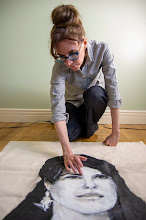
The piece I made wasn’t about body image. It was an investigation of positive and negative space; a juxtaposition of contemporary bridal imagery and ancient religious garb; and a commentary on a verse from the Apocrypha (“A silent wife is a gift from the Lord. Sirach 25:14) used in a reading at our convalidation ceremony. [Click image to enlarge sample for larger piece, aprx. 1 m x 1 m].

To sum up, I was not an aerobic bride, nor am I am a silent wife. I hope that the Bieberettes—those children with ringlets and eye makeup you may have spotted on tonight’s train—grow up to realize that self-assertion and self-acceptance trump vanity.

*Source: Romina McGuiness, “Wow at Your Wedding”, Metro News, November 23, 2010, p. 27. Print.

Friday, October 8, 2010

You like it WHERE?


“...it makes gender specific sex fodder for humour, which is where I get my knickers in a knot."

A new viral campaign on Facebook has been gaining momentum, resulting in updates from women such as, “I like it on the kitchen counter” and “I like it on the floor beside the bed.” Personally, I used to be indifferent but now I prefer the latter. For any gentlemen still in the dark, these comments refer to handbags, not hand…er, never mind. One can’t help but imagine female friends in the act as a result of these naughty-sounding status updates, reminding us of the power of visualization (which interests me as an artist because it reinforces the power of the visual).

As a feminist artist, I’m obviously interested in female power but I dare say this campaign wields none of any consequence. Although its predecessor (January’s bra colour updates) expressed some semblance of girl power by rationalizing itself with an apparent goal of bringing attention to breast cancer, this campaign makes no such claim. In fact, the Facebook message chiding women to participate uses as its incentive the fact that the previous viral campaign made it into the news. May I point out that not all content in the news is newsworthy? A cow on the loose made it into my hometown paper recently. Enough said.

On the surface, the updates seem like an empowering and fun form of sharing female sexuality à la friends Carrie, Miranda, Charlotte, and Samantha in Sex and the City. Ultimately, though, there’s no meaningful disclosure (except of details that might interest burglars on a tight schedule). It actually underscores society’s lack of openness about sexuality. Plus, it makes gender-specific sex fodder for humour, which is where I get my knickers in a knot. Like the bra colour updates, this campaign titillates men by being coy. The locker room-like disclosures lack any sophistication that would point to ironically evening the score of gender imbalance. I am left wondering, what would be the reaction if men started a similarly covert campaign to state where they like their wallet at the end of the day? Surely they'd be chastised. Or maybe they’d seem prudish in comparison (“I like to keep it in my pants”).

Perhaps what really bothers me is the interchangeability of a purse for female sexuality, adding an element of commoditization. It’s just another way that women’s bodies and sexuality are consumed and it doesn’t make it palatable to this writer just because the woman is the seller.

Thursday, September 9, 2010

Writing off women


“...it’s possible that the viewer might take in the book first and move upward to her décolletage.”

It’s been almost two months since I’ve made a post. My life has taken on a greater degree of chaos while I’ve balanced two overlapping roles: outgoing art librarian at Purchase College north of Manhattan and incoming textiles student at Sheridan College southwest of Toronto. The colleges are eleven hours apart if traffic is good. Apartment hunting, writing an entrance exam, battling mold on items in storage…it has all been a whirlwind. My new commute involves the Go Train instead of the Metro North Train. The main difference is access to stray copies of the free Metro newspaper, which I decided to skim yesterday.

My attention was caught by the headline, “Writing off women?” The brief article is about the relegation of female-authored fiction to chick lit. My intention is not to comment on that issue, but to comment on the presentation of it. Unfortunately, the online version of the article does not include the image I discuss below.

An accompanying photo takes up more room than the text of the article. It shows a young, blond, Caucasian woman lying stomach down on the grass while reading a book. It made me yearn for summer, which—at least in Canada—seems to have disappeared amazingly fast. Then I looked closer. The caption mentions Pulitzer Prize winning author, Elizabeth Strout, but does not clarify if the woman is her. The real Elizabeth Strout is about 30 years older, though similarly blond and Caucasian. This image, presumably a stock photo, is a curious choice.

Our fresh-faced reader could do wonders for libraries as a poster child for literacy. Clad in all white (tank top, pants/shorts, and even her bra, whose strap is visible), she exudes innocence. Her mascara-laden lids and lips saturated with colour guide the viewer’s eye towards her ample cleavage and finally, to the book. That, after all, is the real object in the image, right? Or, because she consumes only the top right corner of the image and the rest is grass, it’s possible that the viewer might take in the book first and move upward to her décolletage. Either way, she rivals the book as the focus.

Interestingly, the book’s pages appear virtually empty. One page is entirely white while its opposing page has a blur of text. I am reminded of Reese Witherspoon’s vapid character in Pleasantville discovering words in the previously blank classics that filled her high school library. I’m also reminded of Medieval Books of Hours, those ornate volumes that women—often illiterate women—toted as accessories of sorts. If I think that far back into art history, I may as well reflect on her demure expression, a commonplace strategy to make female subjects seem capable of being overcome. Her gaze is fixated on the book, and not on the onlooker. She is up for grabs.

As a librarian and as a feminist, I am perplexed by the sexualization of reading in visual culture. I don’t mean to imply that beautiful and sexy women don’t read. However, if the editors are attempting to empathize with, or at least, represent the viewpoints of female authors bothered by male dominance in the industry, they would do well to use an image that doesn’t fall into gender traps, or perhaps they could feature one of the three women mentioned in the article/caption.

Source: ----, “Writing women off?”, Metro News, September 8, 2010, p. 31. Print.

Wednesday, July 14, 2010

Feminist's advisory


“…if you are considering becoming a feminist or are trying to convert someone, the most effective book is The Beauty Myth by Naomi Wolf…”

Yesterday at orientation, the father of an incoming student asked me, “Does anyone still read books?” After finishing Click: When we knew we were feminists (Eds. Courtney E. Martin and J. Courtney Sullivan, Seal Press, 2010) last night, I have a belated answer: Third Wave feminists. Maybe it’s because I’m a librarian, but one of the salient features I noticed in this collection of intriguing essays by women from my generation was the emphasis on books.

The book reveals a pivotal moment or experience that converted each of these women to feminism. The majority of the contributors mention at least a few authors or specific works, and almost all of those works are monographs. Most are recommendations, but equally interesting are the contributors’ ‘anti-recommendations’, if you will (i.e., sources they find troubling). For example, Jillian Mackenzie laments that her female friends and acquaintances bought He’s just not that into you: The no-excuses truth to understanding guys (Greg Behrendt and Liz Tuccillo, Simon Spotlight Entertainment, 2004), hook, line and sinker. These Third Wave feminists persuade and dissuade the reader in the realm of TV, film, and music too, but that’s far less frequent than the references to monographs. Thus, I chose to call this post ‘Feminist’s advisory’; it’s a play on the library term ‘reader’s advisory’, the process of recommending sources to library users.

Below is a bibliography I’ve compiled. Why? Click does not include full citations, so if you’d like to do some summer reading, this list should expedite things. Also, I was curious what a quantitative analysis would reveal. The bottom line is that if you are considering becoming a feminist or are trying to convert someone, the most effective book is The Beauty Myth by Naomi Wolf, and the author not to be missed is bell hooks. Actually if you cross-reference the list of recommended books with the list of recommended authors, Gloria Steinem is equally popular as Wolf and hooks.

A few notes on my process: Some of the references are to books in the contributors’ parents’ personal library, but I’ve included them if they are mentioned with a hint of admiration. I’ve left out any works that are presented in a neutral or negative way, which has necessitated personal judgment, but for the most part, the endorsements are pretty clear-cut. A few of them, like the book on ADHD, only make sense in the context of the essays, so consider any confusion to be an enticement to read Click.

A feminist bibliography gleaned from Click: When We Knew We Were Feminists


Online Sources:

Eds. Valenti, Jessica; Valenti, Vanessa; Mukhopadhyay, Samhita; Friedman, Ann; Martin, Courtney E.; Pérez, Miriam Zoila; and Merritt, Pamela. Feministing. 2004 to present, http://www.feministing.com (Endorsed by 1 contributor to Click, who is also an author-editor of Feministing).

Articles:

Banks, Sandy. “A Younger View of Feminism”, Los Angeles Times April 10, 2009. Print. (Endorsed by 1 contributor to Click)

O’Reilly, Jane. “The Housewife’s Moment of Truth.” Ms./New York Magazine, December 20, 1971. Print. (mentioned in introduction as inspiration for the book title; also endorsed by 1 contributor to Click)

Quindlen, Anna. “Public and Private” (column), New York Times, 1990-1992. Print. (Endorsed by 1 contributor to Click)

Rich, Adrienne. “Reflections on “Compulsory Heterosexuality,” Journal of Women's History 16.1 2004, 9-11. Print. (Endorsed by 1 contributor to Click)

Magazines:

Ed. (founding) Pogrebin, Letty Cottin. Ms. , New York Magazine, Ms. Foundation for Education and Communication, Liberty Media, 1971-present. Print.(Endorsed by 3 contributors to Click)

Ed. (founding) Pratt, Jane. Sassy, Matilda Publications, Lang Communications, and Petersen Publishing, 1988-1996. Print.(Endorsed by 1 contributor to Click)

Books:

*juvenile:

Lindgren, Astrid. Pippi Longstocking. New York: Viking Press, 1950.(Endorsed by 1 contributor to Click)

Thomas, Marlo. Free to be…You and Me. New York: McGraw-Hill, 1974.(Endorsed by 1 contributor to Click)

*adult:

Atwood, Margaret. The Handmaid's Tale. Boston: Houghton Mifflin, 1985. Endorsed by 1 contributor to Click)

Baumgardner, Jennifer, and Richards, Amy. Manifesta: Young Women, Feminism, and the Future. New York: Farrar, Straus and Giroux, 2000. (Endorsed by 1 contributor to Click)

Bordo, Susan. Unbearable Weight: Feminism, Western Culture, and the Body. Berkeley: University of California Press, 1993. (Endorsed by 1 contributor to Click)

Boston Women's Health Book Collective. Our Bodies, Ourselves: A Book by and for Women. New York: Simon and Schuster, 1976. (Endorsed by 1 contributor to Click)

Brown, Rita Mae. Rubyfruit Jungle. Plainfield, Vt.: Daughters, Inc., 1973. (Endorsed by 1 contributor to Click)

Collins, Jackie. Lucky. New York: Simon and Schuster, 1985. (Endorsed by 1 contributor to Click)

Estrich, Susan. Sex and Power. New York: Riverhead Books, 2000. (Endorsed by 1 contributor to Click)

Faludi, Susan. Backlash: The Undeclared War Against American Women. Publication: New York: Crown, 1991. (Endorsed by 1 contributor to Click)

Fitzgerald, F. Scott. The Great Gatsby. New York: C. Scribner’s Sons, 1925. (Endorsed by 1 contributor to Click)

Friedan, Betty. The Feminine Mystique. New York: W.W. Norton, 1963. (Endorsed by 2 contributors to Click)

Gordon, Mary. The Company of Women. New York: Random House, 1980. (Endorsed by 1 contributor to Click)

Hill Collins, Patricia. Black Feminist Thought: Knowledge, Consciousness, and the Politics of Empowerment. New York: Routledge, 2000. (Endorsed by 1 contributor to Click)

Kelly, Kate and Ramundo, Peggy. You Mean I’m not Lazy, Stupid or Crazy?!: A Self-Help Book for Adults with Attention Deficit Disorder. New York: Simon & Schuster, 1993. (Endorsed by 1 contributor to Click)

Moraga, Cherríe, and Anzaldúa, Gloria. This Bridge Called my Back: Writings by Radical Women of Color. New York: Kitchen Table, Women of Color Press, 1983. (Endorsed by 1 contributor to Click)

Morrison, Toni. The Bluest Eye. New York: Plume Book, 1994. (Endorsed by 1 contributor to Click)

Pipher, Mary Bray. Reviving Ophelia: Saving the Selves of Adolescent Girls. New York: Putnam, 1994. (Endorsed by 3 contributors to Click)

Steinem, Gloria. Outrageous Acts and Everyday Rebellions. New York: Holt, Rinehart, and Winston, 1983. (Endorsed by 1 contributor to Click)

Susann, Jacqueline. Valley of the Dolls: A Novel. New York: Grove Press, 1966. (Endorsed by 1 contributor to Click)

Wallace, Michele. Black Macho and the Myth of the Superwoman. New York: Dial Press, 1979.(Endorsed by 1 contributor to Click)

Walker, Rebecca. To be Real: Telling the Truth and Changing the Face of Feminism. New York: Anchor Books, 1995. (Endorsed by 1 contributor to Click)

Walker, Alice. In Search of our Mothers’ Gardens: Womanist Prose. San Diego: Harcourt Brace Jovanovich, 1983. (Endorsed by 2 contributors to Click)

Wolf, Naomi. The Beauty Myth: How Images of Beauty are Used Against Women. New York: W. Morrow, 1991. (Endorsed by 4 contributors to Click)

Book Chapters:

Higginbotham, Anastasia. “Chicks Goin’ At It.” In Listen Up: Voices from the Next Feminist Generation. Seal Press, 1995: 11-18. (Endorsed by 1 contributor to Click)

Chernik, Abra Fortune. “The Body Politic.” In Listen Up: Voices from the Next Feminist Generation . Seal Press, 1995: 103-111. (Endorsed by 1 contributor to Click)

Authors/poets mentioned (but not specific works by them):


Bella Abzug (Endorsed by 1 contributor to Click)
Simone de Beauvoir (Endorsed by 1 contributor to Click)
James Boswell (Endorsed by 1 contributor to Click)
Patricia Hill Collins (Endorsed by 1 contributor to Click)
Andrea Dworkin (Endorsed by 1 contributor to Click)
T. S. Eliot (Endorsed by 1 contributor to Click)
Ralph Waldo Emerson (Endorsed by 1 contributor to Click)
Susan Faludi (Endorsed by 2 contributors to Click)
Betty Friedan (Endorsed by 1 contributor to Click)
Nancy Friday (Endorsed by 1 contributor to Click)
Charlotte Perkins Gilman (Endorsed by 1 contributor to Click)
Nikki Giovanni (Endorsed by 1 contributor to Click)
Nathaniel Hawthorne (Endorsed by 1 contributor to Click)
bell hooks (Endorsed by 4contributors to Click)
Zora Neale Hurston (Endorsed by 1 contributor to Click)
Kumari Jayawardena (Endorsed by 1 contributor to Click)
Audrey Lorde (Endorsed by 3 contributors to Click)
Catherine MacKinnon (Endorsed by 2 contributors to Click)
Chandra Mohanty (Endorsed by 1 contributor to Click)
Uma Narayan (Endorsed by 1 contributor to Click)
Pat Parker (Endorsed by 1 contributor to Click)
Katha Pollitt (Endorsed by 1 contributor to Click)
Adrienne Rich (Endorsed by 1 contributor to Click)
Margaret Sanger (Endorsed by 1 contributor to Click)
Gloria Steinem (Endorsed by 3 contributors to Click)
Henry David Thoreau (Endorsed by 1 contributor to Click)
Mark Twain (Endorsed by 1 contributor to Click)
Alice Walker (Endorsed by 1 contributor to Click)
Cornel West (Endorsed by 1 contributor to Click)
Virginia Woolf (Endorsed by 1 contributor to Click)
Elizabeth Wurtzel (Endorsed by 1 contributor to Click)

The contributors aren’t arrogantly name-dropping these authors. They seem to genuinely appreciate the role of the written word in shaping their feminism. For example, Marni Grossman remembers reading prolifically during her recovery from anorexia and Jillian MacKenzie describes reading as revelatory.

That made me reconsider my own conflicted relationship with theory. Here’s my theory about theory: I feel that many people, myself included, are confounded by theory but they feel pressured to include it in academic essays. As a result, obscure theorists are touted more than they might be otherwise. Through a kind of skewed citation analysis, the theorist joins the canon. Although I don’t shirk my responsibilities to add theory to our library collection, personally, I’m more inclined to turn to Gilmore Girls than Guattari to contextualize my art. I feel there’s a more direct connection and that it’s more democratic (read: accessible). Before you say anything, GG fans, I acknowledge that popular culture and scholarly theory aren’t mutually exclusive, and that the show’s writers just worked Betty Friedan’s death into the script immediately and impressively.

As to how all of this relates to my artwork, last week I updated my artist statement to incorporate theory so it would be better suited to an exhibition I’m applying to. I was researching the Other in a feminist context, which naturally led me to Simone de Beauvoir’s The Second Sex. I found a few token passages, and reluctantly added it to my pile of summer reading, figuring it’s a classic I should be more familiar with. Only a few days later, I was watching The Truth About Cats and Dogs, in which the male love interest gives the unwitting female love interest a copy of de Beauvoir’s Letters to Sartre. I searched online to learn more, and I became captivated by the couple’s relationship, which is not unlike my own marriage, at least in terms of an unconventional living situation (I have a long distance marriage) and in terms of mutual support of creative endeavours (we’re both artists). Suddenly I was adding this tome of love letters to my summer reading, along with de Beauvoir’s autobiography, Memoirs of a Dutiful Daughter. Once de Beauvoir went from being a theorist to a person in my mind, I felt more open to reading her theory. Maybe that’s why I enjoyed the stories in Click so much.

Tuesday, June 22, 2010

The California Gurl & the Canadian Girl


“Am I envious that Perry’s video is all the rage and that the cupcake bra has been called genius…?”

Friends have been writing from as far away as Korea to give me the head’s up about Katy Perry’s California Gurls video, which was released mid-June. The reason? Among the many sweet treat brassieres worn by the singer and her entourage is a cupcake bra that bears a striking similarity to my wearable art piece, Sugar & Spice (to see Perry’s in action, see 2:10+ here and for still photos click here).

(PHOTO: Heather Saunders in Sugar & Spice, 2009; click to enlarge)

Without friends, I would be oblivious to the video’s existence. I’ll admit to once thinking Snoop Dogg—who is featured in California Gurls—was called Snoopy Doopy Dog until a more culturally informed friend clued me in; I wish I were kidding. I may not know music, but I do know art: after seeing only a few frames of the video set in a candyland, I thought with admiration, “It looks like an animated Will Cotton painting.” Sure enough, he is the artistic director.

I’m relatively up-to-date on the ins and outs of copyright, having co-presented a workshop on the topic two weeks ago. Thus, I am aware that an artist cannot copyright an idea, including something as specific as a cupcake bra. Even if Will Cotton knew my work (a notion I’m only indulging for the sake of argument) or if Katy Perry herself had seen Sugar & Spice, I doubt I could make a reasonable case for copyright infringement. Sure, I could say with a childish tone that I made mine first, and that I have three public presentations to prove it, dating back as far as April 2009. However, I can picture the counterargument unfolding like an absurdist play.

Perry’s representatives could actually argue for transformative use, which is one of the conditions allowing the reuse of content in US copyright law. Whereas my piece has an explicitly feminist intent (see my artist statement alongside the detail photo here), Perry seems to be objectifying women. At least this is the conclusion I come to based on context—in light of her shooting two cans of whipped cream from another bra, and in light of her lounging naked on a cotton candy cloud. We may be polar opposites in this regard, but we’re more alike than it may seem on the surface. In a behind-the-scenes clip of the filming of California Gurls, Perry refers to her breasts as her assets. When I stepped out of the Green Room in a wearable art show last month in Boston, provoking bold and instantaneous responses with my own cupcake bra, I was well aware of the implications of selling sex.

(PHOTO: Heather Saunders at Artrages Surrealestate Wearable Art Runway Show, hosted by Mobius in Boston, May 2010, photo by Anthony Tremblay; click to enlarge)

Am I envious that Perry’s video is all the rage and that the cupcake bra has been called genius (Trendhunter Magazine) while my piece, which took a week of non-stop sewing to make, lies on the fringes of art world obscurity? Not really. If anything, it gives me the illusion of having my finger on the pulse of popular culture (which, for my Snoop Dogg-confusing self, is admittedly flattering). No, if there are any sour grapes (or cherries?) it’s harmless envy about Perry’s personal association with Russell Brand and her professional affiliation with Will Cotton. In my opinion, much of the bad feelings related to copyright lie in people’s insecurities about one work being confused for another, which seems to be bound up in identity and ego. Frankly, I don’t think there’s any risk of me being confused with a singer who straddled a microphone onstage the other day. I’m happy to let the focus stay on similarities between Perry’s ejaculating bra and Lady Gaga’s gun holster bra from the Alejandro video.

Besides, at the end of the day, can I really harbour bad feelings for someone who says she ‘lurve[s]’ my homeland?

SOURCES:

*----. “Naughty Cupcake Bras: Katy Perry ‘California Gurls’ Video Teaser is Sinfully Tasty,” Trendhunter Magazine, July 2010. Online. http://www.trendhunter.com/trends/katy-perry-california-gurls-video.

Saturday, June 5, 2010

The Heretics


“[We] fell in love with each others’ minds”—Marty Pottenger

New York is a funny place. It feels so big that it could swallow you whole, but sometimes it seems as small as the rural village where I was raised in Canada. For instance, I had no idea that the friendly woman I was chatting with in the bathroom Thursday night at 92YTribeca was Joan Braderman, director of The Heretics, whose screening I was about to see. What would I have done differently had I known it was her—offered her my lipstick? Opted against using lipstick in front a more seasoned feminist than myself? I’ll say this: it was a fitting way to start an evening celebrating the camaraderie between women, and a reminder that the gap between Second Wave feminists and Third Wave feminists—insurmountable though it sometimes seems—can close in an instant.

The documentary, made by a three-person crew in multiple locations, traces the development of Heresies, a significant feminist art publication that ran from 1977 to 1992 out of New York. A goldmine for feminist art historians, it is replete with archival footage and contemporary interviews with 28 of Heresies’ key figures. Any reservations about the value of this film fall quickly by the wayside: we are reminded of the importance of institutional memory by a montage of contributors’ conflicting or nonexistent answers about where the first meeting was held. The film is effectively a piecing together of history, a kind of collaborative storytelling that establishes credence through repetition.

Watching The Heretics, we are captivated by the inception of the publication—by the list of some 300 titles considered, by the ability to mobilize without the power of the Internet, by the founders’ earnest attempts at organizational equity. We are stunned by Heresies’ perseverance in spite of resistance to a business plan, to male advertisers, and to so many conventions that keep publications afloat. And, I can’t speak for everyone, but for those of us who have lost countless nights of sleep to the publishing world (I even bumped the date of my wedding to accommodate a production schedule) in the pre-digital era, we are weirdly nostalgic for the smell of wax. Mostly, though, we are enraptured by the stories of the talented women who came together to change the world, who—as Marty Pottenger phrased it—“fell in love with each others’ minds” and capitalized on synergy.

Inspiring though the documentary may be, the content is gravely serious. A case in point is Lucy Lippard’s retelling of men and women bringing the same slides to galleries and the women being turned away while their male counterparts generated great interest. Stories like these give insight into the impetus for creating and sustaining Heresies. The serious subject matter carries over into the history of the publication itself. For example, Harmony Hammond recalls the tension of restricting the editorial team to lesbians for the lesbian issue, and Su Friedrich tells the story of how she got fired preparing the sex issue late at night in her workplace. Interestingly, despite the sobering content, the film doesn’t take itself too seriously. A saxophone plays in the background when the aforementioned sex issue is discussed and the dramatic sound of thunder accompanies the first mention of the so-called Heretics; there are many such examples. A cut-and-paste aesthetic lends a quirky sensibility to the film, which might come across as amateur if it didn’t reflect the general look of the publication.

On the surface, The Heretics is about the project that tied these women together but it functions as biography in equal measure. The interviews conducted three decades later emphasize that creating the publication was not an isolated act, but rather part of a trajectory in each woman’s life. The Heretics reveals Heresies to be natural outgrowth of the contributors’ existing commitment to feminism, but also as a catalyst for personal change.

For more on The Heretics, see http://www.wmm.com/filmcatalog/pages/c780.shtml

Sunday, May 2, 2010

The female fixation on marriage


“That’s good [said the teenager to her friend]. You have something to look forward to.”

Last night the train out of Grand Central was packed, so I was crammed in beside two young women, who had the following conversation:

“When do you want to get married?”

“Well, I always thought 27 because my birthday is on the 27th and I like the number 27. Are you thinking of marriage?”

“Definitely.”

“Really? With your current boyfriend?”

“Yeah, I know it seems crazy, but I’ve known him for sooo long.”

“That’s good. You have something to look forward to.”

“Some people think teenagers are irrational, but I realize that marriage is, like, a commitment, you know? Don’t go telling everyone in my high school.”

At first, I was fighting the urge to laugh, but then I remembered something pertinent that happened earlier in the day. It was not the conversation I had with a friend about the complexites of marriage, nor was it going to the MoMA and watching the gut-wrenching performance of Marina Abramović and her collaborator/lover Ulay as they met in the middle of the Great Wall of China after each walking one half of the distance, to say good-bye permanently. What I remembered was a short-lived and embarrassing idea that I had in my studio. When I say studio, I refer to the portion of my bedroom that is overtaken by multiple boxes of fabric, a work table, and a sewing machine in need of repair.

I hadn’t picked up a needle for two months, because I wanted to give my body a rest from the intense sewing I did in February. However, there is no time to waste, as I have to sew a pink crinoline underskirt (by hand, no less) in the next week for the ArtRages Surrealestate Wearable Art Runway Show hosted by the Boston artist-run centre, Mobius. I ended up pleating too much netting and was trying to decide what to do with the excess material. Since it’s gathered at one end and about two feet long, it resembles a wedding veil, aside from its pink colour. When I realized this, I felt a surge of excitement. Why not wear it as part of my costume? I had just booked an appointment with a salon called Shag, and surely they could incorporate the makeshift veil into my up-do. Then I stopped myself, admitting that the concept of my outfit had nothing to do with weddings, so I couldn’t justify adding a veil. I was merely reacting to a hard-wired impulse to enact (or in my case, reenact) the role of the bride.

I touched on this female tendency in a recent post (http://artistintransit.blogspot.com/2010/03/social-media-and-sexes.html) where I wrote about a brochure featuring a little girl trying on a wedding dress. A year and a half ago, I made a cocoon sculpture using a pink wedding gown in combination with underwear that said ‘sexy little bride,’ whose wording struck me as eerily reminiscent of the messages written on girls’ clothing. And in 2007, I made a cocoon sculpture with a veil that was based on a t-shirt with hearts on it and embroidered text that said, “Falling for You.” I was reminded of this piece last week-end after visiting a friend who was with me when I bought it in a post-Valentine’s Day sale in Kansas City. I couldn’t believe the shirt when I saw it. My initial reaction, since it was for a two-year-old, was, ‘what is society doing, promoting romance to someone so young’? Interestingly, I showed an image of this work to a new media studies class last semester, and one of the students took a different stance entirely. She felt that the original garment was exposing young girls to a positive view of romantic relationships. My lingering question is, why the double standard? Why don’t we see little boys’ clothing teeming with hearts? Do I believe that the association of romance with females but not males, as established through clothing, contributes to the likelihood that I will never, ever overhear a conversation between two high school boys daydreaming about what age they will marry? On some level, I do.