“…a powerful message.”
"To crack a nut is truly no feat, so no one would ever dare to collect an audience in order to entertain it with nut-cracking. But if...one does do that and succeeds in entertaining the public, then it cannot be a matter of simple nut-cracking." ~ Franz Kafka
After driving two eleven-hour days to Halifax to celebrate our wedding anniversary, my husband and I were in dire need of a long walk. It was fortuitous, then, that we spotted a poster for D’Arcy Wilson’s performance art hike through Point Pleasant Park on our first night there, July 31.
Wilson is an interdisciplinary Halifax-based artist and Point Pleasant Park artist in residence who is concerned with the lack of connection between humans and animals. In Bedtime Stories: Tucking in the Wildlife of Point Pleasant Park, she led a small group of adults to various locations in the wooded park, where she read children’s stories aloud to the wildlife at nightfall. In doing so, she tapped into a long line of artists like Joseph Beuys and Richard Long; the former interacted performatively with a live coyote and a dead hare, and the latter walked extensively through the wilderness. At the same time, Wilson tapped into the 21st century trend of relational aesthetics, the non-object-based experience of art where community is key. A quotation from the recent book, Spheres of Action: Art and Politics (Tate Publishing) comes to mind. Maurizio Lazzarato, in describing Kafka's character, Josephine, singing and piping for the mice people, says, "Josephine does not measure herself up to the list of artist traditions, but she plugs into the outside, into what happens. She makes art as much with small events as she does with large ones."
Wilson’s first destination was a pond surrounded by vacant picnic tables; at that hour, aside from a few dog walkers, we had the place to ourselves. We sprawled on the grass and she kneeled down, perched in such a way that her voice was directed at the water and not the void above it. She began reading Arnold Lobel’s tale of Frog and Toad and the missing button with enunciation befitting a children’s librarian or primary school teacher. Ribbits sounded throughout and conveniently, after her final goodnight wishes.
The photographer and videographer both had a privileged viewpoint, because they were able to move around and position themselves opposite the artist, who always read with her back to the audience. Documenting performance art is necessary in terms of enriching art historical research, enhancing artists’ grant applications, etc., but for the participants—the ones who, in Wilson’s words, made a big commitment by coming out—there is a trade-off. The documentation will surely convey tranquility, not capture tranquility tempered by the distraction of documentation.
Since adults are no more accustomed to being the audience for bedtime stories than animals, some of the distraction is our own doing. One individual, for instance, was spotted checking a cell phone. Folks, please power down in the face of nature and culture! I don’t mean to suggest I was a perfect audience member. When Wilson pulled out a megaphone for one of the stories, I stifled a giggle. Rather than blaming the performance for my waning attention, I chose to dig deeper and question whether I might have lost my sense of wonder. How would the child version of me react in my place? Rapt, undoubtedly. And that is a powerful realization.
Wilson, in contrast, was not short on wonder. She delivered the stories in her shoulderbag in a cheerful tone and was exuberant as she guided us from site to site. With her hair swept up in a bun, it was easy to see her expressions in profile as she marvelled at her surroundings. At one point, she gestured to the sunset and whispered, “So pretty!” As night fell, she took to reading by a headlamp, and the pages assumed a magical glow.
When the performance was over, a group of complete strangers made their way through the dark forest. Personally, I spent most of that stretch feeling grateful that I had never watched The Blair Witch Project. Finally, we arrived to the parking lot, and said goodbyes in hushed tones. Seconds later, five motorcycles careened through the street, making excessive noise. The fact that I bristled is an indication that I was indeed charmed.
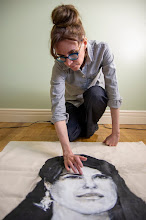
Image: Poster detail advertising event. Reproduced in 2019 via fair use/dealing. Source: https://www.darcywilson.org/recalling-your-presence-while-calling-your-name/jtuzkmi2d103eksc1mz17tec3os1r1
Thursday, August 1, 2013
Wednesday, June 26, 2013
Art Girls Are Easy
“...suitably tame for a young adult audience…”
I’m not the biggest fan of flying. Compared to the alternatives, it’s expensive and bad for the environment. Plus, my gut indicates it defies all laws of physics (and my brain cannot disagree because I never took physics in high school). On my first flight ever, as a teenager, I read a scary novel to distract myself. I was taken back to my teen years earlier this week on a flight to Regina, with a tale of budding artists at summer camp.
Thrown off by the title, Art Girls Are Easy (2013, Poppy) and the fire engine red lips on the cover, I accidentally pre-ordered a young adult novel from Amazon. Alas, I suppose I will donate it to the library at the high school where my husband works. As it turned out, light reading was the perfect prelude to two days of reflecting intensely on how recent changes to copyright law affect academic institutions. Another upshot of reading below my level is that even though I waited until boarding to crack open the Julie Klausner novel, I got through the conclusion at the baggage claim.
When I say ‘conclusion,’ I should really say ‘improbable conclusion’: the prospect of a 15-year-old breaking into the New York art world is as hard for me to buy into as the concept of flight. The characterization of protagonist Indy Hamlisch as a prodigy seems far-fetched because she has the whole package. Her advanced technical skill seems plausible, but the conceptual sophistication of her projects (like her pre-pubescent appropriation of Andy Warhol’s Electric Chair prints using patio furniture and Christmas lights) does not. While her peers are into Dolce and Gabbana, Indy idolizes artist duo Gilbert and George. Granted, she is introspective as a result of her mother dying when Indy was six years old, and she has been exposed to performance art through her performance artist stepmother, but still! I will concede that it’s better to set the bar too high than too low for aspiring artists reading the novel. It’s also exciting that Indy recognizes she is talented and is disinterested in masking it to fit in socially.
Although the novel is endorsed by comedian Amy Poehler, I never found myself laughing out loud at my reading material like my seatmate did with hers. A friend from my Art History Masters who now hails from the library world, she observed that my book looked racy. In actuality, it is suitably tame for a young adult audience. The only x-rated content is a theatrical performance about a sex worker, with Hamlisch’s BFF in the lead role. Kalusner may open the novel with Hamlisch thinking about sex, but she doesn’t go further than kissing. A flawed character, she makes out twice while drunk: with a boy from another camp she doesn’t even like, and with a much older camp instructor she really likes. In a jealous rage over said instructor, she cuts herself intentionally, and takes the studio blowtorch to his painting for revenge.
What Indy discovers after her pyromaniac stint is that personal expression and creativity trump romance (or at least ill-advised romance). This theme is interwoven with the female equivalent of—pardon the vulgarity—‘bros before hoes,’ which gives the novel a surprising feminist twist. Image: reproduced in 2019 via fair use/dealing. Source: https://www.hachettebookgroup.com/?s=art+girls+are+easy
I’m not the biggest fan of flying. Compared to the alternatives, it’s expensive and bad for the environment. Plus, my gut indicates it defies all laws of physics (and my brain cannot disagree because I never took physics in high school). On my first flight ever, as a teenager, I read a scary novel to distract myself. I was taken back to my teen years earlier this week on a flight to Regina, with a tale of budding artists at summer camp.
Thrown off by the title, Art Girls Are Easy (2013, Poppy) and the fire engine red lips on the cover, I accidentally pre-ordered a young adult novel from Amazon. Alas, I suppose I will donate it to the library at the high school where my husband works. As it turned out, light reading was the perfect prelude to two days of reflecting intensely on how recent changes to copyright law affect academic institutions. Another upshot of reading below my level is that even though I waited until boarding to crack open the Julie Klausner novel, I got through the conclusion at the baggage claim.
When I say ‘conclusion,’ I should really say ‘improbable conclusion’: the prospect of a 15-year-old breaking into the New York art world is as hard for me to buy into as the concept of flight. The characterization of protagonist Indy Hamlisch as a prodigy seems far-fetched because she has the whole package. Her advanced technical skill seems plausible, but the conceptual sophistication of her projects (like her pre-pubescent appropriation of Andy Warhol’s Electric Chair prints using patio furniture and Christmas lights) does not. While her peers are into Dolce and Gabbana, Indy idolizes artist duo Gilbert and George. Granted, she is introspective as a result of her mother dying when Indy was six years old, and she has been exposed to performance art through her performance artist stepmother, but still! I will concede that it’s better to set the bar too high than too low for aspiring artists reading the novel. It’s also exciting that Indy recognizes she is talented and is disinterested in masking it to fit in socially.
Although the novel is endorsed by comedian Amy Poehler, I never found myself laughing out loud at my reading material like my seatmate did with hers. A friend from my Art History Masters who now hails from the library world, she observed that my book looked racy. In actuality, it is suitably tame for a young adult audience. The only x-rated content is a theatrical performance about a sex worker, with Hamlisch’s BFF in the lead role. Kalusner may open the novel with Hamlisch thinking about sex, but she doesn’t go further than kissing. A flawed character, she makes out twice while drunk: with a boy from another camp she doesn’t even like, and with a much older camp instructor she really likes. In a jealous rage over said instructor, she cuts herself intentionally, and takes the studio blowtorch to his painting for revenge.
What Indy discovers after her pyromaniac stint is that personal expression and creativity trump romance (or at least ill-advised romance). This theme is interwoven with the female equivalent of—pardon the vulgarity—‘bros before hoes,’ which gives the novel a surprising feminist twist. Image: reproduced in 2019 via fair use/dealing. Source: https://www.hachettebookgroup.com/?s=art+girls+are+easy
Thursday, May 30, 2013
Out of Print at Modern Fuel
"I knew that I wanted to touch
upon...instances where Kingston was directly mentioned (such as an article
addressing the burning of General Idea’s Miss 1984 Pavillion)."--Kevin Rodgers
I
was delighted to make good time between Toronto and Kingston earlier in
the month to attend a series of presentations at the Agnes Etherington
Art Centre about the exhibition, A Vital Force: The Canadian Group of Painters
(for which I copy edited the catalogue). Arriving early meant I got to
visit Modern Fuel Artist-Run Centre, which has an interesting exhibition of art
publications on display until June 15. Artistic Director, Kevin Rodgers,
is interviewed below.
H- As a former art librarian, I was delighted to see gems like the Dennis Tourbin catalogue in Out of Print. How did you curate the selection of materials on display?
K-
I should provide a bit of background first. In December 2012, I started
my position as Artistic Director at Modern Fuel. At the time I noticed
the collection of print material (magazines, artists’ books, etc.) that
were casually placed on a row of shelves in the offices. As someone who
has an interest in print material, I was curious to see what was
actually there (at that point, there were no records that I knew of that
indicated what the contents were). This row of shelving was officially
called the Nan Yeomans Resource Centre, and it was a recent initiative
of the gallery.
Over
the next few months, I began going through the contents. Some items I
was familiar with, and others were completely new to me, such as the
Dennis Tourbin books. I could tell after a few hours of going
through the material that there were some rare and quite wonderful
artists books and items, and I wanted to exhibit them. I wanted people
to know what we had on hand.
The
selection of works was rather organic: I knew that I wanted to touch
upon the political publications of the late 1970s and early 1980s (Red
Herring, Incite), some conceptual practices (N.E. Thing Company) and
instances where Kingston was directly mentioned (such as an article
addressing the burning of General Idea’s Miss 1984 Pavillion). These
were the starting points.
H- When did Modern Fuel begin collecting catalogues and books for the Nan Yeomans Resource Library?
K-
The Nan Yeomans Resource Library was created in 2006. It was the name
given to the collection of material that had been accruing in the
offices--either by subscription, sought out by former board members and
staff, or donated. The material dates back to 1977, the founding of the
KAAI (Kingston Artists Association Inc.).
H-
The postal system has really networked Canadian artist-run centres over
the years and ARCs continue to have an impressive catalogue exchange
system. Is that how the majority of items in your collection were
amassed?
K-
There are numerous items that were acquired through the catalogue
exchange system. I would say many of the items from the 1990s were
acquired this way, although I’d be speculating on how the majority of
items were amassed. Part of the pleasure of looking through this stuff
was thinking about how it came to be here, and there are many that
remain mysterious.
H-Some of the items on display are showing their age. Was the value of the material discovered or agreed upon only recently?
K-
I don’t think the contents of the Library had really been gone through
for some time. My understanding is that there was an awareness of the
value to some of the material, and acknowledgement of this by
transforming the collection into a Resource Library. However, many
items were poorly stored and one of my initiatives is to get this
material properly catalogued, preserved, and displayed.
H- Did you find any interesting inscriptions while going through the materials?
K-
There were not a lot of inscriptions that I found, surprisingly. Some
signatures, some dates. Even those are few and far between. Mind you, I
am slowly working my way through the collection, so I am sure there are
still some to be discovered.
H-
How would you say the role of an ARC library differs from that of a
larger institution? The reason I ask is that you have displayed the
catalogue for Joyce Wieland’s (landmark) show at the National Gallery,
who would have preserved the catalogue already in a climate controlled
facility and promoted access by cataloguing it.
K-
This is a very interesting question, and I’m not sure I have a
satisfying answer. I would like our Library to be a resource, but also a
place to see print works displayed in conjunction with the exhibitions.
So for each exhibition, selections would be brought out from the
collection to complement the artwork, to provide another angle for
meaning and to activate histories. This is one way that perhaps it
differs from the collection as archive, removed from context so to
speak.
Artexte
in Montreal is an amazing facility for collecting artists' books and
material, and I appreciate the type of exhibitions that they put on in
relation to their collection. Modern Fuel has a completely different
mandate, and much less material in our library. What we will do is still
something to be seen, but the spirit of Artexte is one that I’d like to
keep in mind.
H-
Agreed: Artexte is a wonderful model. My first impression of their
space was admiration of their journal collection. Speaking of journals,
can you tell me about Matriart? I had no idea that Canada used to have a feminist art journal!
A- Matriart
was a publication out of the Women’s Art Resource Centre in Toronto,
and lasted for eight years. We have about six issues, including the
first one launched in 1990. Each issue was organized around particular
thematics, such as Empowerment and Marginalization, or Women in Prison.
It is a journal that I was unfamiliar with prior to finding it in our
collection, and one that I’m also interested in looking more into.
H- Are there any plans for the Nan Yeomans Resource Library that you’d like to reveal?
K-
While I’ve mentioned a few ideas throughout my answers so far, the main
change will be when Modern Fuel moves to our new location at the Tett
Centre in the summer of 2014. In that new space, we will have a proper
display area for the material, and visitors will be able to access the
collection easier. We are also reinstating subscriptions, and
reconnecting with galleries for print exchanges. I certainly think there
is a resurgence of artists interested in producing books and multiples,
and I’d like to see our Library be a place (again) where this type of
work is encountered and supported.
H- Best of luck with your move, and thanks for your time, Kevin!
Image: reproduced in 2019 via fair use/dealing. Source: http://www.modernfuel.org/art/programming/event/618
Sunday, April 28, 2013
Renegotiating the Body: Feminist Art in 1970s London
“Jemima Stehli undressed and redressed in front of male
members of the art world…”
Image: reproduced in 2019 via fair use/dealing. Source: https://www.bloomsbury.com/uk/renegotiating-the-body-9781848859616/
As a librarian, I must admit that it’s difficult to be
unbiased about a book that (1) thanks multiple librarians in its
acknowledgements and (2) in its introduction, highlights the importance of
converting private knowledge into public information (via artist interviews).
But here goes…
In Renegotiating the Body: Feminist Art in 1970s London (I.B.Tauris & Co. Ltd, 2013), Kathy Battista
strives to redress the dearth of feminist art scholarship in Britain by younger
academics.
As Linda Nochlin urged in her well-known article, “Why Have
There Been No Great Women Artists?” (1971), Battista doesn’t just cite examples
of talented artists like Mary Kelly. She looks at the conditions that
discouraged or encouraged their professional success.
Battista is clear that her account is not meant to be
encyclopedic. Her introductions of artists are fairly extensive, and once
the reader is familiar with each artist’s oeuvre, she weaves them in and out of
the book, bringing them back into the discussion just when you assume that is
the last you will read of them. Since it would be unnatural to suggest that
each artist only relates to one of the myriad themes she explores, it allows
the reader to appreciate the web of connections as the artists resurface.
As for the title, Renegotiating the Body, Battista notes that prior to the second wave of
feminism, “[t]he only female presence within the public space of the museum was
the female model, often nude” (p. 18). Women artists in Britain needed to work around the existing system. They found alternative spaces to public museums to show their work
(Bobby Baker, for instance, used a mobile home). With painting having reached
something of an impasse with Jackson Pollock, female artists used
unconventional materials in their work. The most available to them was their
own bodies. The body was not so much a theme as a vehicle to address more
complex ideas in performances. Some artists chose to keep their clothes on
(Rose Finn-Kelcey recalls the unstated question about when she would take her clothes off) while others
addressed the female-as-muse trope head on (Carolee Schneeman dressed and
undressed repeatedly while giving an art history lecture).
The issues in London’s 1970s feminist art scene mirror those
elsewhere. For instance, one artist says that wearing makeup was considered
a cardinal sin. I recall that it was also a bone of contention among America’s
feminist artists (Hannah Wilke was pro; Judy Chicago was con). Through archival
research and personal interviews, Battista uncovers many examples of relatively
unknown works that reveal an international web of influence. For instance,
there was a British reinterpretation of Womanhouse (a Californian student installation spearheaded by
Judy Chicago) organized by Kate Walker with such memorable images as a woman in
bridal attire half submerged in a heap of garbage.
Given Battista’s position as Director of Contemporary Art at
Sotheby’s Institute of Art in New York, it’s unsurprising that she demonstrates
how recent British art was influenced by the 1970s, whether consciously or
unconsciously. For example, Jemima Stehli undressed and redressed in front of
male members of the art world and displayed photographs of them photographing
her, which relates to Carolee Schneeman’s aforementioned art history lecture.
Another example is Tracey Emin’s My Bed,
which harks back to Judy Clark’s display of tissues from 28 days of sex with
her partner in Semen in Boxes.
My, how times have changed: Clark was delighted to be offered a solo exhibition
the night she unveiled this work yet Emin’s piece sold to Charles Saatchi for £150,000. One of the factors Battista attributes
to more women being in the limelight now is increased male support, like megastar
Damien Hirst promoting Sarah Lucas. Gentlemen readers, please take note.
The book contains a bibliography, notes, and an index.
Images are in black and white, but it would be helpful to see them in colour,
especially with works featuring blood, fecal matter, etc. since their shock
value is lessened in this state. Also consider the loss of impact in Jemima
Stehli’s Strip Series. When one of her
male subjects wrote about the shoot in The Guardian*, he noted the bright red
wall and the professional black suit he wore. Here, we lose access to those details.
*Adrian Searle, “Why Do I Feel Naked?”, The Guardian, July
15, 2000, http://www.guardian.co.uk/books/2000/jul/15/books.guardianreview4
Sunday, March 31, 2013
From the Feminist Lending Library: Becoming Judy Chicago
“…an art critic...told her that she would have to
choose between being an artist and being a woman.”
I first encountered Jen Kennedy and Liz Linden’s book swap... in a private tour
for Bibliography Week attendees of the Center for Book Arts exhibition, Brother
Can You Spare a Stack? (January 18-March
30). I made a note to self to bring an item to put into circulation the next time I was in Manhattan. Since the intention of the book swap is to facilitate community-based knowledge production in the
face of university and library privatization (1),
the most appropriate book in my collection seemed to be a 1976 reprint of Our
Bodies, Ourselves. In this landmark
publication by the Boston Women's Health Book Collective, women shared intimate
details of their reproductive health and sexuality, forming an incredible resource in the pre-Internet era.
In exchange for donating Our Bodies, Ourselves, I picked up a biography of the artist Judy Chicago
by Gail Levin since I enjoyed her biography of Lee Krasner. Becoming
Judy Chicago (Harmony Books, 2007) may
sound like a familiar title since a book called Becoming Georgia
O’Keefe was published recently.
Back to the books in the FL, coincidentally, Our Bodies, Ourselves is mentioned twice in Becoming Judy Chicago: once as a book on Chicago’s reading list for
students, and again in a quotation accusing Chicago of never moving past the
Our Bodies, Ourselves era with her subject
matter of vulvas, birth, and other ‘female subjects.’
The biography I took home to Canada is actually a
publisher’s proof, which is interesting from an editorial standpoint (for
instance, the photos the text references are absent). As much as
Levin might cringe at the thought of an uncorrected proof falling into hands for
which it was never intended, she’d probably also dig the serendipitous
visual effect shown in this photo (see left). She opens the book with several
paragraphs describing the cover photo, in which the artist is posed as a boxer in the same ring
where Muhammad Ali trained, mocking the machismo of the art world. This publicity stunt marked both
a change in gallery representation and her name (from her married surname to a
nod to her hometown that doubled as a divestment of “male social dominance” [2]). The orange
‘give a book, take a book’ stamp of the Feminist Library on the inside front cover frames her face and
when the light shines through, it looks a bit like a halo and a bit like her face has
been reproduced on a coin. Either way, Chicago’s greatness is implied. It’s
fitting, considering that Levin champions Chicago, for example, in calling her
a pioneer of minimalism and in defending her collaboration, The Holocaust
Project: From Darkness into Light.
Personally, I struggled with Chicago’s self-importance in
her first autobiography and never made it to her second one. Levin points out
that bristling against her chutzpah is both common and unfair, and is rooted in
the genius label seeming mismatched with a woman. Indeed, an art critic Chicago
dated once told her that she would have to choose between being an artist and being
a woman. Fortunately, Levin balances Chicago’s fearlessness and pride
articulated in her personal letters and diaries—which are quoted extensively—with a measured tone. She
delves deeply into her past, but not at the sake of credibility: it was
impressive to read that Levin interviewed a female lover of the otherwise
straight artist and that she, like the two lovers, agreed to protect Chicago’s identity. She does, however, fill in a number of gaps from Chicago’s
autobiographical writings, providing names where Chicago did not.
Chicago has had a very full life. She was raised in a
secular Jewish household watched by the FBI for her parents’ communist
politics. On her father’s deathbed—when she was 13—he explained why he was a
communist, which contributed to her own social justice advocacy over the years,
encompassing the civil rights movement and feminism. She began taking art
classes at the Art Institute of Chicago at age five and although she dropped
out of UCLA briefly to join the New York art scene, she still received her
Masters of Art at age 24, at which point her work had already been covered by Artforum. (Even with the aid of dextroamphetamine, the timing
is remarkable.) But she was just getting started: Chicago formed the first
feminist studio program at an academic institution (at Fresno State College and
later the California Institute of the Arts, where she organized Womanhouse, a student installation that captured the nation’s
attention). Eventually, she took time off as an instructor to focus on the
monumental collaborative installation, The Dinner Party, which finally has a permanent home at the Brooklyn
Museum of Art in the Elizabeth A. Sackler Center for Feminist Art. She has been
married to three artists—widowed by the first when she was 24; divorced from
the second after ten years of marriage; and happily married to the third since
1985. She reinvested all of her finances in her art, waiting until she was in
her fifties to purchase a home (a former railroad workers’ hotel that she and
her husband renovated along with professionals).
The book breezes through the later years, making it feel
like Levin's coverage of Chicago's life needs to be divided between two volumes, like her own take on her
life. All in all, though, it’s a good read.
(1) http://www.brooklynmuseum.org/eascfa/feminist_art_base/gallery/Kennedy_Linden.php?i=2937)
(2) Qtd. on p. 2
(1) http://www.brooklynmuseum.org/eascfa/feminist_art_base/gallery/Kennedy_Linden.php?i=2937)
(2) Qtd. on p. 2
Sunday, March 3, 2013
Rare & Raw at the Leslie-Lohman Museum of Gay and Lesbian Art
“...exciting intersections dealing with queer
representation.” – Steph Rogerson
The College Art Association conference was worth every second of the twenty hours it took me to reach Manhattan by bus and train from North Bay. One of the events I attended was a curatorial tour of the annual CAA Queer Caucus for Art exhibition. Rare & Raw at the Leslie-Lohman Museum of Gay and Lesbian Art in Soho (the first and only dedicated LGBT art museum in the world) features work by Tom of Finland, G.B. Jones, William E. Jones, Will Munro, Kent Monkman, Nina Levitt and Tara Mateik. Once curators Steph Rogerson, Kelly McCray, and I returned to Canada, we chatted about the exhibition.
H - Since you’re both Toronto-based, have you ever
co-curated with one another before?
K - Steph and I have been working together on projects
since the 2006 XVI International AIDS Conference in Toronto. The initial
curatorial project developed for the AIDS conference was called In Tents City.
Images from local, national and international artists were projected onto
carport tents for a month-long period. We re-mounted this exhibition at the
Theatre Centre a year later.
Other projects included the InterAccess Electronic Media
Centre in Toronto. It was a film screening called Rare & Raw. The
title of the Leslie Lohman exhibition was derived from this particular
event. We selected queer films
from the early 1900’s to the 1970’s that were projected to a Toronto audience
both inside the gallery space and to street level audiences through linen-covered windows.
H - Can you comment on your choice of title?
K - Rare & Raw fits
perfectly with our intention to feature what we consider to be rare works of
iconic artists and ephemera from archives exhibited in an accessible raw state
and contextualized alongside or through the eyes of contemporary artists.
S - We wanted a title with a visceral feeling, like
something you could taste or touch.
H - Do you think the exhibition functions differently in a
museum with a mandate to support LGBTQ artists and issues than it might in a
more generic venue?
K - Yes. For example, when the Rare & Raw exhibition ran into New York Art World politics, the
Leslie Lohman museum staff supported the exhibition and needs of the curators
above and beyond the call of duty.
S - I agree. The specific mandate of LLM allows us as
curators to explore LGBTQ themes without fear of censorship or concern about
“offensive” content.
H - I read in Art Journal that the Queer Caucus for Art used to be called the Gay and Lesbian Caucus. The earlier version of its name was in keeping with the times if you
consider that, say, the first book of its kind was called Gay Art: A Historical Collection. As the field has become more inclusive, encompassing bisexual, trans, and intersex individuals, do you find it challenging as curators to give adequate representation while balancing other (aesthetic, thematic, etc.) concerns?
K - I feel fortunate to be working with Steph in that the
two of us are able to agree on a balance of the aesthetic outcome with the
necessary representation of varying sectors of communities. We have a strong
trust in one another and our varied experiences that allows for a rich outcome.
Image: Kent Monkman in front of work by Will Munro. Reproduced in 2019 via fair use/dealing. Source: Google images; original source (now defunct): https://www.leslielohman.org/?s=kent+monkman
S - Queer communities are continually evolving and part of being queer means being open to change. Inclusivity is part of queer discourse and its politics. There is engaging work being produced by queers around the world – case in point the brilliant Kent Monkman. Kelly and I are a great team and process ideas, images, meaning, and feeling about work with great candour. We are committed to creating exciting intersections dealing with queer representation.
H - Steph mentioned that the exhibition is dedicated to
the late Will Munro, “the guy who made nighttime so much fun.” What do you
think he would have made of the show?
K - I think Will would have set up one of his
music/performance nights where all would be invited to dance beneath the glow
of his mirrors.
S - Will would have shit his pants with joy. His work
looks beautiful and paired with William E. Jones’s Tearoom, both works speak to
each other and create an elevated experience.
H - Were there any difficulties getting the Canadian works
across the border?
K - We used a very reliable local shipper who is quite
experienced with customs and cross border “situations.” I also ensured that the
artwork from Canada was well packaged/wrapped/crated to make it more difficult
to take issue with the pieces.
H - Zoe Leonard’s The Fae Richards Photo Archive, 1993-1996 was removed from the exhibition at the request of its owner early on in the exhibition. I’m reminded of the
Robert Mapplethorpe court case where only a fraction of the offending photos
were discussed, prompting one director to note, “Pictures speak to each other;
they become part of a totality” (1). Back to the Leonard series, did you get a
sense of viewers’ response to it before it was taken down?
K - Hard to say; the opening was packed, but we did get
indications from people later that they felt fortunate to have been able to see
the work and were quite appreciative of the curatorial efforts to exhibit elements
of the Fae Richards Photo Archive.
S - People were very excited about The Fae Richards Photo Archive. Some had seen it years ago and for others it was
new. The Fae Richards Photo Archive
was an important component to the show. Its removal is a slap in the face to
the other artists in the show, us as curators and LLM, the only institution of
its kind in North America. The removal of this piece was based on conflicting
demands that the museum and we bent over backwards to appease. The work was
removed for reasons of capital and commerce, although that was never directly
stated. We were “New York-ed” by powerful art people. What’s so painful about
it is that Zoe Leonard has built her career on the back of queer politics as a
member of Act Up & Fierce Pussy. I have admired her work for decades.
Pulling The Fae Richards Photo Archive out of a queer show, in a queer venue, curated by politicized and
passionate queers makes me angry, but even deeper than that is a profound
sadness. Zoe Leonard broke my heart.
H - Archives are referenced a lot these days in art. This
was true of the panel discussion at Leslie + Lohman that followed your tour,
where Nina Levitt spoke about responding intuitively to archival images and Ken
Moffat spoke about desiring the archive. Do you think the archive as an
institution or concept has a unique resonance with queer artists?
K - I believe there is a growing awakening that is
happening throughout, where many communities are beginning to realize the
significance of the past and attempting to reclaim/re-contextualize history for
present and future generations.
S - The archive is a valuable topic right now. From
exhibitions, such as Lost and Found: Queerying the Archive curated by Jane Rowley and Louise Wolthers, to
authors such as Ann Cvetkovich and Heather Love, to massive creative outreach
in queer archives, such as The One Institute & Archives in LA, the
attention on queer pedagogy, queer memory and feeling is at a fascinating point
that has the potential to raise awareness about the past in order to possibly
have greater understandings of the future.
H - Has “queer subversion” become a redundant collocation?
K - Yes – it is now queer to be “un - queer”.
S - I hope not! Because we have civil liberties in Canada,
it’s easy to forget the rest of the world, gay bashing and abuses of power.
Subverting, questioning and challenging the status quo continues to be
important, specifically with issues of capital and commerce. Queers have become
embedded in the corporate ladder, globalization and the race for economic power
in ways that need, even demand, fresh discourse.
K - To clarify, what I am saying is that the “new normal”
is beginning to incorporate a queering of the “normal.” The dominant culture is
no longer dominant in Western society – even though there is still much
pressure to accept that it still is.
It isn’t.
The exhibition closes March 31.
(1) Qtd.
In Kaufman, Ben L. “Mapplethorpe Issue before Court,” The Cincinnati
Enquirer, June 21, 1990. The Cincinnati
jury acquitted the Contemporary Arts Center director, Dennis Barrie, of
obscenity charges related to the 1989 exhibition of photographs by Robert
Mapplethorpe.
Kelly McCray is founder of BANKonART.net and co-founder of ArtBarrage.com. Steph Rogerson is a PhD candidate in Communication and Culture at Ryerson University.
Sunday, February 24, 2013
Celebrating F-read-om with John Berger
“a cautionary tale… royalties go to the Harlem United Community AIDS Center…”
For Freedom to Read Week (February 24-March 2) (http://www.freedomtoread.ca/), I’d like to highlight a somewhat recently challenged book as opposed to a ‘repeat offender’ like Kurt Vonnegut’s Slaughterhouse-Five. Thus, I recommend To the Wedding (Pantheon Books, 1995) by novelist and art critic John Berger (of Ways of Seeing renown). In fall 2011, some parents of high school juniors in Murrieta Valley, California objected to the book being assigned reading based on its mature content. If you research the controversy online, you’ll read about the use of the f-word to describe sexual relations. What is not mentioned, curiously, is the erection a husband has for his new wife while watching her at their wedding, or two loving sex scenes worthy of rereading for their passion. I have to wonder if the unstated real concern is the arguably mature content of SIDA (the main character became HIV positive after sex on the beach with an escaped convict).
As a librarian, I must, and want to, protect the freedom to read. In this particular case, this impulse is intensified by the usefulness of such a cautionary tale (prophylactics were not mentioned in the beach scene) and by the fact that the book’s royalties go to the Harlem United Community AIDS Center (http://www.harlemunited.org/).
The book opens with an old man named Tsobanakos selling metallic accessories for prayer at a Greek market. A father selects a tin one for his daughter, eschewing the gold one because her medical condition is hopeless. Tsobanakos encounters Jean, the father, one more time and overhears him talking excitedly about his daughter Ninon’s wedding plans. He then imagines how their story plays out, and how it came to be.
To the Wedding can be disorienting, between moving backward and forward in time and juggling different points of view (Ninon’s, her fiancée Gino’s, and those of her parents and Gino’s father, Federico). Maybe it’s a fitting structure for conveying the lack of control that exists with incurable disease.
Berger doesn’t dwell on Ninon’s depressed reaction to her diagnosis. With rich images like love letter fragments floating in a toilet bowl and writing like, “All, all, all, all, all I had has been taken” (p. 79), embellishment is unnecessary.
The book focusses on random moments devoid of meaning and those infused with meaning as characters travel to Venice for the wedding. The local colour of Jean travelling by motorbike from Modena, Italy contrasts Zdena, Ninon’s mother, Zdena, arriving by bus and boat from Bratislava, Czech Republic.
The wedding is imagined as a future event, where the couple’s joy is interspersed with glimpses into an even farther future where Ninon is “slowly abandoned by life” (p. 89).
As much as Ninon is terribly unlucky, she is also very lucky. Her parents want desperately to comfort her. Her mother buys a whistle for Ninon to mimic the birds outside Zdena’s home, and her father almost steals an ancient necklace from a museum because he is drawn to its protective qualities. When he picks out perfume for her, the store clerk notes that her own father doesn’t love her like Jean loves Ninon. Then there’s Gino, who couldn’t be sweeter. Even though she doesn’t want to date him anymore, he convinces her to get in a boat and then steers her around a rough current to prove to her that they can face anything. She in turn, learns the very essence of emotionally focussed therapy that eludes so many people: one chapter begins and ends with the three words that are arguably more important than ‘I love you’: “Hold me tight.”
Image: reproduced in 2019 via fair use/dealing. Source: https://www.penguinrandomhouse.com/books/12357/to-the-wedding-by-john-berger/
For Freedom to Read Week (February 24-March 2) (http://www.freedomtoread.ca/), I’d like to highlight a somewhat recently challenged book as opposed to a ‘repeat offender’ like Kurt Vonnegut’s Slaughterhouse-Five. Thus, I recommend To the Wedding (Pantheon Books, 1995) by novelist and art critic John Berger (of Ways of Seeing renown). In fall 2011, some parents of high school juniors in Murrieta Valley, California objected to the book being assigned reading based on its mature content. If you research the controversy online, you’ll read about the use of the f-word to describe sexual relations. What is not mentioned, curiously, is the erection a husband has for his new wife while watching her at their wedding, or two loving sex scenes worthy of rereading for their passion. I have to wonder if the unstated real concern is the arguably mature content of SIDA (the main character became HIV positive after sex on the beach with an escaped convict).
As a librarian, I must, and want to, protect the freedom to read. In this particular case, this impulse is intensified by the usefulness of such a cautionary tale (prophylactics were not mentioned in the beach scene) and by the fact that the book’s royalties go to the Harlem United Community AIDS Center (http://www.harlemunited.org/).
The book opens with an old man named Tsobanakos selling metallic accessories for prayer at a Greek market. A father selects a tin one for his daughter, eschewing the gold one because her medical condition is hopeless. Tsobanakos encounters Jean, the father, one more time and overhears him talking excitedly about his daughter Ninon’s wedding plans. He then imagines how their story plays out, and how it came to be.
To the Wedding can be disorienting, between moving backward and forward in time and juggling different points of view (Ninon’s, her fiancée Gino’s, and those of her parents and Gino’s father, Federico). Maybe it’s a fitting structure for conveying the lack of control that exists with incurable disease.
Berger doesn’t dwell on Ninon’s depressed reaction to her diagnosis. With rich images like love letter fragments floating in a toilet bowl and writing like, “All, all, all, all, all I had has been taken” (p. 79), embellishment is unnecessary.
The book focusses on random moments devoid of meaning and those infused with meaning as characters travel to Venice for the wedding. The local colour of Jean travelling by motorbike from Modena, Italy contrasts Zdena, Ninon’s mother, Zdena, arriving by bus and boat from Bratislava, Czech Republic.
The wedding is imagined as a future event, where the couple’s joy is interspersed with glimpses into an even farther future where Ninon is “slowly abandoned by life” (p. 89).
As much as Ninon is terribly unlucky, she is also very lucky. Her parents want desperately to comfort her. Her mother buys a whistle for Ninon to mimic the birds outside Zdena’s home, and her father almost steals an ancient necklace from a museum because he is drawn to its protective qualities. When he picks out perfume for her, the store clerk notes that her own father doesn’t love her like Jean loves Ninon. Then there’s Gino, who couldn’t be sweeter. Even though she doesn’t want to date him anymore, he convinces her to get in a boat and then steers her around a rough current to prove to her that they can face anything. She in turn, learns the very essence of emotionally focussed therapy that eludes so many people: one chapter begins and ends with the three words that are arguably more important than ‘I love you’: “Hold me tight.”
Image: reproduced in 2019 via fair use/dealing. Source: https://www.penguinrandomhouse.com/books/12357/to-the-wedding-by-john-berger/
Subscribe to:
Posts (Atom)